Werewolves
Of Fates & Fables (The Complete Series)Werewolves are the concealed supernatural population at the center of the novel’s revelations and conflicts. First encountered as apparently impossible wolves in a Bricktown alley, they overturn Romy’s understanding of the world and force her to navigate a society governed by secrecy, bloodline, pack loyalty, magical compulsion, territorial law, and the dangerous intimacy of transformation. Their existence is both a source of wonder and a system of power: the same creaturely abilities that permit protection and belonging can also enable coercion, abduction, forced pregnancy, and war.
Nature and Hidden Society
Werewolves are also known as Shifters, and their existence is initially treated as an impossible secret. Romy sees two enormous dogs at the end of an alley, one brown and pinned beneath a monstrous black animal whose jaws are locked around its neck. The encounter becomes the first concrete sign that the world contains beings beyond ordinary human categories; soon afterward, the conclusion is stated plainly: Werewolves are real. Kash warns Romy that the pack’s number-one rule is to keep that reality hidden, especially from humans who might expose it publicly. Her decision to walk into the middle of a pack while trying to reveal werewolves therefore threatens not only her own safety but the survival of the community’s secrecy.
The concealment is sustained through ordinary-looking social spaces and misleading public narratives. Werewolves appear among students, workers, and residents, and even a janitor can be revealed as a werewolf. Romy’s social-media campaign turns the hidden species into a public joke before it can become accepted truth: The Girl Who Cried Werewolf hashtag trends, gathers spoof accounts and memes on Instagram and Twitter, and attracts hostile reactions from people who assume that Romy is irrational. Later, Brody weaponizes the same dynamic against her by calling her the girl who cried captive, using her damaged credibility to make any future account of her imprisonment easier to dismiss.
Werewolves also possess sensory and physical capacities that separate them from humans. Lynch explains that Shifters can always sense another Shifter, a principle that becomes important when the pack encounters someone who does not register as a normal wolf. Their transformations can occur rapidly and visibly: Kash shifts while moving toward Romy, changing from wolf to naked human in moments, while Brody’s bones crack, clothing bursts apart, pale gray fur covers his body, hands and feet become clawed paws, and his teeth and jaw take on predatory proportions. When another wolf transforms, Romy feels the air pulse with a vibration she identifies as the closest thing to magic she has ever experienced, making transformation not merely a physical change but an assault on the limits of what she believes possible.
Bloodlines, Turning, and the Body
The book distinguishes two routes into werewolf existence. A werewolf may be born to two Shifter parents or may be bitten and turned. Kash identifies himself as born, explaining that both of his parents were Shifters and that the same is true of the rest of his pack. Born werewolves therefore carry a collective identity rooted in family and inherited membership, while bitten wolves enter the species through an intimate act that Kash describes as gentle, extremely private, and normally associated with a Shifter falling in love with a human. The distinction is not merely biological. It becomes a political classification, because some packs regard a born lineage as necessary to legitimate authority and territorial rule.
Transformation by biting is dangerous even when it is not intended as an attack. Danielle is bitten by a werewolf; the bite will not kill her, but human medicine can no longer save her, and her body is already moving beyond ordinary human care. Lynch later recognizes that another victim will turn because the bite is deep and has delivered enough venom, particularly given the victim’s weakened condition. These scenes establish venom as a mechanism of transformation and show how injuries become thresholds between human and werewolf states. They also expose the limits of human medical knowledge: the crucial questions are answered by Shifters, their pack healers, and associated magical practices rather than by ordinary institutions.
The contrast between born and bitten wolves becomes central to the conflict over population and legitimacy. Kash says that Brody needs a pack that is born, not bitten. Old Law defines a true pack through numbers and grants the largest true pack in an area the territory it rules; Kash’s family originally earned its land through that principle, while a larger rival pack may challenge the ruling group. Although the law is described as largely obsolete in everyday practice, it remains politically potent because Brody seeks to use reproduction and controlled population growth to make his faction strong enough to challenge the established order.
Brody’s program turns werewolf bodies into resources for demographic engineering. Nick reveals that the group needs women to create a pure bloodline for the pack. Brody threatens Romy with forced turning and pregnancy, presenting Justice as the instrument who will transform her and keep her pregnant with wolf children. The captive women encountered in the clinic are pregnant, frightened, and marked with tattoos matching Brody’s. Their babies bear the same dark symbols, including a mark on a baby’s arm and another on a chubby wrist. The tattoos make lineage visible on the body while also functioning as signs of ownership and control. In this system, women are treated as reproductive infrastructure, children as extensions of a faction’s bloodline, and transformation as a political technology rather than a freely chosen change.
Pack Law, Alpha Power, and Belonging
Werewolf society is organized through packs and Alphas. Kash corrects Romy when she calls Brody his boss: Brody is not merely an employer or social superior, while Kash is his Alpha and the matter is pack business. Alpha authority is also supernatural. Kash explains that an Alpha’s strong bond with the pack is coded into the beast’s nature; when an Alpha gives an order, a pack member is compelled to carry it out. Submission removes meaningful choice, since the Alpha gains power that cannot simply be overridden. Pack membership is therefore both social allegiance and an embodied mechanism of obedience.
This authority can protect a community, but it can also become domination. Justice is caught inside Brody’s false bond and is forced to obey an Alpha whose claim is illegitimate. Birdie explains that the only way to break a false bond is to find the rightful pack, making belonging the condition of liberation. Romy later discovers that she can control werewolves with her mind. Her compulsion is not treated as an abstract talent: she uses it to protect herself and her friends, and she can abruptly stop Justice’s dancing by removing her hand after initiating the command through touch. The discovery changes the balance of power, giving Romy a defensive capacity within a society where obedience has usually belonged to Alphas.
The pack is also a structure of care and responsibility. During the later crisis, Kash explains that Brody’s growing numbers have caught the Somerville pack off guard and that Justice has been captured and tortured for information. Brody wants to learn how to attack the pack, identify its weaknesses, and locate its homes and land. Kash frames the coming confrontation as a defense of people, territory, and chosen community rather than as a simple contest of strength. The pack will not allow Brody to advance beyond its borders, and its laws convert territorial defense into a collective obligation.
Membership can change through choice as well as coercion. In Brody’s faction, some wolves are deprived of free will through false bonds, magical marks, or the threat of forced reproduction. After Brody is defeated, some members of his pack choose to join the Somerville pack once they regain the freedom to decide for themselves. That movement provides a crucial contrast: the novel does not define a pack solely by shared blood or numerical strength, but also by whether its members can exercise meaningful consent.
Conflict, Reproduction, and the Huntsmen
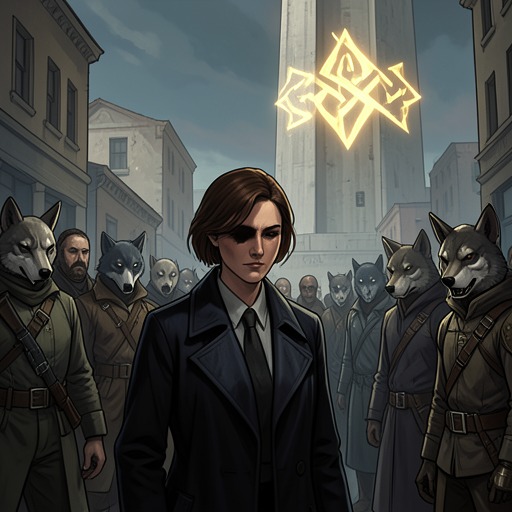
The existence of werewolves produces several competing systems of authority. Brody’s faction uses secrecy, intimidation, transformation, captivity, and reproductive control to expand. Its gray wolf form is not a private identity but the visible expression of a coercive regime. Brody’s transformation before Romy makes his threat physically undeniable, while his promise to use Justice as a breeder reveals how completely he has fused Alpha power with population policy.
The captive women and infants make that policy legible. Their pregnancies, matching neck tattoos, and marked children show a chain that connects sexual coercion, forced transformation, bloodline ideology, and territorial ambition. Romy’s discovery of the children transforms the missing-girl mystery into evidence of a broader breeding operation. What had seemed like isolated disappearances becomes an organized attempt to manufacture a pure-born population and alter the balance of packs. The missing campus athletes later add another layer: the attackers who confronted the protagonists are identified as newborn wolves, linking the campus crisis to the production of newly turned fighters.
Werewolves are not entirely opposed by humans. Xan explains that Huntsmen have existed as long as werewolves and are stronger, faster, and longer-lived than average humans. Their stated purpose is to protect humans from Shifters who go rogue, though most werewolves remain wary of them. Xan and Otto maintained a secret friendship because neither wanted to inflame the prejudice between their peoples. Xan’s investigation began after he noticed an increase in werewolf activity near Somerville, particularly an abundance of newly turned wolves in an area normally dominated by born werewolves. Those bitten wolves vanished whenever Otto tried to track them, and Otto even appealed to the werewolf council. The Huntsmen therefore function as an external balancing force, but the story complicates the boundary between enemy and ally by showing cooperation across species and by distinguishing rogue werewolves from werewolves as a whole.
War and Aftermath
The conflict finally becomes open warfare when magical portals appear throughout the clearing. Yellow-eyed werewolves pour from each portal, surrounding the opposing side while dividing the battlefield into separate confrontations. The yellow eyes identify the attackers as forcibly bitten wolves, connecting the supernatural battle to the earlier politics of involuntary transformation. Romy responds by shifting into her wolf form and attacking Regina’s werewolves. She tears into the throats of two attackers, experiences the shock of having killed, and then allows determination to overcome that reaction so that she can continue toward her enemy.
The battle changes the meaning of Romy’s transformation. The wolf is no longer only the monstrous figure at the end of the alley, the body used by Brody, or the threatening creature that once pursued her. It is also the form in which Romy defends herself and acts within the pack’s struggle. Yet the violence does not become uncomplicated empowerment. She remains conscious of the moral and emotional weight of killing, while the injured survivors require care. After the werewolves’ change in battle, Kash returns to human form and takes Romy’s hand as they look over what remains. The gesture shifts the scene from combat to shared recognition of its cost.
The aftermath is marked by both grief and political reorganization. The Somerville pack loses several members, and that loss is expected to take a long time to heal. At the same time, Brody and his pack are gone, and some former members join Somerville after recovering the freedom to choose. The victory therefore does not restore an untouched order. It produces a damaged but more voluntary community, one that must absorb defectors, mourn the dead, and reckon with the bodily and social consequences of Brody’s program.
Healing is plural rather than purely biological. Romy’s neck and arm carry faint red marks, while internal injuries continue to mend; Birdie’s tea, administered three times a day and apparently adapted from a recipe supplied by Mirabelle, helps stave off the deep ache. This recovery sits beside magical ceremonies, pack medicine, transformation venom, tattoos, and weapons such as tasers and Huntsmen’s blades, suggesting that no single system monopolizes knowledge of the werewolf body. Werewolves survive through a contested combination of instinct, medicine, magic, technology, and communal care.
Narrative Significance
Werewolves give the novel its central boundary crisis: human and animal, birth and choice, secrecy and publicity, protection and possession, intimacy and coercion. The species is not presented as a simple hidden monster category. Its members can fall in love, form mate bonds, live for two or three hundred years because they age more slowly than humans, obey or resist Alphas, heal through nonhuman means, and build political communities. Their long lives and shifting bodies widen the scale of the story, but their laws and conflicts remain recognizable as struggles over authority, territory, reproduction, and belonging.
The most consequential contrast is between werewolf identity as relationship and werewolf identity as ownership. Kash’s recognition of Romy as his mate begins with the instant he sees her defiant response in the alley, while Brody’s system uses marks, compulsion, captivity, and pregnancy to erase choice. Somerville’s eventual acceptance of former enemies who freely choose a new pack offers the book’s clearest alternative to pure-blood ideology. Werewolves thus become the medium through which the story asks whether a body, a bloodline, or a supernatural capacity determines identity—or whether genuine belonging depends on the ability to choose, protect, and be recognized without being possessed.