A Likely Story
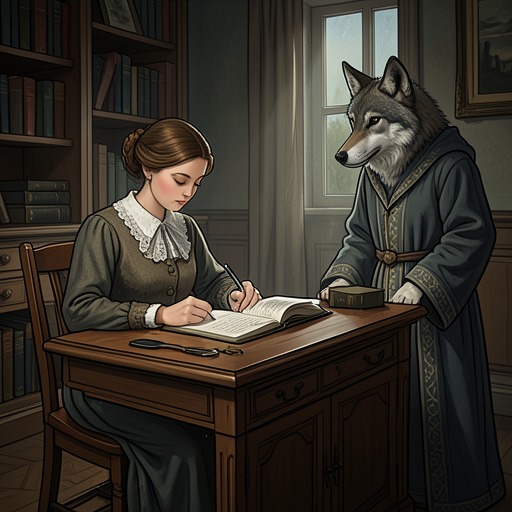
Of Fates & Fables (The Complete Series)A Likely Story is an independent bookshop whose combination of old books, coffee, and quiet concentration makes it Romy’s personal refuge. More than a pleasant campus destination, it is the place where she turns fear and confusion into research: after hearing Lynch describe himself as born a wolf, Romy searches its mythology and folklore shelves for an explanation of Werewolves and discovers how little ordinary human knowledge can tell her about the hidden world around her.
Setting and Atmosphere
A Likely Story is described as Romy’s favorite indie book shop, with a small Cafe tucked into one corner. When she enters, the tension she has carried since the morning dissolves. The scent of old books mingles with coffee, and the familiar surroundings ease the strain in her shoulders after her encounter with Kash Montgomery and Lynch Foster. The shop therefore functions as a recognizable happy place: a civilian, book-centered environment that briefly restores Romy’s sense of self before the supernatural conflict closes in again.
The atmosphere is defined less by dramatic action than by sensory relief and the physical rituals of reading. Romy waves to the girl at the register and moves toward the mythology and folklore section, treating the shop as a space where she can investigate disturbing possibilities without yet entering the dangerous social structures of Werewolves, packs, and Alpha authority.
Romy’s Werewolf Research
Romy searches the shelves for every book that mentions Werewolves, selecting a broad stack and then testing each volume on the carpeted floor. The first book contains information about many paranormal creatures, but its treatment of Werewolves is painfully brief and offers little about their origins. She creates a no pile, picks up another volume, and finds no better answer.
For an hour, she repeatedly browses, chooses, and discards books. Her central question is whether Lynch Foster’s claim that he was born a wolf describes Werewolves generally or only his own condition. The books provide competing possibilities rather than certainty: some mention born werewolves, others bitten werewolves; some say transformation occurs only under a full moon, while others claim that Werewolves can shift whenever they choose. The shop thus becomes the first site where Romy encounters the limits of available human explanations.
By the time she exhausts the store’s options, the effort has left her back and butt aching from sitting on the floor. She ultimately chooses four promising books and hopes that at least one contains the information she needs. Her short drive home is clouded by the conflicting material she has read, showing that A Likely Story supplies tools for inquiry but not a definitive key to the supernatural reality she is trying to understand.
Contrast with Captivity and Danger
The bookshop’s restorative function becomes sharper when set against Romy’s later physical circumstances. In the darkness of the room where she is held after being knocked unconscious, she finds no windows, a door that opens only from the outside, mildew and decay in the air, severe hunger and dehydration, and dizziness at the slightest movement. That sealed underground-like confinement is the inverse of A Likely Story’s open shelves, familiar staff, and freedom to select what she wishes to read.
The contrast also extends to the scenes surrounding Justice and Birdie. Justice enters while Romy is injured after a conversation with his Alpha, Brody Harrison, and brings her food before asking what happened. Later, Birdie examines Romy in a cozy bedroom with a queen mattress covered in quilts after Kash Montgomery asks her to check the scrape left by Derek. These interiors offer forms of care, but A Likely Story remains distinctive as the refuge Romy chooses for herself, before her investigation becomes entangled with forced obedience, bodily harm, and pack politics.
Narrative Significance
A Likely Story marks the point where Romy begins to respond actively to the supernatural mystery rather than merely reacting to encounters with Kash Montgomery, Lynch Foster, and other Werewolves. Books are her first investigative instruments, and the shop gives that investigation a setting grounded in ordinary academic and cultural life. Yet the contradictory contents of the shelves also establish a recurring tension between stories humans tell about Werewolves and the lived reality of those who inhabit that hidden world.
The location’s significance lies in this double movement. A Likely Story calms Romy enough to think, but the research unsettles her by multiplying possibilities instead of resolving them. Its promise of knowledge cannot overcome the secrecy surrounding Werewolves, while its atmosphere of choice stands against the coercive conditions that later govern Romy’s body and movement. The shop is therefore both a sanctuary and a threshold: a place of temporary peace from which Romy carries questions back into a world where folklore is incomplete, danger is real, and personal testimony matters more than the books on the shelves.