Half-shifted form
Of Fates & Fables (The Complete Series)Half-shifted form is an intermediate bodily state in which human and wolf features coexist rather than resolve into a fully human or fully wolf appearance. The novel gives no general account of how the state works, but two sharply different manifestations make it visible: Talia DuPont’s conspicuous, unsettling partial shift and Romy Cartelli’s surprised discovery of ears and a tail. Together, they establish the condition as real while leaving its limits and causes uncertain.
Definition and Appearance
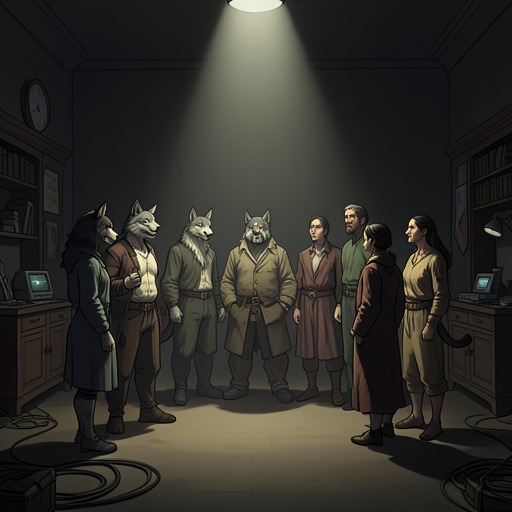
Talia’s form makes the mixture unmistakable. Her hands and feet have become furry paws, while her arms and legs remain smooth and human. A wolf’s head rises beneath a spill of bright pink hair, and her growl sounds caught between animal noise and speech. The details do not describe a simple halfway point measured across the whole body: human and wolf traits occupy different parts of her at once.
Romy’s partial shift looks different. She is told that she has wolf ears, then notices a large, fluffy tail protruding above her backside. The scene mentions these features without suggesting that she resembles Talia in every respect. The two instances therefore define the state through visible combinations of traits, not a single fixed appearance.
Talia’s Partial Shift
Those around Talia give her room, and the unusual sight draws their attention. Romy first hears the rough, growling sound, then sees the paws and the contrast between Talia’s human limbs and wolf-like head. When Romy calls the condition half-shifted, Lynch denies responsibility for what has happened; neither his reaction nor the scene supplies an explanation for how it came about.
The state does not silence Talia or erase her familiar force of personality. Though her voice is gravelly and more growl than speech, Romy understands her. Talia immediately sees a use for the alarming appearance: she is pleased by the prospect of frightening Brody’s werewolves. When Romy urges Lynch to protect her, Talia drops the partial shift and makes clear that she wants her sword, not someone to shield her. Her change of form thus appears alongside purposeful speech and action, rather than replacing her agency.
Romy’s Discovery
Romy’s own partial shift is revealed through details she initially misses. Kash points out her ears; Talia identifies the tail and calls the change a half-shift. Romy’s startled inspection makes the transformation a discovery rather than something she recognizes at once. Kash’s playful tug at her tail, and his approval of her new look, contrast with her horror at finding fur in places she prefers to keep trimmed.
Talia’s confidence that Romy could do it frames the moment as an ability Talia expected her to have, although the evidence does not explain what enables the shift or whether Romy can control it. Unlike Talia’s dramatic combination of paws, human limbs, and wolf-like head, Romy’s observed changes are limited to ears and tail. The text does not establish whether this difference reflects control, circumstance, or a broader variation in the form.
Significance and Limits
The two scenes make half-shifted form legible through bodily contrast: wolf traits emerge without displacing every human feature, and the precise combination differs between Talia and Romy. Talia’s case is treated as unprecedented by those watching, while Romy’s later change is recognized and encouraged by her friend. That contrast suggests the condition is not yet understood even within their circle; Lynch cannot explain Talia’s appearance, and the account of Romy’s offers no transformation rules.
The state also changes how the characters approach their immediate situations. Talia regards her appearance as a potential advantage and seeks a weapon rather than protection; Romy first experiences her ears and tail as an embarrassing surprise. Half-shifted form is therefore more than a visual marker of transformation: in these scenes, it exposes different responses to a body that has become visibly mixed, without settling whether the state is controllable or what further changes it permits.