Magical cloaking
Of Fates & Fables (The Complete Series)Magical cloaking is a witch-assisted form of concealment that hides a werewolf pack’s wolf side and frustrates attempts to identify or find those using it. In the conflict around Brody Harrison, it is more than a device for keeping supernatural identities secret: it shields a pack involved in a wider conspiracy and complicates the search for missing girls. Its effects are powerful, but not absolute. Investigators can follow physical traces, and magical concealment can be disrupted enough to expose someone hidden within a spell.
Function and Discovery
The investigation into cloaking begins with a mismatch: the werewolf population is out of balance, while Otto Montgomery has been kept in the dark about what is happening. Xan Andrew Higgins, a Huntsman who takes a teaching job so he can investigate without attracting attention, spends months searching for an explanation. His initial efforts produce little. He and Otto eventually reason that magic is concealing the pack’s wolf side, which redirects the inquiry toward a witch.
That conclusion changes the nature of the search. A hidden wolf identity is not simply a matter of keeping out of public view; it requires magical assistance, and the person supplying that assistance becomes a crucial link in the investigation. Xan commits his resources to finding the witch. He locates an address, but by the time he reaches it, the place has been abandoned. Nothing identifiable or magical remains there. The empty location demonstrates how cloaking and flight work together to deny investigators a clear target, while also leaving behind the possibility that the search has come close.
Traces and Limits
Although the suspected magic obscures the pack, it does not erase every material clue. At the abandoned address, Xan finds a truck, also left behind, registered to Brody Harrison. The vehicle connects the failed search for the witch to Brody and gives the investigation a lead where the abandoned building itself offers none. Xan sends Otto a note asking him to meet and share Brody’s name, but Otto never arrives; Xan only learns days later what happened to him. Cloaking thus sits within a chain of concealment whose consequences extend beyond the hidden wolves: the evidence is delayed, and the person meant to receive it is lost before the warning can be delivered.
Xan cautions that Brody is working with powerful magic. The witch who helps cloak the pack sees that Xan and Otto are coming for the house and leaves before they arrive. The episode establishes both an advantage and a limit: the magic protects its users by helping them evade detection, but the investigators can still identify the existence of a magical accomplice and pursue the trail. Xan warns that the witch is not someone to underestimate, and later urges Romy and Kash Montgomery to bring their own witch because the dark magic involved is powerful and its effects are uncertain.
Regina and the Concealed Presence
The search eventually points toward Regina, identified as the witch Brody is using for his cloaking. Romy obtains a possible address, and Kash tells Xan that they may have found it. Xan has been trying to locate Regina since the night Otto died; he reasons that Brody may be with her because he needs her magic to remain hidden. This makes the suspected address significant not only as a place to search but as a possible connection between the concealed pack and the witch sustaining its concealment. The address is still described as possible, however, and the investigation proceeds without certainty that Regina or Brody will be there.
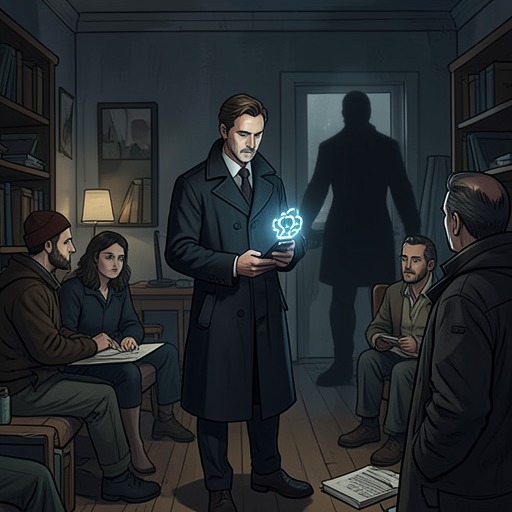
At the location, the group finds signs of recent activity but no visible occupants. Smoke still curls from a discarded bundle of sage in a dish, and two clear impressions remain in the sagging couch, indicating that people sat there recently. On the floor is a roughly drawn circle with lines through it. The spell’s operation is not explained in full, and the scene does not identify the concealed person before the reveal. Instead, the characters test the symbol: Birdie begins working magic, the air crackles, and a loud snap marks the moment when someone hidden inside the spelled circle becomes visible. The scene gives cloaking a concrete dramatic form—an apparently empty room that contains a person—without suggesting that every instance of pack concealment works through this same circle.
Narrative and Practical Significance
Cloaking repeatedly makes absence hard to interpret. An abandoned address, a missing witch, an unlocated pack, and a room that seems empty can all conceal a meaningful presence or connection. The characters must therefore read partial evidence: a vehicle’s registration, a warning about magical assistance, recently used furniture, burning sage, and a drawn symbol. Concealment raises the cost of investigation because ordinary observation cannot be trusted to reveal who is present or what supernatural identities are nearby.
The magic also exposes an imbalance in knowledge and power. Xan and Otto infer that a witch is involved only after their first searches fail, and even then the witch anticipates them and escapes. Romy and Kash have to accept that their opponents possess resources they do not yet understand, including dark magic strong enough to warrant bringing a witch ally. Yet the concealment never becomes complete: a truck points toward Brody, a possible address leads the group to signs of recent occupation, and a spell’s hidden occupant can be revealed. Magical cloaking therefore delays recognition and protects the conspiracy, but it also shapes the trail by which that conspiracy is eventually pursued.