Somerville pack territory
Of Fates & Fables (The Complete Series)Somerville pack territory is the protected compound associated with Kash Montgomery’s pack, and its decisive significance lies in the way it turns refuge into collective resistance. After the rescue of Brody Harrison’s captive women and their children, the territory becomes more than Kash’s home: it is a defended sanctuary, a maternity shelter, a medical and domestic support network, and the headquarters from which the pack prepares to challenge Brody’s claim to power.
Definition and Setting
Somerville pack territory includes the pack house and surrounding compound, with spare bedrooms, cabins, a backyard, and other spaces that can be adapted to the needs of a growing community. The evidence presents it as a place protected by wards, which makes travel beyond its boundaries especially dangerous and gives decisions about leaving the territory strategic importance. Romy Cartelli and Kash Montgomery agree that they should remain together until reaching Reverence, separating only after arriving there, because neither wants unnecessary exposure outside the wards.
The compound is both private and communal. Kash lives there with members of his pack, while the pack house can rapidly absorb a large group of traumatized outsiders. Its physical organization reflects that dual function: domestic rooms become shelter, unused cabins are cleaned for future occupants, and the surrounding territory supports patrols and defense. The compound therefore operates less like a single household than like a small, flexible settlement whose spaces are continually reorganized around collective danger.
Refuge After the Rescue
The territory’s clearest transformation follows the extraction of the pregnant women held by Brody Harrison. When Talia DuPont brings the rescue vehicle to the pack house, several of Kash’s pack members are waiting outside. The men initially react with surprise at the number of pregnant girls being returned, then immediately help them out of the van. Kash leads the group upstairs, with Romy reassuring the women that they are safe. Benjamin, Levi’s brother, is assigned to watch over them while the women are settled into spare bedrooms.
The arrival exposes the limits of physical escape. One rescued woman reports that her tattoo feels strange, and Romy realizes that freedom has not yet been completed because Brody’s magical marks still bind the captives. Birdie later performs a binding ceremony for every rescued girl, removing the magic from the tattoos, although the ink remains on their skin. The compound consequently becomes the site of both rescue and recovery: it shelters bodies that have escaped Brody while acknowledging that coercion can persist through marks, fear, pregnancy, and memory.
Kaitlyn’s baby makes that unfinished condition especially visible. The child bears Brody’s tattoo, a mark that remains even after the magical binding is broken. Kaitlyn refuses to let the community treat the baby’s existence as proof that she chose what happened to her. At a baby shower in the territory, she insists that the group remember the kidnapping, forced turning, and repeated rape behind the pregnancies, and that Brody and his werebros must answer for their actions. Her refusal to conceal the tattoo gives the sanctuary a public moral purpose: comfort must not erase accountability.
Community, Care, and Reconstruction
After the ceremony, Birdie leaves to recover from the amount of magic she used, warning the others not to create another emergency that would require her intervention. Talia DuPont obtains concealer so the women can cover the remaining tattoos while Birdie searches for a permanent way to remove the marks. This practical response does not undo the violence, but it gives the survivors control over how their bodies are presented while they wait for a deeper remedy.
The compound also develops an organized system of care. The rescued mothers-to-be initially feel safest together, so Kash Montgomery has the men of the pack conduct patrols, clean unused cabins, and prepare additional living options for the time when the women want separate spaces. Danielle returns to the territory with experience in home birthing and training as a certified doula. She visits the expectant mothers every day, fussing over their comfort and taking responsibility for their care. The work gives Danielle a purpose that begins to draw her out of depression, linking the rehabilitation of the rescued women with the recovery of one of their protectors.
Romy, Talia DuPont, and Anna Price also use the compound as a place of physical preparation. Talia’s demanding “fight club” routine has Romy running, lifting weights, and practicing kickboxing, while Anna briefly joins before retreating behind the claim that cooking now takes longer because her treasured kitchen supplies are missing. These domestic and martial activities occupy the same territory. Training, cooking, childcare, concealment, and emotional reassurance are not separate from the war effort; together they create the conditions under which the pack can continue fighting.
The territory’s everyday life retains traces of intimacy even during crisis. Talia and Lynch Foster share private affection while Romy drinks coffee and observes them from across the room, and Kash Montgomery reheats a casserole prepared by Anna Price. The compound is thus not only a military base. Its ordinary meals, teasing, bedrooms, and family routines provide evidence of a chosen household being rebuilt around people whose previous domestic arrangements were defined by coercion.
Command Center and Political Stronghold
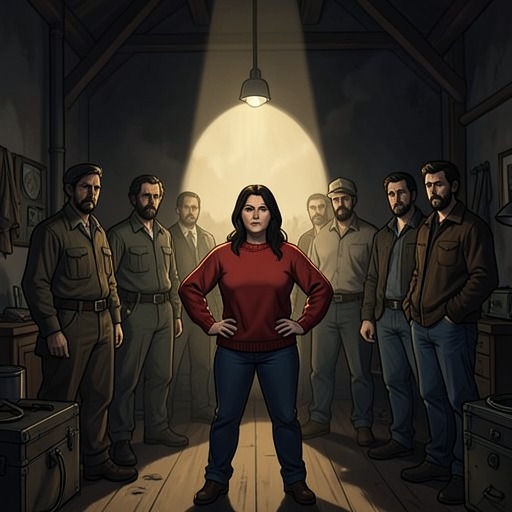
The compound becomes a strategic headquarters when Romy obtains an address connected to Regina. Kash convenes Lynch Foster, Justice, Levi, Doyle, Lina Montgomery, and other pack members in the sunroom to discuss the next move. The meeting shows the territory functioning as a political center: it gathers evidence, weighs tactics, assigns forces, and includes Lina, whose renewed alertness is tied to her determination to avenge Otto Montgomery.
The pack’s mobilization begins from this domestic base. After Birdie agrees to accompany the operation, Kash’s forces form a convoy of four cars and travel toward a remote, deteriorating neighborhood near a retired train station. The address is deliberately inconspicuous, and the compound supplies the personnel and coordination required to investigate it. The contrast between the quiet pack house and the convoy leaving it captures the territory’s central role: it is a place of shelter that can convert quickly into an engine of organized action.
Kash also uses the compound to respond to institutional delay. When the council hesitates over whether to investigate the rescued women’s testimony, Romy condemns the idea that survivors should be made to relive their abuse before the governing body acts. Kash supports her and declares that the pack will stop Brody with or without the elders, calling on the Huntsmen and Witches as possible allies. Somerville pack territory therefore represents an alternative source of authority. Where the council protects its own procedural distance, the compound treats immediate protection as an obligation.
That political identity becomes explicit when Romy addresses the pack. She argues that the council members are politicians who hope the crisis will disappear without requiring them to act, then tells the assembled wolves that the fight belongs to them. The pack cheers, and Doyle calls Romy “boss lady,” recognizing the reversal from her earlier outsider status. Within the territory, she is no longer merely someone protected by Kash; she participates in defining the pack’s collective purpose.
Defensive and Thematic Significance
Somerville pack territory embodies the contrast between Brody Harrison’s model of territorial power and Kash Montgomery’s. Brody seeks land through kidnapping, forced transformation, sexual violence, pregnancy, and the creation of a born-werewolf population marked by his magic. Kash’s territory expands instead through rescue, accommodation, shared labor, and alliances. Its legitimacy is represented not by the number of bodies controlled, but by the number of vulnerable people who can recover agency within its protection.
The territory also provides the material background for Romy’s transformation into a leader. She arrives at Kash’s compound as someone who needs protection, but the community gives her opportunities to train, speak, make strategic judgments, and defend others. Her confidence develops alongside the compound’s transformation into a war base. By the time she confronts Brody, she can use Alpha command magic against him and cut through his Delta tattoo, releasing murky green magic while his hold over the wolves weakens. Kash then attacks Brody’s exposed throat, and Romy joins him by driving a knife into the already-open wound.
That final violence is prepared by the territory’s earlier work. The rescued women’s rooms, the patrols, the ceremony, Danielle’s care, the training sessions, the council confrontation, and the convoy all turn the compound into a collective answer to Brody’s private tyranny. Somerville pack territory is not merely a backdrop for the conflict. It is the lived alternative to Brody’s regime: a guarded place where survival becomes organization, organization becomes solidarity, and solidarity becomes the capacity to resist.