The Captives’ Unbinding Ritual
Of Fates & Fables (The Complete Series)The Captives’ Unbinding Ritual is the decisive second stage of the rescue of the women held by Brody Harrison. Their removal from his hidden operation does not immediately make them free: the matching neck tattoos still carry magic, and one captive’s warning that her tattoo feels strange exposes the unfinished danger. The ceremony therefore transforms a rescue from a change of location into a struggle over bodily autonomy, identity, and the power to define what happens next.
From Captivity to an Unfinished Rescue
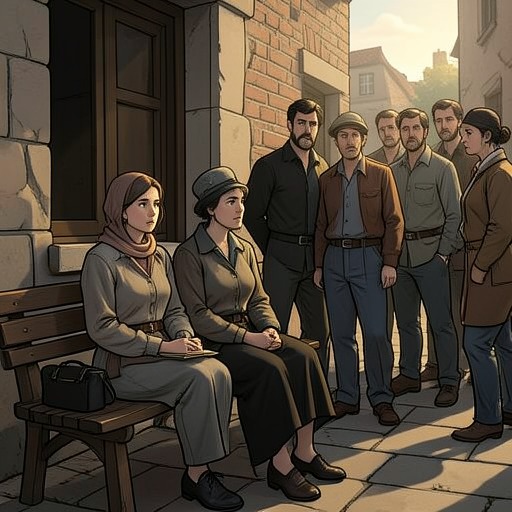
The ritual becomes necessary after Romy Cartelli and her allies discover the captives: a succession of frightened, pregnant women with short hair and tattoos on their necks matching Brody Harrison’s mark. They are brought to Kash Montgomery’s pack compound, where Romy reassures them that they are safe and the women are given rooms, showers, and protection. Yet the apparent safety is conditional. One woman reports that her tattoo feels strange, and Romy realizes that the women have not been fully freed. The tattoos are not merely identifying scars; their magic preserves Brody Harrison’s hold even after the captives have crossed into a protected home.
Kash Montgomery immediately recognizes the practical and magical scale of the problem. Romy asks whether Birdie can perform an unbinding ceremony for such a large group, and Kash answers that she will have to, despite the uncertainty visible in him. He then tells Lynch Foster that they need to speak with Birdie about performing a ritual of that size. Lynch accepts the task and is also instructed to check that Reagan and Justice are safe, linking the women’s liberation to the wider crisis surrounding Brody Harrison’s control over his followers and victims.
The Ceremony and Its Cost
Birdie ultimately performs the binding ceremony for all the girls rescued from Brody Harrison. The scale of the work matters: this is not a private release granted to one person, but a collective rite for a group whose bodies and pregnancies have been made part of Brody Harrison’s breeding operation. The ceremony requires enough magic to exhaust Birdie, who leaves to recover only after ordering the pack not to create another emergency that would require her immediate intervention.
The ritual’s result is precise rather than absolute. Birdie removes the magic from the tattoos, breaking the supernatural mechanism that binds the women to Brody Harrison. She cannot, however, remove the ink itself. Kaitlyn’s reaction when she understands that her baby will retain Brody Harrison’s mark reveals the ritual’s emotional contradiction: the coercive power is gone, but the visible evidence of coercion remains. Birdie is sufficiently troubled by this limit to promise that, after recovering and replenishing her magic, she will search for a way to erase the marks as well. Until then, Talia DuPont obtains highly effective concealer so the women can cover the tattoos while a permanent solution is sought.
Freedom, Memory, and Testimony
The unbinding separates magical control from embodied memory, but it does not pretend that separation is painless. The women settle together in the pack house while Kash Montgomery’s men patrol the territory and prepare unused cabins for them. Their shared living arrangement reflects both their need for safety and the fact that recovery cannot be reduced to the removal of a spell. The compound becomes a provisional community in which the rescued women can decide when they are ready for private spaces and what forms of support they require.
At a baby shower held for the women, Kaitlyn holds her son Hunter while his small tattooed wrist remains visible. She states that she is grateful for the rescue and for the comfort the pack has provided, but insists that no one forget why the women are there. She would never give up Hunter, yet she refuses to let anyone mistake her determination to care for him for consent to what Brody Harrison did. Her words make the ritual’s moral meaning explicit: liberation does not erase the original violation, and making the best of an imposed situation does not absolve Brody Harrison or his werebros. Romy Cartelli’s guilt over having maimed Derek recedes as Kaitlyn’s testimony restores the violence to its proper scale and confirms that resistance was justified.
Ritual as Reclaimed Belonging
The ceremony also belongs to a larger pattern of rites through which the story negotiates identity and social membership. In Kash Montgomery’s ceremony for Justice, Romy stands beside Kash, passes red candles, binds wrists with white cloth, and follows Birdie’s instructions involving blood and an ornate dagger. That ritual formalizes entry into a chosen pack. The captives’ unbinding reverses the direction of ritual power: instead of binding people into an imposed hierarchy, Birdie uses magic to sever Brody Harrison’s claim over them.
This contrast gives the unbinding ceremony its structural force. Blood, magic, marks, witnesses, and communal protection can either enforce domination or help dismantle it, depending on who controls the rite and whether the participants possess meaningful choice. The women are not simply absorbed into Kash Montgomery’s pack as replacements for the authority they have lost. Their rescue is followed by a process that removes the false belonging imposed by Brody Harrison while leaving room for them to determine their own futures.
The later matching tattoos created for Romy Cartelli, Talia DuPont, and Anna Price sharpen the distinction. Birdie specifies that the new tattoos contain no magic except the special magic placed in Romy and Talia’s versions, and the friends jokingly treat the resulting magical tracking function as a secret signal. Those marks are chosen, shared, and understood by their bearers; Brody Harrison’s tattoos were imposed, coercive, and tied to forced reproduction. The same outward form—a tattoo—thus carries opposite meanings depending on consent and power.
Consequences and Narrative Significance
The immediate consequence of the ritual is that the rescued women are no longer magically controlled by Brody Harrison, even though their bodies still visibly record what happened. That partial victory prevents the story from treating rescue as a clean erasure. Birdie’s exhaustion, the need for concealer, the women’s continued need for protection, and Kaitlyn’s insistence on accountability all show that freedom requires more than removing an enchantment.
Narratively, the ceremony converts private suffering into a collective claim for justice. Brody Harrison’s violence has operated through isolation, bodily control, forced transformation, pregnancy, and marking. The unbinding answers each of those mechanisms with communal witness, magical intervention, shelter, and the restoration of choice. Its value shift is therefore from apparent safety to recognized danger, and then from physical rescue to genuine—though incomplete—autonomy. The women leave Brody Harrison’s authority behind, but the ink remains as a reminder that ending control is not the same as undoing history.