The Clinic Truck Escape
Of Fates & Fables (The Complete Series)The Clinic Truck Escape is the high-risk getaway from the abandoned free clinic in which Romy, Talia, Kash, Lynch, Justice, and the rescued girls flee Brody Harrison’s pursuing wolves. Its decisive significance lies in the reversal it stages: the captives have been removed from the clinic, but they are not yet safe. Freedom must be defended mile by mile, inside a vulnerable vehicle carrying injured people, frightened girls, and enemies determined to reclaim them. The truck therefore becomes both refuge and battleground, while Romy’s participation marks her movement from rescued captive toward active member of the resistance.
From Rescue to Pursuit
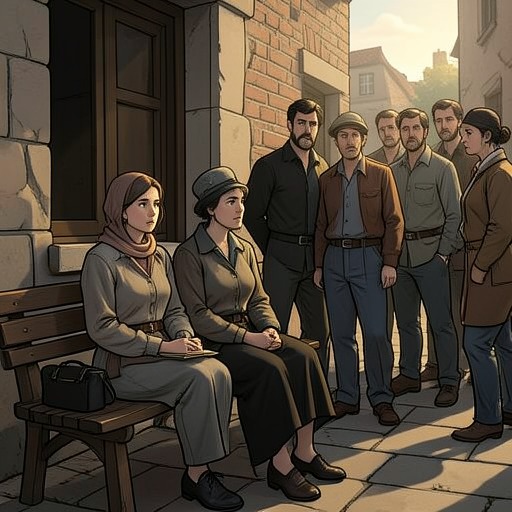
The escape begins with urgency rather than triumph. Talia arrives behind the wheel of Anna’s truck after a horn announces the vehicle, and the group rushes the girls toward the opening where the front door once stood. The blunt command to leave gives the departure its practical shape: there is no time to consolidate, treat every wound, or establish a secure route. Justice joins the movement, while Kash and Lynch help manage the vehicle and the people packed inside it.
The first impact destroys any illusion that the clinic raid has ended the danger. A wolf rams the back of the truck hard enough to shake the entire vehicle, sending the girls screaming. Talia answers the panic with abrasive humor and launches the truck from the grass onto the winding road. For a moment, the light-brown wolf falls behind, and Romy believes the group has won without encountering Brody Harrison. That hope is immediately overturned when headlights appear behind them. Brody Harrison is driving an extended-cab pickup with Zac and additional Delta members in the truck bed; the pursuing wolf slows, jumps into the bed, and joins the organized chase. The enemy is no longer a stray attacker but a coordinated force with a driver, vehicles, and reinforcements.
The Truck as a Moving Battlefield
Brody Harrison presses the pickup against the escape vehicle’s bumper, forcing Talia to accelerate while the girls whimper and Kash tightens his hold around Romy’s waist. The physical arrangement makes the stakes unmistakable: the people being protected are trapped in the same confined space as the people trying to save them, and every collision threatens everyone at once. When Talia demands help, Kash and Lynch pry open the back door and begin throwing whatever is available at the wolves in the truck bed.
The improvised weapons are both comic and desperate. Kash throws one of Anna’s mixing bowls, while Romy hands Lynch a tub of flour and worries that Anna will be furious about the expensive baking equipment. Talia promises to replace it, prioritizing the escape over property. The humor does not cancel the danger; it gives the group a shared rhythm in a situation otherwise governed by impact, speed, and fear. The scene repeatedly converts domestic objects into defensive tools, showing how ordinary resources become meaningful when formal protection has failed.
Talia then produces a small brown device that Romy initially mistakes for a grenade. It is a sticky bomb, with only about four seconds remaining before it must be discarded. Kash tears it from Romy’s hands and throws it over the truck, but the explosion still rocks the rear of the vehicle and sends the group fishtailing. Kash and Romy tumble to the floor together, and the chase briefly contracts into an intimate moment: believing death may be near, Romy becomes acutely aware that Kash is naked, and Kash answers the thought she has not consciously spoken. He assures her they will not die and kisses her fiercely. The kiss does not end the danger, but it changes the emotional charge of the scene, turning panic into renewed attachment and resolve.
Signals, Tactics, and Collective Agency
The escape depends on more than speed. Talia instructs Romy to use a coded phrase, “Clean up on aisle seven,” and then tells her to discard the phone without breaking it, because the device must continue transmitting the GPS signal someone will need. Kash throws the phone onto the roadside, preserving the possibility that rescuers can locate them while denying the pursuers an obvious device inside the truck. The tactic reveals Talia’s preparation and her ability to make Romy part of an operation rather than treating her merely as someone to be carried to safety.
The coded call also gives the chase a second direction. The truck is fleeing one threat while simultaneously creating a trail for intervention. That dual movement distinguishes the sequence from a simple flight scene: the group is not only trying to survive the present attack but also arranging the conditions of a counterattack or rescue. Talia drives, Kash and Lynch fight from the rear, Justice positions himself among the girls, and Romy helps pass supplies and follows the logic of the signal. Each person occupies a functional role, and the rescued girls remain the reason for every maneuver.
The group’s cooperation is especially significant because it forms under pressure rather than through stable authority. Talia’s orders, Kash’s physical protection, Lynch’s readiness, Justice’s placement in the center aisle, and Romy’s increasingly direct participation produce a temporary defensive structure. It is fragile, improvised, and loud, but it is also a practical alternative to Brody Harrison’s coercive control. The pursuers rely on domination and recovery; the escapees rely on coordination, trust, and the conversion of whatever is at hand into a means of survival.
Consequences and Larger Significance
The truck escape does not resolve the conflict with Brody Harrison. It carries the rescued girls away from the clinic, but the continuing pursuit demonstrates that extraction alone cannot undo the violence inflicted on them. The group must still confront the wider system that allowed Brody Harrison’s breeding operation to continue. Romy later challenges the council’s demand to interview the women, condemning the prospect of forcing them to relive their abduction, forced transformations, and repeated abuse. The truck sequence supplies the physical evidence of why such protection cannot be postponed: even after rescue, Brody Harrison remains close enough to ram the vehicle and deploy explosives.
The escape also anticipates the later political and military resistance. Romy eventually declares that the council members are politicians who hope to keep their hands clean while others fight, and she tells the pack that the war is theirs to win. That declaration echoes the truck’s practical ethic. The group does not wait for institutional permission while the girls remain under attack; it acts with the materials and people available. The later cutting of Brody Harrison’s Delta tattoo and the attack that kills him extend the same logic from evasion to liberation, as the removal of magical control becomes a precondition for breaking his hold over the wolves.
Within Romy’s larger arc, the escape is a threshold. She has already experienced the darkness, dehydration, isolation, and bodily helplessness of captivity, and Justice’s arrival at the clinic forces her to confront the betrayal attached to his connection with Brody Harrison. In the truck, however, she is no longer lying still and waiting for someone else to decide her fate. She handles equipment, passes defensive objects, participates in the signal, endures the blast, and remains beside the others as the pursuit continues. The vehicle may be battered and the road may still be dangerous, but the direction of agency has changed: Brody Harrison is chasing people who have begun acting together, not isolated victims waiting to be recovered.