The Council Confrontation
Of Fates & Fables (The Complete Series)The Council Confrontation exposes the gap between the werewolf council’s cautious procedures and the urgent protection demanded by Romy and Kash. Faced with the women Brody Harrison abducted and abused, the council hesitates; Romy refuses to let that hesitation turn survivors into evidence to be examined before anyone acts.
The Council Arrives to Find the Survivors
The confrontation begins when three visitors—two men and a woman in suits and expensive shoes—enter through the sunroom’s backyard door at the Somerville home. Their formal appearance and doubtful looks set them apart from the tense, close-knit group inside. Talia rises beside Romy, a protective gesture that also signals their unity, while Romy recognizes that the encounter may force her to clarify who holds authority in the pack.
Kash leads the visitors into the living room, where the rescued women are gathered. The evidence of what has happened to them is immediately present: the women are pregnant, and their condition registers on the visitors’ faces one by one. Rose reacts with widened eyes and confusion; Charles furrows his brow, while William narrows his eyes, leaving Romy uncertain whether his anger is directed at the pack or at the events that brought the women there. The survivors glance nervously toward their rescuers but do not speak. Their silence gives the room a different weight from an ordinary briefing: the people whose lives are at stake are present, but the conversation is already threatening to make them subjects of an inquiry.
Small details show both the damage of their captivity and the fragile routine taking shape after rescue. Reagan sits with the remote while an episode of The Vampire Diaries plays. Kaitlyn cuddles a sleeping Hunter and reads Soul In Darkness, a romance novel Romy lent her after the baby shower. Girlfriend sleeps nearby. Kaitlyn smiles at Romy, but questions remain in her eyes; before she can ask who the visitors are, Kash ushers everyone back into the sunroom. Lina, Lynch, and Talia stay where they are, their matching irritation making clear that the council’s arrival has not put the household at ease.
The Council’s Caution Meets Romy’s Protest
Kash explains that the women were rescued from an underground bunker inside an abandoned clinic. Brody Harrison had captured them, turned them against their will, and forced them to mate with members of his pack. The account gives the council a concrete view of the crime behind the accusations: the survivors’ pregnancies are not incidental, but evidence of a campaign designed to produce a pack born rather than bitten. Kash connects that campaign to Brody’s ambition to claim his lands. Rose responds with horror, while William asks why Brody would do such a thing.
Charles acknowledges that the allegations Romy and Kash previously brought to the council are not unfounded, but says the members need time to interview the women and corroborate their accounts. Romy rejects the proposed sequence. To her, the survivors are not evidence awaiting validation; they are people who have already endured abduction, forced transformation, repeated rape, and pregnancy. She argues that requiring them to recount the abuse would make them relive it, while the governing body charged with protecting them delays action. Her anger turns the meeting from a procedural review into a dispute over what protection means when the harm is already visible.
Kash supports Romy’s intervention by making the personal stakes explicit: Brody held her captive for days and beat her when she would not reveal information about Kash or his pack. He insists that the conflict can no longer be treated as merely an attempt to take his mate. A war is coming, he warns, and the council will eventually have to choose a side. Romy’s own experience thus becomes part of the case against delay—not a substitute for the survivors’ testimony, but proof that Brody’s violence reaches beyond the women in the room.
From Petition to Independent Mobilization
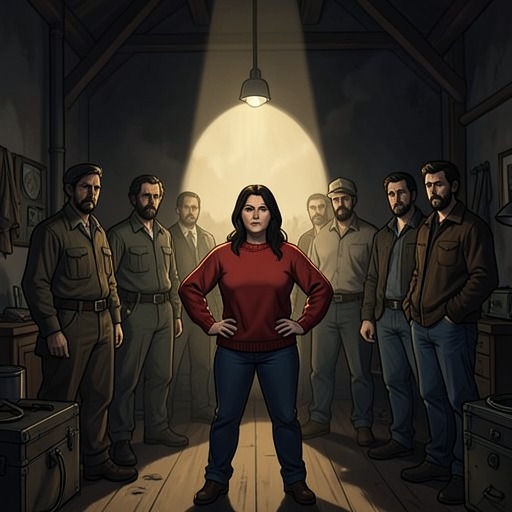
Justice encourages Romy with an approving, deliberately theatrical show of support, and murmurs of agreement rise from the room. Romy still checks Kash’s reaction: this is his pack, and she does not want to overstep his authority. His small nod gives her room to speak. She argues that stopping Brody will fall to them if the council refuses to intervene, and that the council alone is not their possible source of help. Her appeal shifts the meeting from demanding a response to preparing for action without one.
Kash rises and comes to Romy’s side, resting a hand at the small of her back as he backs her position. He says the pack is strong enough to act with or without the elders, and points toward other allies: the Huntsmen and the Witches, whose communities are also threatened by Brody. The confrontation therefore ends not with council authorization, but with a broader strategy that treats the conflict as a danger shared across supernatural groups.
The council’s hesitation remains a live political grievance as the pack prepares for war. Later, Romy characterizes the council members as politicians who hope the pack will handle the crisis while they keep their hands clean. She tells the gathered pack that their reluctance does not change what must be done, and that they will be ready when Brody comes. The pack cheers; Kash teases her about sounding like a politician, while Doyle calls her boss lady. That response marks a change in her standing: the woman who entered Kash’s world as an outsider is now helping articulate the pack’s course of action.
The Limits of Council Authority
The dispute carries added force because Brody’s scheme targets more than individual survivors: it seeks to create a larger pack of werewolves born to the condition, then use that numerical strength to challenge Kash’s family’s claim to its territory. Under the Old Law, the largest true pack in an area rules the land, and a stronger rival pack can challenge that authority; if it wins, the territory passes to it. The council’s hesitation therefore leaves two conflicts unresolved at once: how the survivors are to be protected, and whether an old territorial rule will be allowed to serve as cover for Brody’s violence.
The confrontation does not produce the immediate intervention Romy demands. Instead, it clarifies the limits of what the council is willing to do while making the pack’s own responsibility harder to avoid. The later battle gives that refusal a physical consequence: Romy cuts through Brody’s Delta tattoo, and the murky green magic draining from it weakens his hold over the wolves. When Kash pins Brody, Romy takes up the dropped knife and drives it into his already-open throat. These acts do not occur in the council meeting, but they show where the path away from authorization leads: the people the council failed to protect confront Brody themselves.
The confrontation’s political significance lies in that transition from appeal to resistance. Romy begins by insisting that the council’s duty is to protect people already harmed, not to make survivors relive their abuse before acting. When its procedures offer no timely remedy, she helps turn the pack toward allies and collective defense. Her challenge thus makes the council’s inaction part of the conflict itself, while establishing her as a participant in deciding how the pack will meet the threat.