The Girl Who Cried Werewolf label
Of Fates & Fables (The Complete Series)The Girl Who Cried Werewolf label is the public identity imposed on Romy after she announces that werewolves are real. First amplified as an internet joke, it follows her from social media into encounters with strangers and even shapes how people interpret her disappearance. Its significance lies in that double edge: the label makes her easier to dismiss, but Romy refuses to let ridicule erase what she knows, and eventually uses her public voice to confront a larger danger.
Origin and public performance
At the start of her account, Romy speaks as Romy Reads Romance, warning followers that her story is neither fanfiction nor a publicity stunt. She says the version circulating in the news is wrong and presents what follows as the true story of how she became involved with werewolves. She has already embraced the label enough to list it among her social-media handles, even as she insists that being mocked does not make her account false.
The label becomes conspicuous when Romy livestreams outside a building where she believes she can obtain proof. She tells viewers that werewolves exist, says she has seen evidence herself, and promises to go inside and bring back proof. Her confident performance is designed for an audience: the camera, the announcement, and the invitation to watch turn her investigation into online content. But she does not return with the proof she promised, and the gap between her certainty and what viewers can see gives the tag its opening as a joke.
The reaction is not limited to isolated comments. A post mocks her claim, while another turns The Girl Who Cried Werewolf into a favorite internet drama; #RavingRomy supplies a second, personal insult. Romy throws her phone onto the nightstand and resolves to prove that she is not crazy, even while acknowledging that her pursuit may put her in danger. The label thus begins as a crowd’s shorthand for disbelieving her, but her determination to answer it keeps it attached to the story.
Ridicule, credibility, and repeated updates
By the time Romy records another update, #TheGirlWhoCriedWerewolf is officially trending. A few people defend her, but most of the messages are hostile; she considers turning off comments and decides instead to ride out the backlash. In the livestream, she recasts her failed attempt to get proof as a continuing investigation: the werewolf she saw is clever, her phone was stolen, and she plans to look for others. Her public persona stays playful and bookish, but behind the performance she is managing an audience that doubts her and a threat she cannot yet explain.
At Hallowed Grounds, the label has spread beyond her own posts. Romy sees that it has spawned spoof accounts on Instagram and Twitter, complete with memes, while her follower count has fallen dramatically. The same moment brings academic anxiety: she fears that the distraction will keep her from acing her final and may even make her fail it. A stranger later recognizes her as the werewolf girl and draws another woman into the encounter. Online ridicule has become a ready-made identity that strangers can use to approach her in person.
Romy’s reactions expose a tension between wanting to be believed and knowing that the format of her own updates encourages viewers to treat the claim as entertainment. She continues to address followers through jokes, hashtags, and dramatic promises, but the facts she is trying to communicate are not jokes to her. When she learns that magic is real, she points out that the very idea of magic makes plain why the others should have told her more. The label’s mockery rests on a world her audience cannot see, while Romy’s increasingly direct experience makes the label less and less adequate to what she knows.
Captivity and the cost of being disbelieved
During her captivity, Romy records a video about the missing girls and the werewolves’ breeding plot. She describes the account as a time capsule of proof: she believes no one will accept it yet, and she cannot expose her new boyfriend or make him appear responsible. She struggles to stop the recording, then falls asleep before deciding whether to post it. The episode sharpens the difference between speaking publicly and being heard. Her online identity has given her a means to document what she knows, but it cannot guarantee that anyone will recognize the warning as credible.
Her captor makes that credibility problem explicit. He tells Romy that she is not one of the missing girls in the public eye because she has already disappeared once; no one will believe that she has vanished again. Even if she escapes, he says, the public will treat her as the girl who cried captive. Talia has already been turned away by the police, a practical consequence of the story attached to Romy: disbelief is not merely insulting but can obstruct efforts to find her.
Even under control, Romy continues to use her phone and online habits strategically. She crops and adjusts an old photograph so that men from Delta are clearly visible, then prepares a book-themed #ManCrushMonday post and marks it as a throwback. The ordinary-looking content provides cover in a situation where her communications are being monitored. Here, her familiar social-media persona is not simply a performance for followers; it becomes a tool for concealing information from people who control her access to the phone.
Reclaiming the label
Later, Romy and Talia prepare a post that jokingly suggests a famous actor could be a werewolf, tying the insinuation to #BookBoyfriendsAreReal and #TheGirlWhoCriedWerewolf. The post repeats the comic style associated with Romy’s online image, but now she and Talia are knowingly turning the audience’s appetite for celebrity speculation toward her subject. Talia recognizes the potential for the post to spread. The tactic does not itself prove the existence of werewolves; it shows Romy learning to use attention and ridicule rather than only endure them.
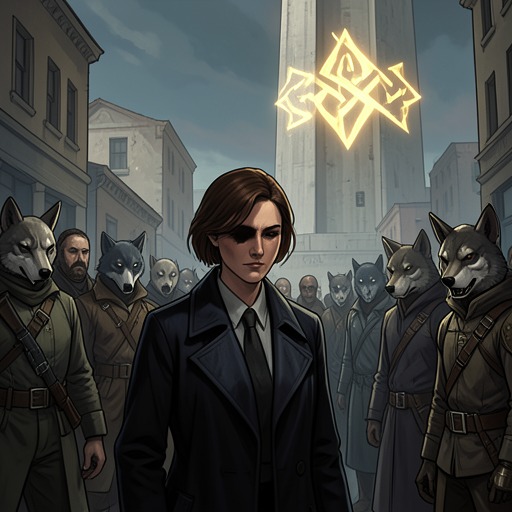
The label’s meaning changes most decisively when Romy addresses the pack before the expected battle with Brody. She challenges the Council as politicians who hope the pack will resolve the crisis without their involvement, then tells the group that the fight is theirs to win. The pack cheers, and Doyle calls her boss. Romy is startled by the reversal: the woman once dismissed as a werewolf-obsessed outsider is now a werewolf, an Alpha’s mate, and someone whose words help set the group’s course. The old joke has not simply disappeared; its power to define her has diminished as she claims authority in public.
The label therefore traces a movement from notoriety to contested credibility and, finally, self-directed speech. It captures how a viral tag can flatten a person into a punchline, invite strangers to treat that caricature as fact, and make genuine warnings easier to disregard. Yet Romy repeatedly returns to the same public channels—to announce, document, disguise, and mobilize. By the time the pack listens to her, the label no longer tells the whole story: the so-called girl who cried werewolf has become one of the people preparing to face the danger she had been trying to name all along.