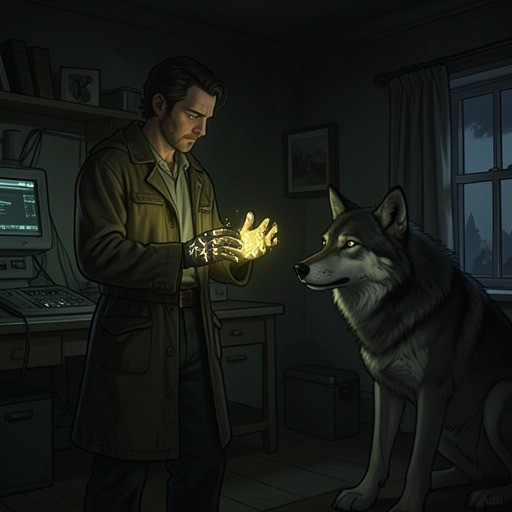
Wolf pack and alpha rule
Of Fates & Fables (The Complete Series)The novel’s pack order is both a system of rule and a test of belonging: it assigns territory, enforces obligations, and gives members grounds to defend one another, while Alpha authority can also be used to override their will. The conflict between those functions comes into focus as Kash Montgomery’s pack confronts Brody Harrison’s challenge. Its outcome depends not only on strength or numbers, but on whether a pack’s members remain under compulsion or can choose where they belong.
Law, Territory, and Membership
Pack life has rules in addition to human laws. Kash explains that breaking those rules can lead to punishment in cells, although he cannot remember when they were last needed. The cells make the pack’s internal authority concrete: its members are not simply a loose alliance, but a community that claims the power to set rules and enforce them. Romy’s reaction also marks a gap between human understanding and pack life. She had not known magic was real, and the explanation makes clear that a system she is only beginning to understand already governs the people around her.
The territorial order rests on Old Law, which Kash describes as an infrequently invoked rule rather than an everyday procedure. Once a group is recognized as a true pack, numbers determine who rules an area: the largest true pack receives the territory, and another pack with greater numbers can challenge its claim. Kash’s family originally gained its land under this arrangement. The rule makes collective size a basis of political legitimacy, but also leaves a ruling pack exposed to rivals who can build their numbers and force a contest. Brody’s challenge therefore threatens more than a boundary; it attacks the principle by which Kash’s family holds the land.
Membership has practical consequences within that order. When Justice Erskine is taken by Brody’s pack, Kash argues that Justice is now a member of his own pack and that this status gives them the right to go after Brody’s group and bring him back. Romy is the person Kash credits with Justice’s membership. The claim turns an act of inclusion into a basis for collective defense: Justice is not treated as an outsider whose danger can be ignored, but as someone whose new allegiance carries obligations for the group.
Authority and the Limits of Consent
The Alpha’s position is not merely ceremonial. In the conflict with Brody, commands can compel newly turned wolves to act, and an Alpha’s hold can persist even when its subjects resist. During the battle, some of the wolves under Brody begin to howl and fight against his compulsion, but their resistance does not fully release them. The scene distinguishes visible dissent from actual freedom: opposition is present, yet authority still constrains what the dissenters can do.
The pack’s capacity for solidarity is likewise more complicated than the promise of protection alone. Brody’s captives were turned against their will and then forced to mate with members of his pack. At a gathering for the rescued women and their babies, one woman insists that gratitude for rescue and care must not be mistaken for forgiveness or consent. She says she would choose to keep her baby again, but stresses that the circumstances were not her choice and that Brody and his werebros must answer for their actions. Her distinction challenges any attempt to present the pack’s reproductive violence as legitimate simply because a victim later loves and protects her child.
Romy also faces a struggle over who will be believed outside the pack. While held captive, she is told that the public already saw her disappear once and would dismiss another escape as the behavior of the girl who cried captive. The threat uses public disbelief as another means of control: even a person who escapes may lack the credibility to make her account matter. The novel places this social pressure beside the pack’s own systems of rules and compulsion, showing that coercive power need not take only one form.
The Challenge to Kash’s Pack
Brody’s growing numbers turn the territorial rule into an immediate danger. After the rescue of the captive women, Romy recognizes that Brody has lost nearly twenty pack members, with more losses likely as the babies are born. Because his established breeding plan depends on replacing members, she suspects he may turn strong men from the campus to replenish his ranks. Elsewhere, missing-athlete posters prompt the observation that the absent men were not among an earlier attacking group, but that their fighting technique suggested they were newborns. The details connect population growth to deliberate recruitment and transformation, rather than treating Brody’s challenge as an accidental increase in strength.
Brody’s capture of Justice makes that threat personal and strategic. Kash warns the pack that Brody will torture Justice for information about their location, vulnerabilities, and defenses. He expects Justice to reveal what Brody wants to know, but declares that the enemy will not get beyond their borders. The warning presents loyalty and defense as collective responsibilities, while acknowledging the risk created by an enemy who can exploit coercive pressure on a captured member.
The response changes the scale of the pack’s deliberations. Earlier meetings had taken place in small groups behind the closed door of Kash’s office; now the members gather in the ceremonial space in the yard because the whole group must fit there. Kash frames the coming defense as a decision that will put lives at risk to protect homes and families. Romy adds that the Council members are politicians who may prefer to leave the pack to handle the crisis on its own. Rather than wait for their intervention, she urges the group to prepare, and Talia DuPont steps beside her as a beta and presses the question of what they can do.
Romy’s practical proposal is to place patrols and lookouts along the borders so the pack learns as soon as Brody arrives. The plan makes the boundary more than an abstract inheritance under Old Law: it becomes ground that members must watch and defend together. Kash also recognizes that Brody may suspect a trap if Justice gives up their location too readily. The pack’s defense therefore depends on anticipating the enemy’s reading of their actions, not simply on trusting its own numbers.
Battle, Release, and the Meaning of Allegiance
In the battle, magical portals appear across the clearing, and yellow-eyed werebros pour through them, surrounding and dividing Kash’s side. Brody’s newly turned wolves rush to obey his orders. Kash is drawn into a fight against two wolves while positioning himself to shield Romy. The scene makes the pack’s structure visible in action: commands mobilize one force, while protection and cooperation shape the other’s response.
Brody’s compulsion proves powerful, but not absolute. Some of the wolves behind Romy howl as they continue fighting, their resistance showing through the hold that still binds them. The change that follows alters the meaning of surrender: Kash shifts back to human form and takes Romy’s hand as they look over the remaining battle. Brody’s werebros begin to yield, some lowering their heads and backing away, others shifting into human form and raising their hands. The visible surrender marks the end of the immediate fighting, but the larger change is that they are no longer simply acting as extensions of Brody’s command.
The aftermath refuses to equate victory with an untouched community. Kash’s pack loses members, and their deaths will take a long time to heal. Brody is gone, and his pack is broken; some of its former members choose to join Kash’s group once they can make that choice freely. Their arrival offers a counterpoint to Brody’s compelled following. The novel’s pack order can protect members and authorize their defense, but its moral legitimacy rests on more than size or an Alpha’s power: the ending gives weight to the difference between obedience enforced by compulsion and allegiance chosen without it.