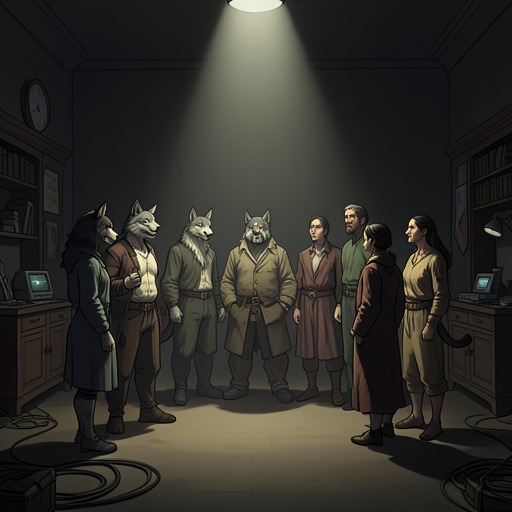
born werewolves
Of Fates & Fables (The Complete Series)Born werewolves and bitten werewolves are distinguished by how they acquire their condition, but the distinction in the Somerville story quickly becomes more than a matter of origin. Born wolves are the local norm; bitten wolves appear in an unusual influx that points to a hidden operation. Brody turns that difference into a program of control, treating bloodline, transformation, and pack membership as things he can engineer. Romy’s eventual insistence that being bitten does not decide her identity directly contests his attempt to make origin a sentence of ownership.
Definition and the local pattern
Xan Andrew Higgins explains that werewolves in the area are born rather than bitten and that nearly all belong to Kash Montgomery’s pack. Lone wolves sometimes travel through, but the region near Somerville is usually relatively clear of them. The arrival of many newly turned, bitten wolves therefore stands out as a disruption, not an ordinary fluctuation in the local population. Their presence also signals that a rule of the local order has been breached: Kash’s pack would not condone the practice that produced them.
The difference is made legible through investigation. Otto Montgomery had tried to track the new wolves himself, but they vanished whenever he drew close; he also sought help from his council and was dismissed for lack of evidence. He then asked Xan Andrew Higgins, a huntsman whose tracking ability is described as unparalleled, to follow the newcomers back to their alpha. Xan’s account turns what could have seemed like scattered cases of transformation into evidence of an organized source. Romy identifies Brody as the person behind the wider pattern, connecting the influx to the harm already done to captive women.
Forced turning as a population project
The political meaning of the distinction becomes explicit when Nick blurts out that the pack needs women to establish a pure bloodline. Romy understands the implication: girls are being turned and abducted so they can be impregnated. The phrase pure line is not merely a claim about ancestry; it is the rationale for controlling who is transformed, who bears children, and which pack will claim them. The distinction between born and bitten thus becomes part of a broader project that treats women’s bodies and future children as resources for pack expansion.
Brody makes the threat personal when he presents Justice as the person who will turn Romy and then keep her pregnant with wolf babies if she refuses to answer questions. The casual delivery intensifies the menace: forced transformation and reproductive violence are presented as routine instruments of authority. Justice’s willingness to step forward, and the lack of surprise from Derek and Zac, show that this is not an improvised threat but a plan familiar within Brody’s group.
The consequences extend to the children born through that coercion. When Romy sees a dark tattoo on a baby’s arm, she recognizes it as a sign that Brody has already claimed the child. Later, Kaitlyn holds Hunter, whose wrist also bears a tattoo. She is grateful for the rescue and loves her baby, but insists that her decision to keep him must not make anyone mistake what happened for consent. Her account preserves two truths at once: a mother can love her child and make the best of her circumstances without absolving Brody or his werewolves. The marks make the breeding program’s claim visible on the next generation.
Venom, marks, and contested allegiance
In this world, a bite does not simply create a new werewolf; the source of the bite can also affect which pack claims the transformed person. After Brody bites Romy and leaves her gravely wounded, Kash says he must bite her repeatedly so that his venom outweighs Brody’s. Otherwise, she may wake belonging to Brody’s pack. Birdie’s magic can slow the bleeding, but it cannot settle this question of allegiance or remove the danger of Romy’s injuries. Kash’s attempt to transform her is therefore both an act of care and a race against the biological consequences of Brody’s bite; the loss of blood makes survival through the change uncertain.
The werewolves’ eyes offer another possible sign of forced turning, though the characters do not claim certainty. Kash tests Romy to determine which alpha her wolf has claimed, despite her lack of the yellow eyes associated with forcibly bitten werewolves. He explains that the group only suspects the color may relate to the amount of venom remaining in their systems and to Brody having forced both their change and their mark. The uncertainty matters: visible signs may invite classification, but they do not provide a complete account of a person’s history or allegiance.
The marks themselves connect transformation to ownership. Brody’s system joins a bodily change to an imposed sign and then uses both to assert pack authority, even over babies. Against that logic, the need for Kash’s venom to outweigh Brody’s shows that the bite’s consequences can be contested, although at grave physical risk. A transformed body is not presented as politically neutral: who caused the change and whose mark remains can determine who is treated as its rightful claimant.
Origin, identity, and belonging
Romy’s response rejects the idea that birth status should dictate a person’s place. Confronting Derek, she says that being bitten or born does not matter: she was meant for this life, for her people, and for Kash. The declaration is not a denial that she was bitten or that the process has consequences. Rather, it refuses to let Brody’s violence define her future or turn the circumstances of her transformation into proof that she belongs to him.
That refusal complicates the hierarchy implied by Nick’s demand for a pure bloodline. Brody’s program treats birth as an ideal to be manufactured through coercion and treats bitten wolves as products that can be assigned to an alpha. Romy’s position instead makes belonging relational: it is bound to the people she chooses and stands with, not settled solely by whether she was born a werewolf or made one by a bite. Her transformation remains dangerous and politically charged, but it does not erase her ability to claim her own life.
The category therefore holds two opposed meanings. It can describe a real difference in origin, as Xan’s account of the local population establishes, but Brody weaponizes it to rank bodies, force pregnancies, and claim children. Romy’s answer does not make those distinctions disappear; it denies that they give an alpha the right to own the transformed. Through the contrast between a manufactured pure line and Romy’s chosen allegiance, the story exposes bloodline language as a means of domination rather than a neutral measure of identity.