Anna Price
Of Fates & Fables (The Complete Series)Anna Price is one of Romy’s closest friends and a central maker of community within the Somerville circle. Her defining significance lies in the contrast between her gentle, baking-centered persona and the sharp competence beneath it: she builds a successful culinary business, recognizes danger when it reaches her friends, and ultimately chooses love and solidarity without allowing either to erase her autonomy.
Identity and Background
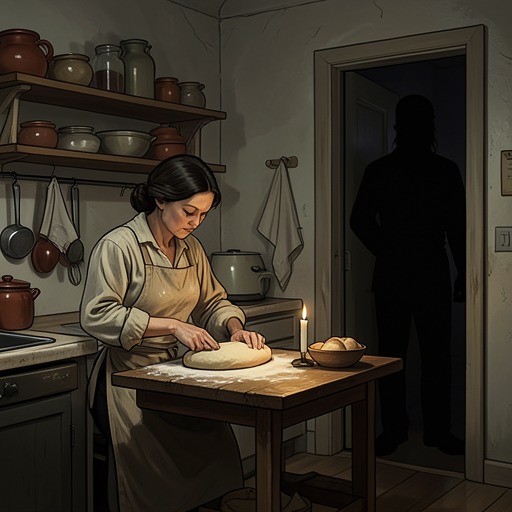
Anna already owns a successful dessert business when she meets Romy as a college freshman. Her Just Desserts food truck becomes one of the most popular in Reverence, not merely because of its playful menu names—such as Holy crepe, Well, I eclair, Bless your tart, and Butter my biscuit—but because she is an exceptionally skilled baker. Romy initially describes her as possessing a sweet naivete, then immediately qualifies that impression by recognizing that Anna’s innocence does not extend to business: she is a baking genius who understands how to make talent commercially durable.
Her ambitions reach beyond running a beloved local truck. Anna studies how to expand the business and become a household name, treating culinary work as both a craft and an enterprise. The later image of her appearing on television as Anna Price of Just Desserts, introduced as a rising culinary star whose down-home recipes and artistic eye have attracted public attention, confirms that the expansion she once pursued has become reality. The arc gives material weight to her labor: baking is not a decorative hobby but the basis of her public identity, economic independence, and eventual professional success.
Courage Under Pressure
Anna’s courage is most visible when danger arrives at the Just Desserts truck. When Brody appears and focuses his attention on her, she stands frozen near the sink while Talia moves in front of her. Anna does not attack him, but her presence becomes the point around which the others organize protection, and Brody’s hostility exposes how vulnerable ordinary friendship and business space have become under his threat. The scene also makes clear that Anna has already lost her appetite for the kind of loser Brody represents; her emotional separation from him is not something he can simply reverse by appearing before her.
Even when frightened, Anna continues to act. During preparations for a possible war, she admits in a small, unsteady voice that she wants to know what she can do. The uncertainty of the question is paired with visible bravery: she is not presented as a fighter by training, yet she does not retreat from responsibility. When Lina asks her to accompany her on an errand, Anna accepts a role in the group’s practical response rather than remaining only the person who feeds everyone.
The same movement appears in her support of the rescued women and children. At a baby shower for the survivors of Brody’s operation, Anna responds to Kaitlyn’s insistence that the women’s captivity and forced pregnancies must not be forgotten by calling her brave. Her compassion does not erase the violence or turn survival into a sentimental ending. Instead, Anna helps create a social setting in which the survivors can receive care while still naming the crime committed against them.
Relationships and Conflict
Anna’s friendship with Romy is intimate, playful, and dependable. Romy knows the details of Anna’s business and takes pride in introducing her to Beau through the coffee cake served to the group. Anna’s desserts repeatedly function as social currency: they bring people together, sustain the pack, and allow her professional skill to become part of collective life. Her work therefore connects private friendship with communal survival.
Her relationship with Brody is marked by rejection and danger rather than romantic reconciliation. Brody’s conduct toward women is defined by threats, coercion, and possession, and his appearance at the truck brings that pattern into Anna’s immediate space. Talia physically places herself between him and Anna, while Anna’s own response is a refusal to treat his attention as meaningful or welcome. The contrast is important: protective care from friends respects Anna’s safety, whereas Brody’s interest functions as intimidation and control.
Anna’s encounter with Beau opens a different model of intimacy. Romy introduces them, and Beau responds to Anna’s coffee cake with formal courtesy, lifting her hand and kissing her knuckles. Their connection develops into a fated-mate relationship, but Anna does not accept it without hesitation. She tells Beau that the supernatural life is not something she would choose for herself and refuses to ask him to give up his own life merely to accommodate her. Her resistance is an ethical statement as much as a personal fear: affection cannot justify demanding that another person abandon an identity or community.
Beau answers by choosing freely rather than claiming her. He throws down his blade and tells her that he does not need that life if he has her. The gesture turns the mate bond away from coercion and toward consent, although Anna’s initial qualification remains crucial. She is willing to love Beau, but she will not pretend that supernatural destiny has made her wishes irrelevant.
Development and Later Life
Anna’s development is not a transformation into someone harder or less caring. It is the revelation that care and competence were present together from the beginning. Her baking business shows that she can manage risk, build a reputation, and imagine a future on her own terms. Her conduct during the crisis adds another dimension: she can be afraid and still volunteer, be protected and still retain agency, and comfort survivors without minimizing what happened to them.
Her role also expands through the community’s changing needs. While Danielle is forced to abandon her medical education after being unable to control her shift and losing her scholarship, Anna remains attentive to the damage that supernatural violence has caused. She supports Danielle’s later path toward supernatural medicine, when Birdie begins training her as an apprentice and pack doctor. Anna’s presence in this network of care links professional ambition with collective reconstruction: one woman’s culinary enterprise and another’s interrupted medical vocation both become ways of rebuilding a life after violence.
By the end, Anna’s success has become public and unmistakable. The television appearance presents her not as someone’s girlfriend, pack accessory, or rescued bystander, but as the named owner and creative force behind Just Desserts. Her down-home recipes and artistic eye have carried her from a popular Reverence food truck to national-facing culinary visibility. The ending therefore preserves the qualities that first defined her while enlarging their scale: sweetness becomes confidence, craft becomes enterprise, and friendship becomes a form of courage.
Narrative Role and Significance
Anna provides the story with an alternative to the power structures represented by Brody. He treats bodies, relationships, and reproductive capacity as resources to control; Anna turns food, labor, and hospitality into resources that sustain chosen community. Her desserts are humorous and commercially successful, but their deeper narrative function is connective. They create occasions for conversation, welcome, celebration, and recovery.
She also gives the narrative a measure of ordinary human choice within a supernatural world organized by bloodlines, Alpha authority, transformation, and mate bonds. Anna does not seek the werewolf life for herself. Her hesitation prevents the romance with Beau from becoming a simple reward assigned by destiny, while Beau’s willingness to lay down his blade makes room for a relationship shaped by choice. Through Anna, the story argues that tenderness is strongest when it is backed by competence, boundaries, and the freedom to decide what kind of life one will inhabit.