Delta fraternity
Of Fates & Fables (The Complete Series)Delta fraternity is the organization through which an ordinary campus brotherhood is revealed as the social mask and logistical machinery of Brody Harrison’s werewolf pack. What first appears to be a conventional fraternity becomes, through its members’ loyalty and concealment, the setting for Romy Cartelli’s captivity, the disappearance of campus women, and a struggle over who controls the werewolf community.
Public Identity and Campus Presence
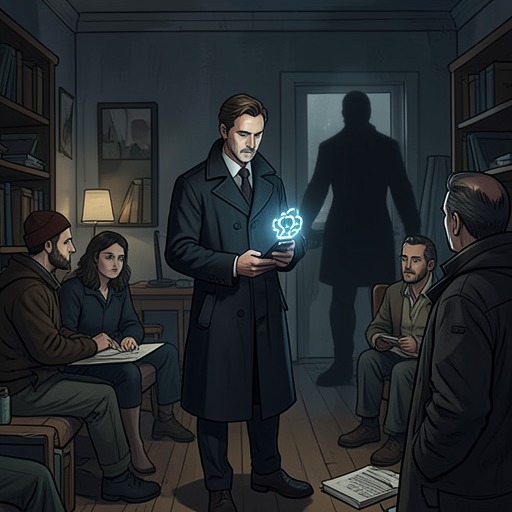
Delta fraternity initially belongs to the recognizable social world of university Greek life. At a gathering held for Danielle, every Delta and Kappa on campus appears at Brody Harrison’s fraternity house. The scene is deliberately familiar: two beer kegs stand by the back windows, liquor and mixers crowd the kitchen bar, one Delta tends the drinks, and loud music fills the rooms even before twilight has ended. The apparent normality is part of the organization’s protection. A gathering intended to organize a search for missing girls looks indistinguishable from any other fraternity party, making the social ritual itself a cover for a crisis.
The fraternity’s public image also shapes what outsiders can believe. Brody Harrison tells Romy Cartelli that, after her earlier disappearance, no one will believe she has vanished again; if she escapes, the public will treat her as “the girl who cried captive.” The phrase turns the victim’s testimony into a stigma and shows how Delta fraternity’s respectable campus position helps discredit anyone who exposes what happens inside it. The organization does not need to announce its supernatural nature. Its ordinary institutional appearance makes disbelief available to the people who might otherwise intervene.
Fraternity Structure and Werewolf Allegiance
The Deltas are not merely human associates of Brody Harrison. Romy Cartelli eventually recognizes that the fraternity’s distinctive marks, previously mistaken for a hazing ritual, are connected to werewolf membership. When Talia DuPont observes that all the Deltas have them, Romy identifies the truth directly: the Deltas are Brody Harrison’s pack. The fraternity therefore operates on two levels at once. It is a campus organization with pledges, parties, houses, and social affiliations, but it is also a pack hierarchy organized around an Alpha and bound by supernatural loyalty.
This double structure explains why the fraternity can absorb suspicious events without collapsing. Nick, a Delta whom a pledge claims has quit and gone home, is actually the werewolf captured and questioned by Kash Montgomery after attacking Danielle. Romy connects Nick’s disappearance, Danielle’s attack, Brody Harrison’s werewolf identity, and the missing girls as parts of one system. The fraternity’s membership is thus not incidental background; it is the network that allows Brody Harrison’s activities to appear as isolated campus incidents while remaining coordinated beneath the surface.
The organization’s allegiance is also visible during Romy’s captivity. After Brody Harrison threatens to have Justice transform her and keep her pregnant with wolf children, additional men enter the basement room where she is held. The hidden space is populated and controlled by more than one perpetrator, while Justice’s unconscious body is treated as another problem to be managed by the group. When Talia DuPont and Lynch Foster later consider whether to bring the others into the room with Justice, the Deltas appear as a collective force rather than a single villain’s private entourage.
The Hidden Basement and Its Operations
Delta fraternity’s most important physical feature is the concealed basement room beneath Brody Harrison’s house. Romy Cartelli wakes after being knocked unconscious and realizes that the cell holding her is in the fraternity basement, the last place she remembers before being dragged away. The room’s design makes captivity possible inside a familiar student residence: an overhead light can be switched on to expose the space, several men can enter, and the open doorway reveals a larger basement beyond the small cell.
Missy Quinn confirms that the basement is not an improvised hiding place but a long-standing center of Brody Harrison’s operations. After learning about Brody Harrison’s desire for ultimate power and his unwilling harem of girls, the group asks whether anyone has checked Delta house. Missy Quinn explains that Brody Harrison ran everything from there when they were together and that a basement room was hidden behind a false wall. Her testimony gives the fraternity a history of organized concealment, linking Brody Harrison’s intimate abuse, supernatural plans, and use of the house as an operational headquarters.
Missy Quinn had discovered the room while searching for storage space because Kappa house lacked closets. The door was open, and she saw four men in a tiny room, each at a different stage of transformation. One of them moved toward her, forcing her to flee to campus police. By the time police arrived, Brody Harrison had sealed the room behind wall art. The concealment succeeded partly because his fraternity brothers covered for him and partly because campus police were unlikely to believe that werewolves existed. Delta fraternity’s methods therefore combine physical architecture, group complicity, and the institutional power of ordinary disbelief.
Complicity, Violence, and Consequences
Delta fraternity’s social bonds become criminal solidarity when its members protect Brody Harrison’s hidden activities. The fraternity house is associated with the imprisonment of Romy Cartelli and with the larger operation involving missing girls, attacks, forced transformation, and reproductive control. Brody Harrison’s threat to use Justice against Romy makes the pack’s goal explicit: transformation is not presented as a personal choice but as a tool of domination and forced breeding. Delta fraternity’s structure turns that threat into a collective capacity.
The organization also illustrates how abuse can be disguised by intimacy and reciprocity. Talia DuPont asks when Missy Quinn decided to leave, and Missy Quinn recalls that they began dating during senior year without her knowing what Brody Harrison was. Her account places the fraternity’s violence within a relationship that initially appeared ordinary. Brody Harrison’s social identity as a student and fraternity leader helps postpone recognition, while the house gives his private control a communal infrastructure.
The consequences extend beyond the fraternity itself. The women rescued from Brody Harrison’s control insist that rescue must not erase the coercion that brought them there. At a baby shower, one survivor expresses gratitude for the rescue and for the comfort offered afterward, but emphasizes that her pregnancy and the circumstances surrounding it were never her choice. She refuses to let Brody Harrison and the other werebros escape accountability merely because she is trying to build a life with her child. Her statement exposes the human cost of the fraternity’s hidden system and rejects the idea that survival or adaptation cancels the original violence.
Narrative Significance
Delta fraternity is significant because it converts the familiar campus institution of the fraternity house into a contested site of secrecy, power, and evidence. Its beer kegs, music, pledges, tattoos, and party culture are not separate from the supernatural plot; they are the camouflage that allows the plot to operate. The fraternity’s ordinary surface repeatedly delays recognition, while its basement reveals what that surface has concealed.
The organization also makes the conflict political. Brody Harrison’s pack uses Delta fraternity to pursue power and claim bodies, territory, and institutional authority. When Romy Cartelli argues that the council members are politicians who hope the crisis will resolve itself so they can keep their hands clean, she places responsibility on the remaining protagonists rather than on distant officials. Her declaration that the fight is theirs to win frames Delta fraternity not as a private campus scandal but as part of a wider war over community protection and legitimate leadership. The Deltas therefore stand as both a social organization and a model of corrupted collective power: a brotherhood whose solidarity protects domination until its hidden structure is exposed.