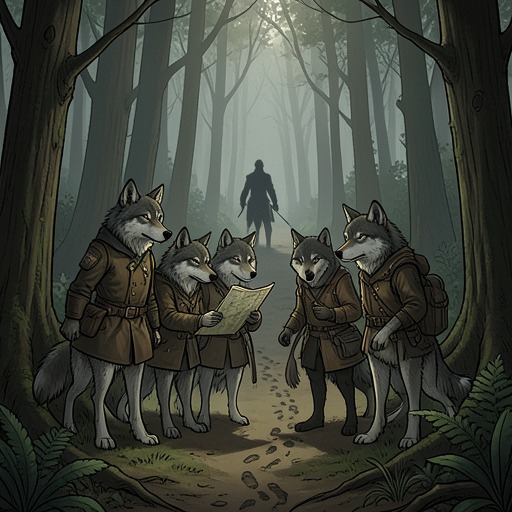
Hunter and Wolfman Coexist
Of Fates & Fables (The Complete Series)Cooperation between werewolves and hunters takes shape under pressure, as separate communities bring their strengths together to defend Somerville from Brody Harrison’s growing pack. The alliance is more than a last-minute arrangement: it challenges the assumption that supernatural and human groups must remain on opposite sides, while distinguishing willing cooperation from the coercive rule Brody imposes on his own followers. Its clearest expression is a battle in which werewolves, Huntsmen, Witches, and human reinforcements fight toward a common defense without becoming a single, uniform force.
The conflict that makes cooperation necessary
The alliance arises after Somerville is caught off guard by the growth of Brody’s forces. Kash Montgomery tells the pack that Justice Erikson has been taken and may be tortured for information about their weaknesses and defenses. He warns that Brody will come for the pack’s people, homes, and land, making the defense of the territory an immediate shared concern rather than a matter for werewolves alone. Kash’s response is to gather every available source of help.
The danger is sharpened by the Old Law governing claims to territory. Lynch Foster explains that its idea of a “true pack” favors werewolves born to werewolf parents over those turned by a bite. Under this law, territorial authority depends on numbers: the largest qualifying pack in an area rules, and a rival pack can challenge it and take the land if it wins. Kash confirms that a victory would transfer the territory, even though it has been in his family for generations. The law makes a fight over land more than a personal feud; it threatens the homes and security of the Somerville pack. The episode also reveals that werewolf society has its own prejudices and competing rules, so the conflict is not simply a united supernatural community facing an outside enemy.
A defense built across communities
As the threat approaches, Kash calls for everyone to assemble at the Ceremonial Oak, the place associated with Justice’s initiation into the pack. The choice brings a significant communal site into the preparations for a fight that could decide the pack’s future. Brody’s forces have grown, and the pack knows that the attackers may try to discover how to breach its defenses. In this moment, help is treated as necessary, not as a compromise of the pack’s identity.
Xan Andrew Higgins arrives with fellow Huntsmen after Lina Montgomery contacts him about the danger. Their arrival invigorates the pack. Romy Cartelli watches werewolves work alongside Huntsmen and Witches, each using distinct abilities in the effort to protect their family. The groups do not merely gather in the same place: they take positions together along the perimeter. Birdie and Mirabelle strengthen the wards, then weaken a selected section according to Romy’s instructions, incorporating magical defenses into the shared plan. The resulting line of defense depends on coordination between participants whose powers and roles remain different.
The protected civilians give the alliance a concrete purpose beyond preserving territory. The rescued women and their babies are kept concealed and spelled inside Levi’s cabin in a secluded part of the property. Their captor, Brody, had turned women against their will and forced them to mate with members of his pack. The women’s captivity and the danger to the pack are connected, but the rescuees are not reduced to symbols: Kaitlyn insists that loving her baby, Hunter, does not mean the violence that led to his birth was chosen or should go unanswered. This insistence helps clarify what the defense is for: protecting people from coercion as well as defending the community’s homes.
The battle and the limits of an alliance
The coalition is tested in the fighting itself. Huntsmen fight with deadly skill, but they are heavily outnumbered; for every wolf they bring down, two more take its place. Xan and Beau stand back to back, guarding each other while a fallen enemy lies at their feet. Their pairing makes the alliance visible at the level of immediate mutual protection, even as the wider battle remains precarious.
Talia DuPont and Lynch Foster demonstrate another form of cooperation. Talia fights in a half-shifted state, wielding a samurai sword, while Lynch uses his teeth and claws to take down wolves who close in on her. The two fight in tandem, combining her weapon and unusual form with his wolf’s physical capabilities. Their partnership does not erase the difference between them; it turns that difference into a tactical advantage.
Additional help arrives by more than one route. Lina steps through a magical portal with the rest of the council, whose members join the fight where Brody’s forces have the numerical advantage. Separately, Talia’s father sends reinforcements by helicopter. A dozen human fighters repel into the yard and enter the battle without recoiling from the sight of wolves fighting alongside magical people. Talia tells them to target yellow eyes only, giving them a practical distinction to guide their actions amid the confusion. These arrivals broaden the defense beyond the original pack-and-Huntsmen partnership, but they remain specific, situational acts of support rather than evidence that all human institutions now accept werewolves.
Choice, coercion, and a changed boundary
The ethical contrast between the alliance and Brody’s rule comes into focus when Brody taunts Romy for relying on humans to fight. Romy answers that she relies on people who are willing to stand with her, rather than forcing them to do so. The distinction echoes the rescued women’s testimony: Brody’s followers have used power to compel mating and expand their numbers, while Somerville’s defense is assembled through people choosing to help. Cooperation is therefore presented not as simple numerical strength but as a different basis for loyalty.
The book also complicates the line between communities through Finn. After handling a Huntsman’s blade, he learns that the blade chooses its master and that its response makes him a Huntsman. Finn objects that he is already a werewolf; Xan explains that he is both. Xan has never witnessed this combination before, but he trusts the blade’s verdict. Finn immediately grasps the possible consequence: he may be able to hunt werewolves who deserve to be stopped. His dual identity does not by itself resolve the conflict between groups, yet it makes their boundary less absolute and gives the alliance a striking individual counterpart.
Cooperation between werewolves and hunters remains rooted in a crisis, and the evidence does not establish a lasting political settlement or universal trust. Its significance lies instead in what the defense makes possible: groups with distinct abilities can protect one another without surrendering those differences, and membership does not dictate a person’s allegiance. Against the Old Law’s contest over territory and Brody’s coercive recruitment, the coalition offers a rival model of strength—one built from chosen support, shared risk, and a willingness to defend people beyond one’s own group.