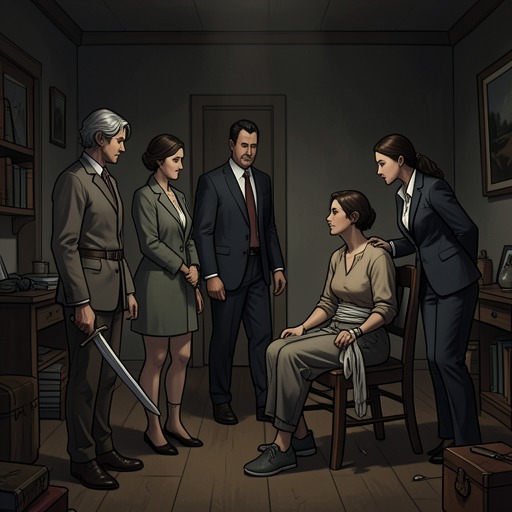
Kash's rescue and reunion with Romy
Of Fates & Fables (The Complete Series)Kash's rescue and reunion with Romy marks the decisive turn from captivity to recovery. Romy has been confined in a lightless room with no windows, a door that opens only from outside, air thick with mildew and decay, and a body weakened by extreme hunger, dehydration, dizziness, and shallow breathing. Her isolation is so complete that she does not even know what she is waiting for. Against that suspended helplessness, Kash's arrival restores movement, recognition, and the possibility of safety: she sees the wolf coming for her, realizes that it is Kash, and chooses to run toward him rather than away.
Captivity and the Conditions of Rescue
Romy's rescue acquires its force from the physical severity of her confinement. She wakes repeatedly after being knocked unconscious, but only gradually becomes clear-headed enough to understand her surroundings. The room appears underground, its darkness persistent even after her eyes adjust, while the single externally locked door makes escape impossible. Hunger cramps her stomach, dehydration has gone far beyond ordinary thirst, and even the smallest movement produces waves of dizziness. Curled on the cement floor, she can only lie still and wait without knowing whether anyone will come. The rescue therefore does not begin as a conventional pursuit witnessed from outside; it arrives as an interruption to a state in which time, agency, and expectation have nearly collapsed.
Her condition also shapes the reunion's later gestures. After she is recovered, Justice enters with food and immediately cups her face, asking what happened to her, but Romy answers with bitter humor about having endured another conversation with Brody. She turns away from Justice despite recognizing that he is not directly responsible for her injuries, because the betrayal attached to his connection with Brody remains active. The scene shows that rescue does not erase the captivity's emotional consequences. Romy's body is alive, but trust must still be negotiated among people implicated in the power structure that harmed her.
Kash's Arrival in Wolf Form
The encounter begins when Talia notices that something is wrong behind Romy and urges her to move. Romy barely turns before a large blue-eyed wolf races toward her with its teeth bared and fur standing on end. Talia reads the animal as an imminent threat and calls for Romy to get out of the way. Romy, however, recognizes the wolf as Kash. Her fear changes direction in an instant: instead of leaping clear, she launches herself at him, wraps both arms around his neck, and buries her face in his fur. His momentum knocks them backward, and they tumble together onto the grass.
This choice is the scene's central proof of their bond. Romy is not rescued as a passive object carried away from danger; she identifies her rescuer and moves toward him before anyone can explain what is happening. Talia's alarm remains understandable because Kash's pack has already been associated with violence and Romy has already been endangered, but Romy's response distinguishes Kash from the forces that held her. Her embrace turns the apparent attack into recognition, making bodily contact a form of knowledge that precedes explanation.
Kash then steps back and transforms. The air around Romy pulses with a vibration she experiences as the closest thing to magic she has ever felt, and even pain, exhaustion, and fear cannot suppress her awe at witnessing something she believed impossible. As his paws become hands and feet, Kash pulls her against his chest in a desperate hug. The transformation is not merely a supernatural display; it bridges the two forms in which Romy has known him and confirms that the wolf who found her and the man who holds her are the same person.
Recognition, Safety, and the Return of Fear
Kash's first words after transforming express the terror beneath the rescue: he tells Romy that he thought he had lost her. Romy answers that she is there and reminds him that she had already told him he was stuck with her. Their exchange restores the intimacy interrupted by her abduction, while Kash's growl, relief, and visible love communicate what he cannot fully put into words. When he cups her face, the pain and fear in his expression mirror her own. Safety is therefore presented not as the absence of trauma but as the presence of someone whose fear recognizes hers.
The reunion also immediately turns toward accountability. Kash demands to know who took Romy and declares that he will hunt them down. Before the protective impulse can become a plan, Talia's furious interruption forces both of them to stop and face the larger situation. Her response recalls that Romy has already been targeted and that Kash's apparent rescue cannot be separated from the danger surrounding his pack. The scene moves in a single emotional breath from reunion to confrontation: love brings Romy back into Kash's arms, but anger reopens the question of who allowed the threat to reach her and what must be done to prevent it from happening again.
The Pack's Law and the Larger Stakes
Kash's rescue takes place within a society governed by rules that extend beyond human law. He explains that werewolves maintain cells for those who violate pack rules, although the cells have rarely been used, and identifies the private residence where Romy is held or questioned as his own rather than the pack house. This distinction makes Kash's authority concrete: the pack house, garage, cells, and private residence all belong to him, but each space carries a different function within his leadership. Romy's rescue consequently brings her not simply to a lover's home but into the territory of an Alpha whose authority is contested.
That contest is rooted in the Old Law. Lynch explains that the law recognizes as a true pack those born of a werewolf rather than bitten, and that territory is awarded according to the numbers of the largest true pack in an area. Kash's family originally earned its land through that system, but another pack with greater numbers can challenge the ruling pack and take the territory if it wins. Brody's campaign is therefore not only personal violence against Romy or an attack on Kash's relationship; it is an attempt to build a born-werewolf pack and use its numbers to claim Kash's homes and ancestral land. The conditions that made Romy's captivity possible are tied to a struggle over sovereignty, inheritance, and the legitimacy of competing packs.
Kash's rescue and reunion with Romy marks the decisive turn from captivity to recovery. Romy has been confined in a lightless room with no windows, a door that opens only from outside, air thick with mildew and decay, and a body weakened by extreme hunger, dehydration, dizziness, and shallow breathing. Her isolation is so complete that she does not even know what she is waiting for. Against that suspended helplessness, Kash's arrival restores movement, recognition, and the possibility of safety: she sees the wolf coming for her, realizes that it is Kash, and chooses to run toward him rather than away.
Captivity and the Conditions of Rescue
Romy's rescue acquires its force from the physical severity of her confinement. She wakes repeatedly after being knocked unconscious, but only gradually becomes clear-headed enough to understand her surroundings. The room appears underground, its darkness persistent even after her eyes adjust, while the single externally locked door makes escape impossible. Hunger cramps her stomach, dehydration has gone far beyond ordinary thirst, and even the smallest movement produces waves of dizziness. Curled on the cement floor, she can only lie still and wait without knowing whether anyone will come. The rescue therefore does not begin as a conventional pursuit witnessed from outside; it arrives as an interruption to a state in which time, agency, and expectation have nearly collapsed.
Her condition also shapes the reunion's later gestures. After she is recovered, Justice enters with food and immediately cups her face, asking what happened to her, but Romy answers with bitter humor about having endured another conversation with Brody. She turns away from Justice despite recognizing that he is not directly responsible for her injuries, because the betrayal attached to his connection with Brody remains active. The scene shows that rescue does not erase the captivity's emotional consequences. Romy's body is alive, but trust must still be negotiated among people implicated in the power structure that harmed her.
Kash's Arrival in Wolf Form
The encounter begins when Talia notices that something is wrong behind Romy and urges her to move. Romy barely turns before a large blue-eyed wolf races toward her with its teeth bared and fur standing on end. Talia reads the animal as an imminent threat and calls for Romy to get out of the way. Romy, however, recognizes the wolf as Kash. Her fear changes direction in an instant: instead of leaping clear, she launches herself at him, wraps both arms around his neck, and buries her face in his fur. His momentum knocks them backward, and they tumble together onto the grass.
This choice is the scene's central proof of their bond. Romy is not rescued as a passive object carried away from danger; she identifies her rescuer and moves toward him before anyone can explain what is happening. Talia's alarm remains understandable because Kash's pack has already been associated with violence and Romy has already been endangered, but Romy's response distinguishes Kash from the forces that held her. Her embrace turns the apparent attack into recognition, making bodily contact a form of knowledge that precedes explanation.
Kash then steps back and transforms. The air around Romy pulses with a vibration she experiences as the closest thing to magic she has ever felt, and even pain, exhaustion, and fear cannot suppress her awe at witnessing something she believed impossible. As his paws become hands and feet, Kash pulls her against his chest in a desperate hug. The transformation is not merely a supernatural display; it bridges the two forms in which Romy has known him and confirms that the wolf who found her and the man who holds her are the same person.
Recognition, Safety, and the Return of Fear
Kash's first words after transforming express the terror beneath the rescue: he tells Romy that he thought he had lost her. Romy answers that she is there and reminds him that she had already told him he was stuck with her. Their exchange restores the intimacy interrupted by her abduction, while Kash's growl, relief, and visible love communicate what he cannot fully put into words. When he cups her face, the pain and fear in his expression mirror her own. Safety is therefore presented not as the absence of trauma but as the presence of someone whose fear recognizes hers.
The reunion also immediately turns toward accountability. Kash demands to know who took Romy and declares that he will hunt them down. Before the protective impulse can become a plan, Talia's furious interruption forces both of them to stop and face the larger situation. Her response recalls that Romy has already been targeted and that Kash's apparent rescue cannot be separated from the danger surrounding his pack. The scene moves in a single emotional breath from reunion to confrontation: love brings Romy back into Kash's arms, but anger reopens the question of who allowed the threat to reach her and what must be done to prevent it from happening again.
The Pack's Law and the Larger Stakes
Kash's rescue takes place within a society governed by rules that extend beyond human law. He explains that werewolves maintain cells for those who violate pack rules, although the cells have rarely been used, and identifies the private residence where Romy is held or questioned as his own rather than the pack house. This distinction makes Kash's authority concrete: the pack house, garage, cells, and private residence all belong to him, but each space carries a different function within his leadership. Romy's rescue consequently brings her not simply to a lover's home but into the territory of an Alpha whose authority is contested.
That contest is rooted in the Old Law. Lynch explains that the law recognizes as a true pack those born of a werewolf rather than bitten, and that territory is awarded according to the numbers of the largest true pack in an area. Kash's family originally earned its land through that system, but another pack with greater numbers can challenge the ruling pack and take the territory if it wins. Brody's campaign is therefore not only personal violence against Romy or an attack on Kash's relationship; it is an attempt to build a born-werewolf pack and use its numbers to claim Kash's homes and ancestral land. The conditions that made Romy's captivity possible are tied to a struggle over sovereignty, inheritance, and the legitimacy of competing packs.
Recovery, Protection, and Resistance
The rescue's aftermath repeatedly tests whether protection will restore Romy's agency or merely place her under another authority. Kash's concern is attentive when he offers to ask Talia or Anna to help remove Romy's clothes, stopping as soon as she shakes her head and asking whether anyone harmed her. Romy explains that she wants to burn the clothes because they have become reminders of what happened, but that she cannot lift her arms over her head. His relief when she answers that nothing sexual occurred, followed by his teasing question about whether she truly never wants to see the clothes again, allows the scene to hold trauma and familiar intimacy together without treating recovery as instantaneous.
Birdie later examines Romy in a cozy bedroom at Kash's request, specifically checking the place where Derek's teeth scraped her neck. The medical attention contrasts with the secrecy and helplessness of the cell: Romy's injury is now visible to someone tasked with assessing it, and Kash's concern has been converted into practical care. Yet Danielle's experience shows how incomplete that recovery can be for a newly transformed woman. She is alive, but losing control of her shift forced her to leave school, cost her scholarship, and destroy her hope of entering medical school. Rescue from immediate danger does not return the life that coercion has taken; it begins the harder work of rebuilding a future.
Romy's own resistance develops alongside that recognition. When Conner is about to be turned into another servant for Brody, Talia rejects the prospect and kills him with the pendant from her necklace, driving it into his neck until his body goes still. The act is violent and unauthorized, but the threat is understood as urgent: allowing the transformation would add another minion to Brody's side. The rescue story thus expands from saving one captive to preventing the machinery of captivity from producing new agents.
From Private Reunion to Collective War
The rescued women and Romy eventually force the private violence behind the abductions into public view. Before the council, Kash states that Brody is obsessed with breeding a pack born rather than bitten so he can claim Kash's lands. When the council proposes interviewing the women and corroborating their accounts before acting, Romy erupts, insisting that Brody kidnapped them, forcibly turned them into werewolves, repeatedly raped them until they became pregnant, and left them to relive that ordeal for institutional proof. Her anger changes the meaning of the rescue: the survivors are not evidence waiting for officials to validate them, but people whose testimony already establishes the emergency.
The council's delay makes the contrast between official procedure and immediate defense explicit. Romy later tells the pack that council members are politicians hoping the crisis will resolve itself so they can keep their hands clean. The pack answers her challenge with cheers, and Doyle calls her boss lady, marking her movement from outsider to recognized participant in the pack's war. The rescue has therefore altered not only her physical location but her political position. She is no longer merely the person Kash must recover; she becomes one of the people defining what the group will defend.
That transformation reaches its clearest expression in the final confrontation with Brody. Romy takes a knife and cuts through his Delta tattoo on behalf of Justice. Blood carries out a murky green residue as the magic drains away, weakening the mark's control over the wolves behind him even though their resistance is initially incomplete. When Kash pins Brody and bites his exposed throat, Romy takes the dropped knife and plunges it into the already opened wound. Her action completes the rescue's reversal: the woman once too weak to move on a cement floor now acts decisively against the force that made captivity possible. Kash's reunion with Romy begins as an intimate recovery, but its lasting consequence is collective resistance, in which recognition, care, testimony, and chosen violence become connected stages in reclaiming freedom.