Romy's Hidden Social-Media Distress Signal
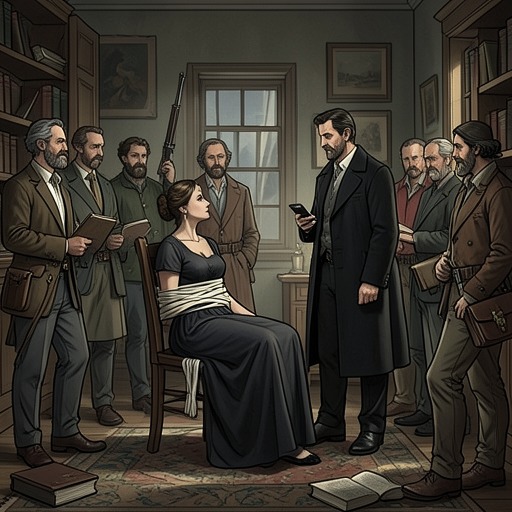
Of Fates & Fables (The Complete Series)Romy's Hidden Social-Media Distress Signal is the moment when Romy converts her enforced online performance into an act of resistance. Imprisoned in a windowless, mildew-filled room with a door that opens only from the outside, suffering from hunger, dehydration, dizziness, and the uncertainty of not knowing who is looking for her, she recognizes that her most reliable route to the outside world may be the very public identity her captors want to control. The resulting post is not an open cry for help but a concealed signal: a piece of ordinary influencer content designed to look safe while preserving evidence and directing attention toward the people holding her.
Captivity and the Need for a Signal
Romy's situation makes communication both necessary and dangerous. After being knocked unconscious, she wakes alone on a cement floor, unable to establish how much time has passed and unsure what she is waiting for. Brody intensifies that isolation by insisting that nobody is looking for her because she has already gone missing once. His claim attacks not only her physical security but also her credibility: if friends and authorities interpret another disappearance as voluntary or unsurprising, the fact of her captivity may remain invisible.
The social-media strategy begins as a negotiation over access to her phone. Romy asks for it on the grounds that her schoolwork and regular posting schedule must continue, arguing that her accounts are her life and that any sudden silence would alert Talia and Anna. She offers Brody a controlled alternative: he can supervise what she posts, approve it, and monitor the account. The proposal appears to give him greater control, but it also preserves her connection to an audience and creates a narrow space in which she can communicate without openly challenging him.
The Manufactured Innocent Post
Brody initially treats the request as an opportunity to gather information. He demands that Romy explain how she entered Kash Montgomery's compound, and when she reveals that she does not know what he means, he and Derek consider whether the compound's wards might exclude only other werewolves. Brody realizes that her answer has disclosed something he did not know, yet he rewards the revelation with permission for one social-media post. The exchange shows the asymmetry of the captivity: even a routine upload requires negotiation, while every answer may expose Romy or her allies to further danger.
Derek returns Romy's phone only under supervision and checks the proposed content. Romy selects an old photograph from her saved archive, crops it, adjusts its lighting, and chooses a filter that leaves the men from Delta clearly visible. She frames the image as a playful #ManCrushMonday post about three men who supposedly thought they could compete with Sebastian Beckett, calling them #BookBoyfriendMaterial and adding the customary author tags, bookish hashtags, and recommendation. Its surface belongs to Romy's established brand, Romy Reads Romance: flirtatious, literary, and commercially familiar rather than alarming.
The harmlessness is carefully engineered. Derek is reassured because the image can be presented as a throwback, and he approves the text without recognizing that the photograph's visibility may matter more than its joke. He taps the share icon, waits for the post to appear at the top of the feed, and then powers off the phone. The captors believe that they have restricted the message by controlling its production, but Romy understands that publication itself creates a trace. As she reflects after Derek leaves her with the backpack containing her schoolwork, they think they have won the round; if the post works, they are facing an awakening they cannot anticipate.
Media Performance as Resistance
The signal depends on the difference between Romy's public persona and the private circumstances behind it. Earlier, she uses livestreams to announce that werewolves exist, promising followers proof from the warehouse across the street and later presenting herself as a determined investigator whose evidence keeps slipping away. Even when frightened, she knows how to smile for the camera, address followers, and turn danger into a serialized public story. Her online identity is therefore not incidental decoration but a practiced instrument of audience management.
That instrument becomes more complex after the kidnapping. Romy cannot simply tell her followers that Brody has imprisoned her, because he is watching the account and can punish her for anything suspicious. Instead, she maintains the appearance of continuity: saved photographs substitute for real-time life, a routine hashtag disguises the operation, and the visible faces in the image preserve a possible lead. The post works simultaneously as performance, archival record, and indirect accusation. Its power comes from making the captors participate in the deception; they approve the message because they mistake its recognizable format for obedience.
The same strategy carries a darker psychological dimension. Romy later records a drunken video describing the missing girls and the werewolves' breeding operation as a time capsule of proof, acknowledging that she cannot openly reveal the truth without exposing Kash Montgomery or making him appear to be the villain. That recording is less immediately tactical than the supervised post, but it shares the same logic: when direct testimony is impossible or likely to be dismissed, Romy creates a future record that can outlast the conditions silencing her. Her insistence that the truth will eventually prove her right turns disbelief into part of the evidence's intended history.
Immediate Consequences and Wider Meaning
The post does not instantly free Romy, and the immediate physical conditions of captivity remain unchanged. Justice enters with food and reacts to the injuries caused by Brody, while Romy responds with anger and a sense of betrayal even though she knows Justice did not directly cause her pain. Later, the question of whether anyone harmed her becomes charged with the violence of what she has endured, and Birdie examines the scrape left by Derek's teeth after Kash Montgomery asks her to check Romy following the wolf-bite scare. These encounters show that the social-media signal operates alongside bodily evidence: the post preserves a public trace while injuries make the captivity legible to those who can finally examine her.
Romy's method also clarifies the difference between control and authority. Brody can seize the phone, dictate access, demand information, and command Justice, but he cannot fully reproduce Romy's knowledge of her followers, her archive, or the conventions of her platform. His power is physical and coercive; hers is procedural and interpretive. By making him approve the post, she turns his surveillance into a blind spot. The captor becomes an editor who does not understand the text he has authorized.
The event therefore advances the book's larger concern with credibility, labels, and public narrative. Romy is repeatedly treated as someone whose claims can be dismissed as absurd, sensational, or attention-seeking, even though she has seen the evidence herself. Yet the identity that makes her seem unreliable also supplies the means of resistance. The online persona that once promised proof of romantic fantasy becomes a vehicle for documenting confinement, exposing the people connected to it, and preserving Romy's claim to have told the truth before the wider world was prepared to believe her. By the time an A-list celebrity later presents the prologue of her book on television, the story has moved from a private livestream and a hidden post into a public account of how she became entangled with werewolves. The concealed signal is a crucial bridge between those two forms of narration: it transforms a controlled performance into testimony that can survive its captors' attempt to define reality for her.