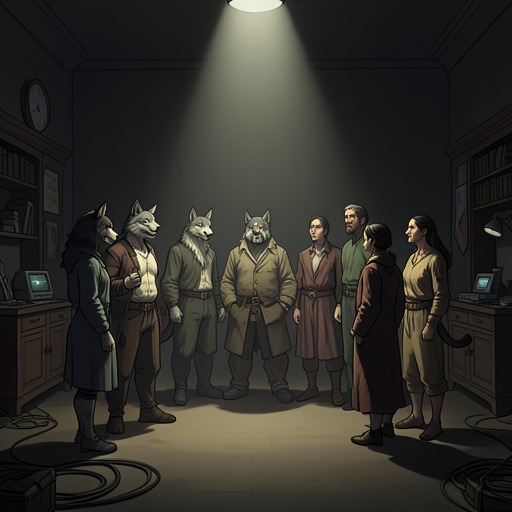
Wolfman transformation love norms
Of Fates & Fables (The Complete Series)The werewolf-turning norm distinguishes an intimate, ordinarily love-associated transformation from the coercive use of a bite as a weapon of control. Kash explains that werewolves may be born to shifter parents or be bitten and turned, and that turning is normally gentle, extremely private, and undertaken when a shifter falls in love with a human. The plot’s revelations about Nick and Brody make that norm more than background lore: they show what happens when a private transformation is commandeered for a pack’s reproductive ambitions.
Definition and ordinary practice
Kash explains the norm to Romy while she is trying to understand the supernatural world she has entered. In response to her question about whether werewolves are born or made, he describes two routes: a werewolf may be born to parents who are both shifters, or may be bitten and turned. He contrasts the latter with the violent transformations familiar from books and movies. In his account, the act is gentle and extremely private, and is normally performed when a shifter falls in love with a human.
The explanation makes the bite consequential without making it inherently an act of aggression. Turning can change a human’s identity and place them within werewolf society, but its usual context is a personal bond rather than an order imposed by a leader. Kash also identifies himself as born a werewolf, like the rest of his pack, because both his parents were shifters. His account therefore separates inherited identity from transformation by biting, while presenting the latter as an intimate exception to ordinary birth.
The commanded bite and the breeding plot
The norm’s sharpest violation emerges during the questioning of Nick, who has bitten a girl. When Lynch asks why, Nick first answers that it was an Alpha’s order. He then corrects the implication that he was ordered to attack her: the order was to bite her, and Lynch recognizes that the purpose was to turn her. Nick’s distinction is chillingly precise. The bite is not incidental violence in an attack; it is the means by which a leader intends to alter a woman’s status and make her available to a larger scheme.
Under pressure, Nick explains the motive: the pack needs women to establish a pure bloodline. Romy understands the revelation as a plan to turn girls and take them away for impregnation. The ordinary association between turning and love is thus inverted. A transformation that Kash describes as private and relational has been converted into a population-making tool, with women’s bodies treated as resources for a pack’s future.
Brody later makes the same purpose explicit as a threat against Romy. He tells her that Justice will turn her and then try to get her pregnant repeatedly. Justice’s willingness to carry out the threat, and the absence of surprise from Derek and Zac, show that this is not presented as an improvised menace unique to the moment: the men already know of the plan. The forced bite would remove Romy from the ordinary circumstances Kash describes and place her transformation within Brody’s system of command and reproductive control.
Bodies, marks, and continuing control
The consequences of this departure from the norm extend beyond the moment of transformation. At a later gathering, Romy sees a dark tattoo on a baby’s arm and recognizes it as a mark Brody has already placed on the child. She subsequently notices a tattoo on Hunter’s wrist while holding him. Kaitlyn makes clear that rescuing the women and helping them does not erase the coercion behind their circumstances: she loves Hunter and would keep him, but insists that her pregnancy and the situation that produced it were not her choice. Her determination to protect her child does not absolve Brody and his werebros.
The tattoos make the breeding scheme visible on the bodies of its youngest subjects. The attempted control does not end with turning or pregnancy; the mark on a baby suggests that Brody’s claim reaches into the next generation. In this way, the story links transformation, reproduction, and inherited pack power without treating them as the same thing: the bite changes a person, pregnancy produces a child, and the tattoo asserts a claim over that child.
Knowledge, credibility, and narrative significance
Romy’s understanding of the norm develops amid a broader struggle to make the supernatural world legible. She initially confronts the fact that magic is real only after Kash refers to Nick as having been spelled. Elsewhere, she sees a social-media spoof account turn the label of the Girl Who Cried Werewolf into public mockery, and Brody later exploits her earlier disappearance to argue that others will not believe she has been taken again. These episodes do not define the turning norm, but they clarify the conditions in which its abuse can remain hidden: supernatural facts are difficult for outsiders to accept, and Romy’s credibility is already vulnerable.
The norm also supplies a measure against which the story’s competing uses of power can be read. Kash presents turning as intimate and usually tied to love; Nick’s testimony and Brody’s threat expose a system that substitutes an Alpha’s command for personal choice. Romy eventually rejects the assumption that the authorities or the council will resolve the danger for her group, insisting that they must prepare to fight Brody themselves. The contrast is therefore not simply between being born a werewolf and becoming one by bite. It is between transformation understood as a private bond and transformation imposed as an instrument of control, with the latter revealing the political and bodily costs of Brody’s rule.