Gabilan Mountains
Of Mice and MenThe Gabilan Mountains rise east of the Salinas River, forming the far wall of the valley where the novel's final scene unfolds. In the late afternoon, the sun has already left the valley floor to climb up the slopes of the Gabilans, leaving the hilltops rosy in the sun while the pool among the mottled sycamores lies in a pleasant shade. The mountains are the first feature to catch the day's last light and the last to surrender it, marking the passage of time as the scene moves toward evening.
Setting and Visual Presence
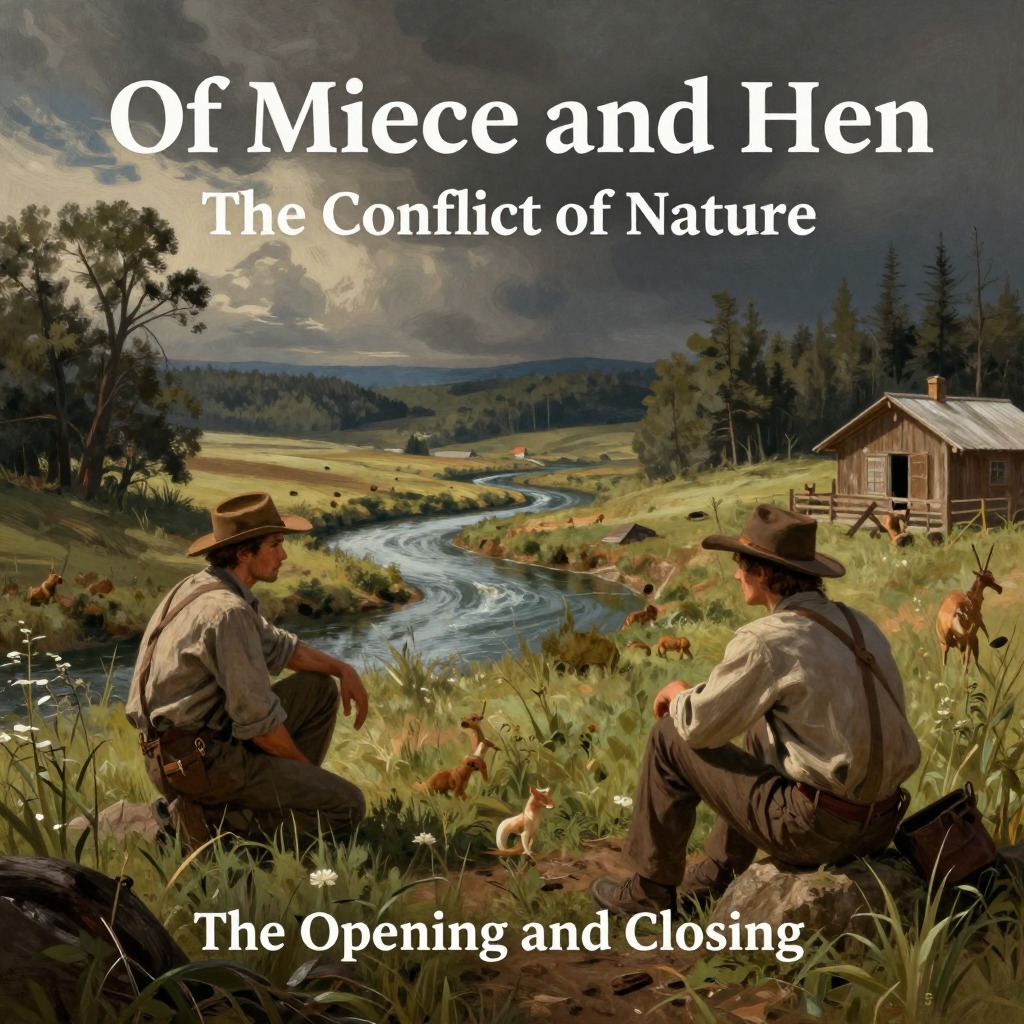
The Gabilans are introduced as the sun's destination: the light has left the valley to go climbing up their slopes, and the hilltops blaze with increasing brightness as the afternoon deepens. When Lennie Small arrives at the pool, he turns his head and looks at the bright mountain tops, and it is toward them that he speaks his first words of regret and fear about George Milton's anger. Later, as George recites the dream of the little place for the last time, he instructs Lennie to look across the pool and up the darkening slopes of the Gabilans, telling him to look so he can almost see the place they will never reach. The mountains thus become the visual anchor for the dream itself, the horizon against which the imagined farm is projected.
Chronological Marker and Thematic Significance
The Gabilans function as a precise chronological marker for the scene's duration. When Lennie first arrives, only the hilltops are in the sun; by the time George has finished the recitation and raised Carlson's Luger, only the topmost ridges remain lit, and the shadow in the valley is blue and soft. The mountains measure the shrinking of daylight and the approach of the men who are hunting Lennie, compressing the scene's emotional arc into the interval between full afternoon and near-darkness. Their steady, indifferent progression from light to shadow mirrors the inevitability of the novel's outcome: the dream cannot survive the night, and the mountains will outlast both the dreamers and their pursuers.
Narrative Role and Symbolic Weight
As a geographical feature, the Gabilans belong to the natural world that surrounds and contains the human drama without participating in it. The heron, the water snakes, the wind, and the sycamores all act within the clearing, but the mountains remain fixed and distant, the boundary of the visible world. Lennie's gaze toward them when he speaks of finding a cave and living alone connects the mountains to the idea of escape and isolation, a wild refuge beyond the reach of George and the law. Yet the mountains also frame the place where George chooses not to let Lennie go alone: the shot that kills Lennie rolls up the hills and rolls down again, and the mountains return the sound as if acknowledging the act. In the final moment, the Gabilans are the last thing Lennie sees, the landscape of a dream that dissolves into the darkening slopes.