George Milton
Of Mice and MenGeorge Milton is the sharp-witted, protective companion of Lennie Small in John Steinbeck's Of Mice and Men, a migrant ranch worker whose dream of owning a small farm is shattered by the necessity of killing his friend to spare him a crueler death. His decisive significance lies in embodying the novel's central conflict between loyalty and survival, and in performing the story's most harrowing act of mercy.
Identity and Background
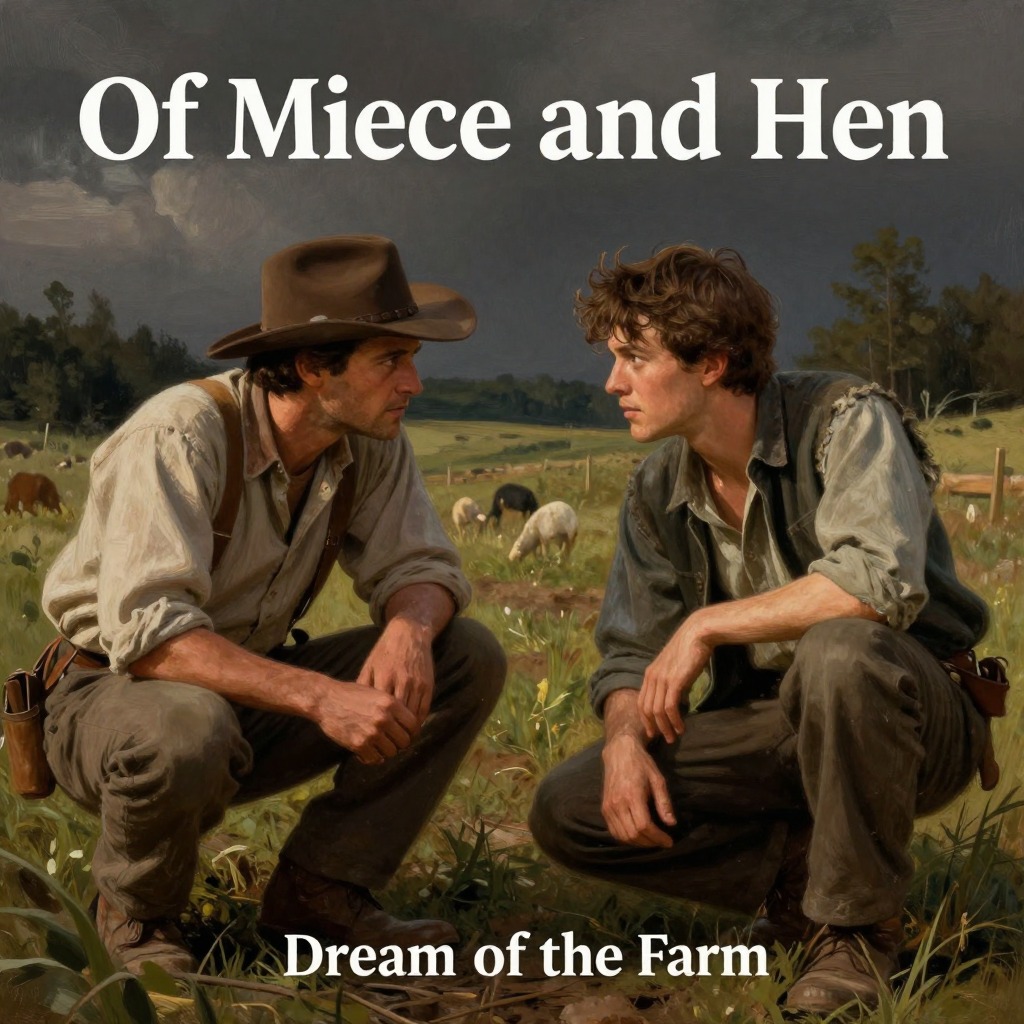
George Milton is a itinerant farm laborer during the Great Depression, a man of quick intelligence and restless energy who has spent years caring for the mentally disabled Lennie Small. He is defined by the burden of this responsibility: he has given up the freedom of a solitary life—the ability to spend his pay in a whorehouse or play snooker in a pool room—to keep Lennie out of trouble. George's speech reveals a man who has internalized the loneliness of the migrant worker's existence: "Guys like us got no fambly. They make a little stake an' then they blow it in. They ain't got nobody in the worl' that gives a hoot in hell about 'em." Yet he has also constructed a counter-narrative of companionship and shared hope, a dream of a little place with a cow, a pig, chickens, and alfalfa for the rabbits that Lennie will tend.
Arc Through the Plot
George's trajectory in the novel's final scene is one of agonizing choice. After Lennie has killed Curley's wife, George finds him at the pool by the Salinas River, the place he had instructed Lennie to hide. He arrives quietly out of the brush, and his first words are a weary question: "What the hell you yellin' about?" When Lennie, terrified of abandonment, asks if George will leave him, George answers simply, "No." He then recites their shared dream one last time, but this time the recitation is a prelude to violence. As he speaks of the little place and the rabbits, George reaches into his side pocket and brings out Carlson's Luger, snapping off the safety. He looks at the back of Lennie's head, at the place where the spine and skull are joined. His hand shakes violently as he raises the gun, and he drops it to the ground before raising it again. When the voices of the pursuing men come close, he steadies his hand and pulls the trigger, killing Lennie with a single shot to the back of the head.
Relationships and Conflict
George's relationship with Lennie is the defining bond of his life, a mixture of exasperation, tenderness, and profound loyalty. He has rehearsed a litany of complaints—"If I was alone I could live so easy"—but he never truly abandons Lennie. When Lennie begs him to recite the old story of their difference from other men, George complies, and the exchange becomes a ritual of affirmation: "Because I got you an'—" "An' I got you. We got each other, that's what, that gives a hoot in hell about us." Yet this bond is also a trap. George knows that Lennie's strength and innocence will inevitably lead to disaster, and he has already been forced to flee with Lennie from the town of Weed. The conflict between his love for Lennie and his knowledge of the danger Lennie poses reaches its climax when he must choose between letting Lennie be lynched by Curley's mob and killing him himself.
Change and Ending
After the shooting, George undergoes a profound transformation. He throws the gun away from him, back up on the bank near a pile of old ashes, and sits stiffly, looking at his right hand that had held the weapon. When Slim arrives and sits beside him, saying, "Never you mind. A guy got to sometimes," George does not argue. He tells Carlson a lie—that he got the gun away from Lennie and then killed him—and his voice is almost a whisper. He lets Slim help him to his feet and lead him away for a drink. The final image of George is of a man emptied of purpose: he has lost not only his friend but the dream that gave his life meaning. The dream of the little place, the rabbits, and living off the fatta the lan' dies with Lennie, and George is left with nothing but the memory of the shot and the weight of his own hand.
Thematic Significance
George Milton is the novel's central figure of moral agency and tragic choice. He represents the possibility of genuine human connection in a world of radical loneliness, but also the limits of that connection when confronted with a society that has no place for the vulnerable. His act of killing Lennie is both a mercy killing and a surrender to the brutal logic of the ranch world, where the weak are destroyed and the strong must enforce that destruction. George's final lie to Carlson—that Lennie had the gun and George took it from him—preserves Lennie's dignity and allows him to die believing in the dream. In this, George performs the ultimate act of love: he gives Lennie a death free of fear, and he takes upon himself the full moral cost of that gift.
The character of George Milton has been portrayed by numerous actors across stage and screen adaptations of the novella. In the original 1937 Broadway production, directed by George S. Kaufman, Wallace Ford originated the role, and the play was named Best Play of 1938 by the New York Drama Critics' Circle. Ford later reprised the part in the 1939 Los Angeles production. On film, Burgess Meredith played George in the first cinematic adaptation released in 1939, which earned four Academy Award nominations. Subsequent television versions featured George Segal (1968) and Robert Blake (1981) in the role. The most acclaimed film adaptation, directed by Gary Sinise in 1992, saw Sinise himself portray George opposite John Malkovich's Lennie, a pairing that originated in the 1980 Steppenwolf Theatre Company stage production; the film earned Sinise a Palme d'Or nomination at Cannes. On stage, Kevin Conway played George in the 1974 Broadway revival opposite James Earl Jones's Lennie. The character also appears in Carlisle Floyd's 1970 opera adaptation of the novella.