the little place
Of Mice and MenThe little place is the central dream-object of George Milton and Lennie Small, a small farm they hope to own one day, representing their shared vision of independence, security, and mutual care in the harsh world of itinerant ranch workers. It is the emotional and symbolic core of their relationship, the promise that sustains them through poverty and loneliness, and its final, irrevocable loss marks the tragic climax of the novel.
The Dream and Its Details
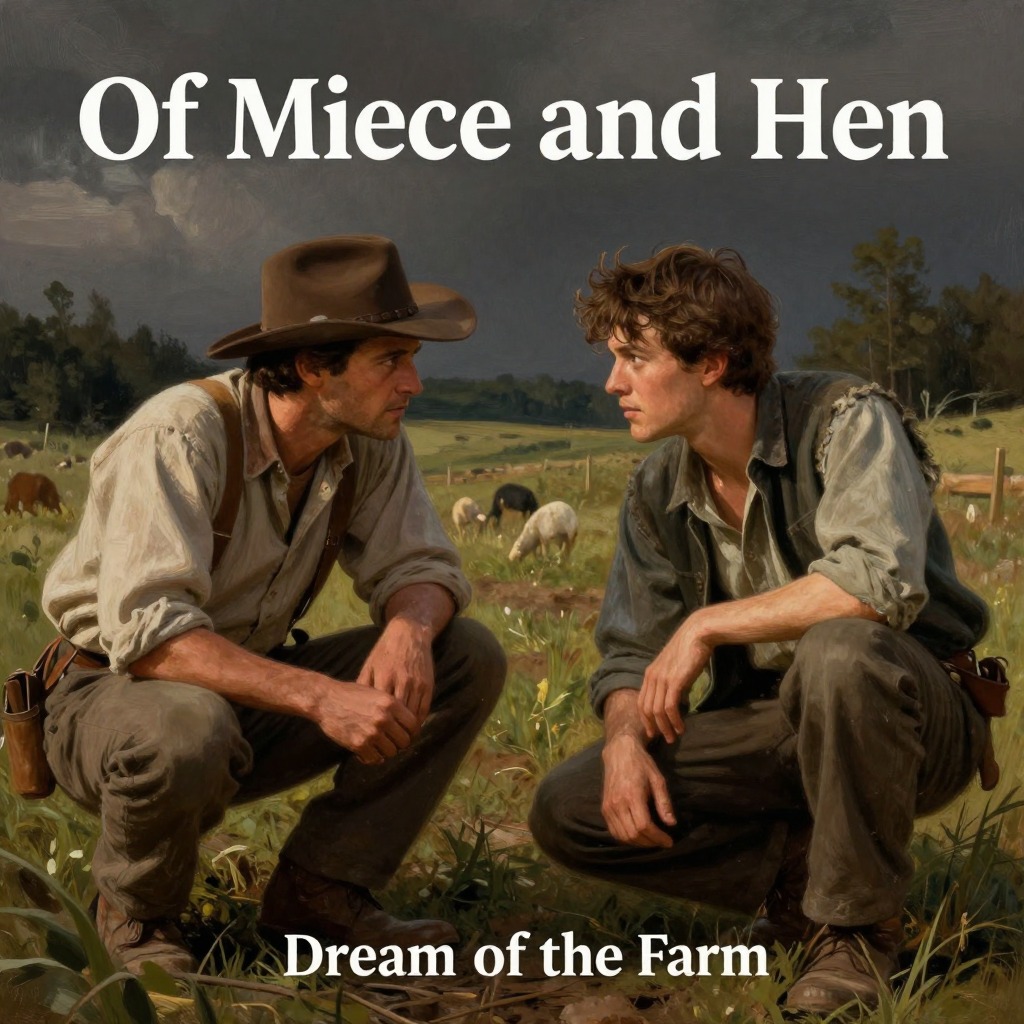
The little place is not a fully realized plan but a cherished fantasy, recited so often that its details have become a ritual. George describes it to Lennie as a place "down the flat" with a "little piece alfalfa," where they will have a cow, maybe a pig, and chickens. The most important detail, for Lennie, is the rabbits: "And I get to tend the rabbits," he shouts, and George repeats the promise back to him. The dream also includes living "on the fatta the lan'"—a phrase that evokes a life of abundance and self-sufficiency, a stark contrast to the meager wages and transient existence of the ranch hands. The dream is always spoken of as something to be done "soon," a future that feels both tantalizingly close and perpetually out of reach.
The Dream as a Bond Against Loneliness
The little place is more than a farm; it is the foundation of George and Lennie's unique bond. In a world where "guys like us got no fambly" and "they ain't got nobody in the worl' that gives a hoot in hell about 'em," George and Lennie have each other. The dream gives their partnership a purpose and a destination. Lennie, in his final moments, insists on hearing the story again, and George recites it not with hope but with a hollow, wooden monotony, as if the dream has already died. The recitation becomes a final act of love, a way to give Lennie a moment of peace before the inevitable. The dream is what makes them different from the other lonely men; it is the proof that "we got each other."
The Dream's Destruction and Final Recitation
The little place is finally destroyed not by external forces but by the tragic consequences of Lennie's own actions. After Lennie has killed Curley's wife, the dream is impossible. George knows that the lynch mob will not stop, and that he must be the one to end Lennie's life. In the clearing by the Salinas River, as the sun sets and the shouts of the approaching men grow closer, George gives Lennie one last recitation of the dream. He tells Lennie to look across the river "like you can almost see the place," and describes the cow, the pig, the chickens, and the alfalfa. Lennie, giggling with happiness, asks, "An' live on the fatta the lan'?" and George answers, "Yes." As he speaks, George brings out Carlson's Luger, snaps off the safety, and steadies the gun behind Lennie's head. The dream is the last thing Lennie hears before George pulls the trigger. The shot that kills Lennie also kills the dream, and George is left sitting on the bank, looking at his right hand that had thrown the gun away.
Thematic Significance: The Dream as an Unattainable Promise
The little place functions as a powerful symbol of the American Dream—the promise that hard work and loyalty can lead to a better life. Yet the novel systematically shows that this promise is a lie for men like George and Lennie. The dream is always deferred, always "soon," and it is finally destroyed by the very violence and loneliness it was meant to escape. The little place is not a real possibility but a fantasy that keeps the men going, a story they tell themselves to endure their brutal reality. Its loss is not just a personal tragedy but a commentary on the impossibility of the dream for the dispossessed and the powerless. The final image of George walking away with Slim, leaving the dream and Lennie behind, underscores the novel's bleak vision: in this world, there is no little place, only the endless road and the next job.