water snake
Of Mice and MenThe water snake is a minor but symbolically charged creature that appears in the novel's opening description of the Salinas River pool, where it enacts a miniature drama of predation and survival that mirrors the larger human tragedy to come. Its two brief appearances—first as prey, then as a survivor—establish the pool as a space governed by the same impersonal, cyclical laws of violence that will ultimately claim Lennie Small's life in the same location.
Appearance and Predation
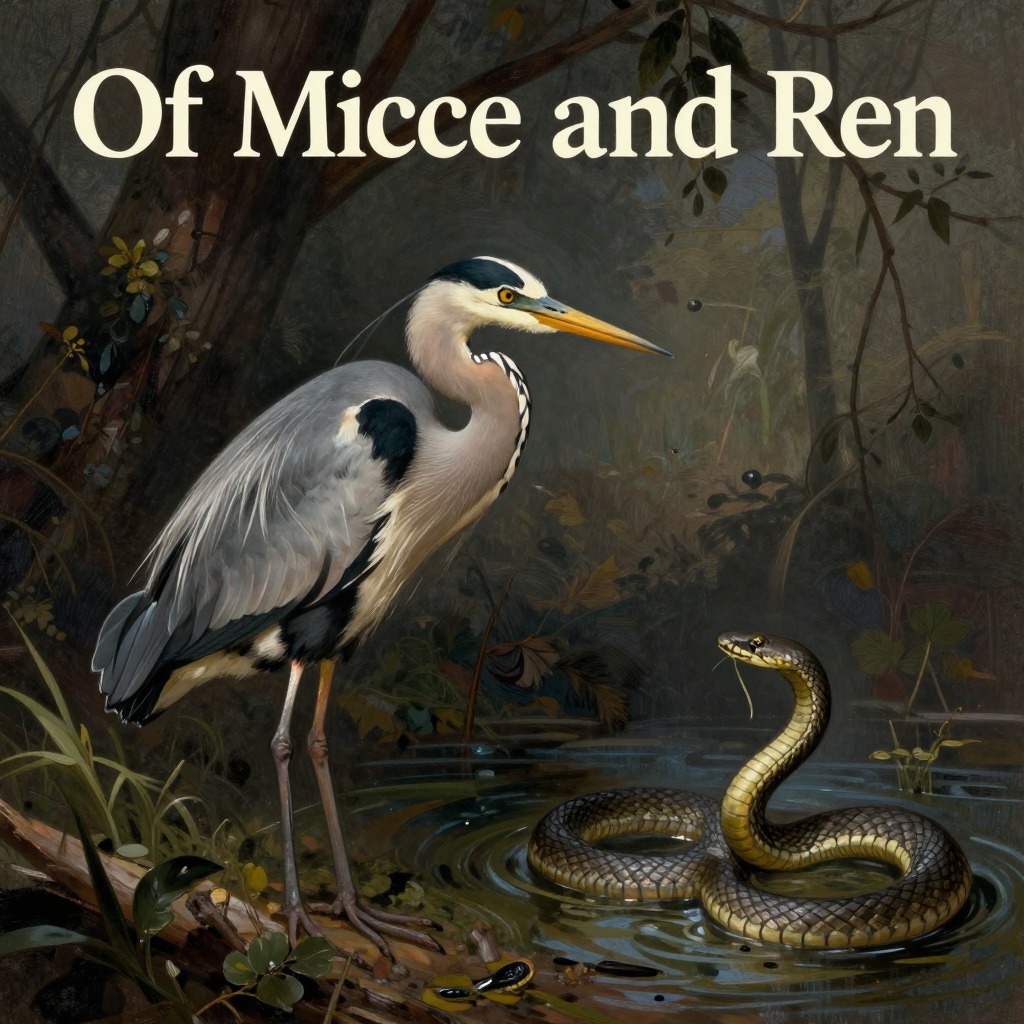
In the late afternoon stillness of the Salinas River valley, a water snake glides smoothly up the green pool, twisting its periscope head from side to side as it swims. The snake travels the full length of the pool until it reaches the legs of a motionless heron standing in the shallows. Without warning, the heron's silent head and beak lance down, pluck the snake out by the head, and swallow it while the snake's tail waves frantically. The scene is observed with detached, almost documentary precision: the snake's movement is graceful, the heron's strike is instantaneous and efficient, and the death is swift and unremarkable.
Return and Retreat
After a gust of wind passes through the clearing, stirring the sycamore leaves and sending ripples across the pool's surface, the wind dies as quickly as it came, and the clearing falls quiet again. The heron remains motionless and waiting in the shallows. A second little water snake swims up the pool, again turning its periscope head from side to side, repeating the same pattern of movement as its predecessor. This time, however, the snake's fate is different: when Lennie Small emerges silently from the brush, moving like a creeping bear, the heron pounds the air with its wings, lifts itself clear of the water, and flies off downriver. The little snake slides in among the reeds at the pool's side and escapes. The snake's survival is contingent on the same disturbance—Lennie's arrival—that will later bring George Milton to the same spot to end Lennie's life.
Narrative Significance
The water snake's paired appearances form a diptych that frames the pool as a place of both violent death and narrow escape, establishing a natural order in which predation is constant but outcomes are not predetermined. The first snake dies; the second lives, but only because a larger disruption intervenes. This pattern of repetition with variation—two snakes, two outcomes—echoes the novel's central relationship between Lennie and George, in which a familiar cycle of trouble and flight is broken only by a final, irreversible act. The snake's periscope head, described identically in both appearances, becomes a small recurring motif that links the pool's animal life to the human drama: like the snake, Lennie will be killed at the water's edge, and like the second snake, George will be the one who survives to walk away. The water snake thus functions as a natural emblem of the novel's governing themes—the precariousness of life, the indifference of the environment, and the way violence can arrive without warning, whether from a heron's beak or a friend's hand.