Ainhoa Church Cemetery
Ofrenda a la tormentaAinhoa Church Cemetery encircles the church at the center of Ainhoa, a place where burial grounds are woven into the village rather than screened off from it. Its crowded family plots, carved stones, and visible tombs make it both a distinctive local landmark and the setting for an unresolved question about whether Yolanda Berrueta’s children were still where their coffins had been laid. What first appears to be a place of settled memory becomes, as the investigation proceeds, a difficult boundary between testimony, grief, and physical proof.
Setting and Arrangement
Ainhoa lies just across the French border at Dantxarinea, in the Basque territory of Labourd. The settlement was built in the thirteenth century along a border route of the Way of Saint James connecting with Baztán; like Elizondo, it was conceived as a place of passage and welcome for pilgrims. The cemetery occupies a small rise around the church dedicated to Our Lady of the Assumption. It is among the features that most decisively define the village: from the street, shops, and cafés, the tombs and crosses remain in view.
Burials around the church began around the sixteenth century, when a settled population and the deaths of passing pilgrims made a cemetery necessary. Its galleries were laid out so that each household had a sepulchral stone beside its neighbors’. The graves are so closely packed that reaching some of them requires stepping over other tombs. The many disk-shaped steles carry geometric designs, Basque crosses, suns, and representations of the dead people’s occupations; the most elaborate recount a life from birth to death. With no enclosing wall to divide the churchyard from the living village, everyday movement and the presence of the dead share the same open space.
The Tremond Family Tomb
During the investigators’ visit, the church was dark, cold, and quiet, with only a man and a woman seated in the front row. After circling the cemetery, Amaia Salazar and her colleagues found the Trémouin Family Tomb. It was covered with flowers, mostly white, the customary color for very young children. The inscriptions did not include the children’s names. To reach the tomb, Iriarte had to step across neighboring graves, a breach of respect that Amaia explained was unavoidable in a cemetery where some plots could not otherwise be approached.
Jonan Etxaide moved several bouquets aside to inspect the stone. From a short distance he noticed that the slab seemed to tilt. Amaia initially treated the apparent angle as an optical effect, but the stone itself supplied a more concrete clue: old sandstone had crumbled where pressure from a lever had been applied. Running her fingers over the edge, she found the gap and the clearer gouge left by the attempted levering. The mark did not establish who had tried to force the tomb or what was inside, but it made the question of access material rather than merely speculative.
Yolanda’s Claim and the Church’s Account
A priest who knew the family described Yolanda’s repeated visits. Each week, he said, she came trying to persuade him that her children were not in the tomb and that, as their mother, she could feel their bodies had been taken. He understood the force of maternal grief but did not accept her conclusion: he had officiated at the funeral and witnessed the coffins being lowered into the grave. Asked whether Yolanda had once tried to open it, he assented gravely. His account established what he had seen at the burial and what Yolanda continued to believe, but it could not by itself verify the children’s later whereabouts.
The cemetery consequently held two competing forms of testimony. The priest’s recollection supported the ordinary account of a funeral and burial; Yolanda’s certainty, initially entangled with the effects of grief and medication, insisted that the bodies were gone. The investigators could not resolve that conflict simply by reading the names on a stone, since the children’s names were absent from the inscription they examined. The crowded layout also made the family tomb physically difficult to reach, adding a practical complication to any inspection.
Restricted Inspection and Its Interruption
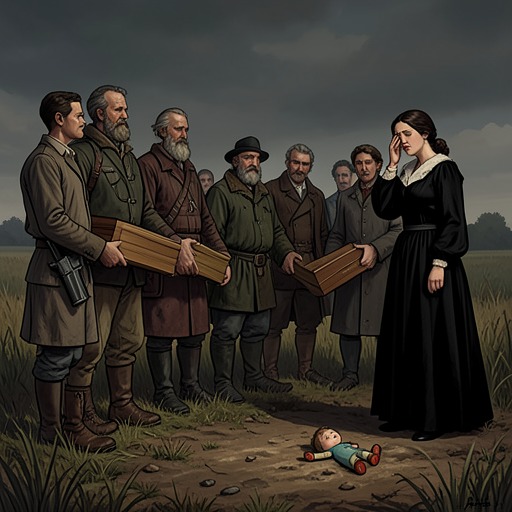
Jueza De Gouvenain’s order allowed only a narrowly defined inspection: the slab could be removed, investigators could descend into the tomb and open the children’s coffins to check whether the bodies were present, but the bodies could not be removed or handled. Yolanda was permitted to look down from above. The French National Gendarmerie and two patrols accompanied the operation to enforce those limits. Before it began, the priest supported Yolanda as she leaned against his shoulder, distressed but composed.
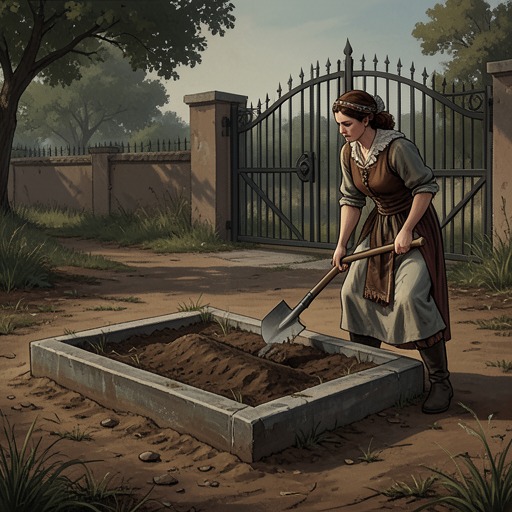
Rain had darkened the porous stone and brought out the moss and lichens on the tombs. When the workers returned with a crane, they spent another fifteen minutes positioning its supports on the cemetery’s uneven ground. They threaded lifting straps beneath the slab and began to raise it. The chief gendarme then ran toward them, phone at his ear, and ordered them to stop. The inspection was interrupted before the evidence inside the coffins could be checked; the carefully delimited order therefore did not produce the confirmation Yolanda had sought.
Aftermath and Investigative Significance
Yolanda later told Amaia that she had confused the coffins while frightened and affected by medication, but maintained that her central belief had been right: her baby’s body had been stolen. She also recognized the consequence of the failed inspection. Had she been able to confirm that her children were present, the missing child from another family might have remained undiscovered, and the bereaved mother in Elizondo might not have been heard. The cemetery thus becomes more than the setting of a disputed burial. Its interruption leaves an uncertainty that helps bring a wider pattern of missing infant remains into view.
That investigation also depends on how places are entered onto maps. When Amaia replotted the investigated deaths, Jonan’s files included Amaia’s sister but omitted Yolanda Berrueta’s children; Amaia likewise left Ainhoa out of the comparison that revealed a line of cases following the Baztán River. Ainhoa’s exclusion was a feature of that particular pattern-making exercise, not proof that the cemetery or its family tomb was irrelevant. The distinction matters: a map can disclose a relationship among recorded cases, while an unverified grave demands a different kind of evidence. At Ainhoa, the visible scar in the sandstone, the remembered funeral, and Yolanda’s insistence remain separate pieces of a story whose decisive physical check was stopped at the moment the slab began to rise.