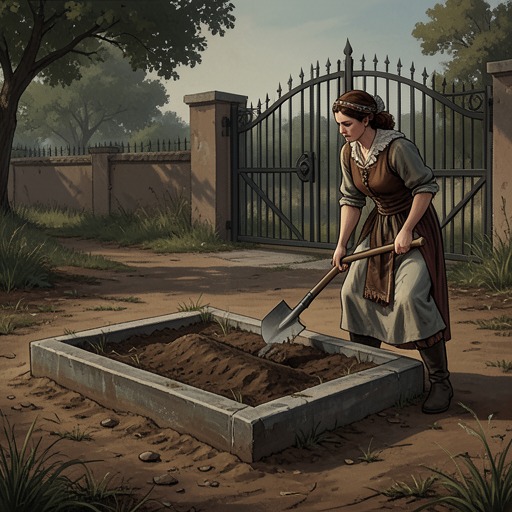
Ainhoa Family Cemetery
Ofrenda a la tormentaAinhoa Family Cemetery becomes more than the setting for mourning: its opened graves expose that the remains of Yolanda Berrueta and Marcel Tremond’s children do not match what their family and community had been told. The cemetery’s tombs hold both the visible evidence of the twins’ burials and the unsettling proof that another child’s body was replaced by a bag of sugar.
Setting and Burial
The cemetery is where the Tremond-Berrueta family’s children were laid to rest. A priest who knew the family said he had officiated at the funeral and watched the coffins lowered into the grave. He also described Yolanda returning every week, convinced that her children were not there and that someone had taken their bodies. He understood the force of a mother’s grief but did not endorse her claim: in his account, the funeral and burial were witnessed facts, set against Yolanda’s persistent certainty.
That divide gives the cemetery its importance in the investigation. For the priest, it appeared to certify the deaths and settle where the children lay. For Yolanda, the graves remained a source of doubt. The later examination shows that her distress cannot be dismissed simply because the funeral took place and the graves were closed.
The Graves Examined
Jonan Etxaide’s photographs of the children’s tomb record more than twenty-five views of its interior and details. They show the coffins identified by the initials D. T. B. and M. T. B., for Didier Tremond Berrueta and Martín Tremond Berrueta. The images also draw attention to a separate metal coffin intended for ashes, which lay overturned and open. Its initials were H. T. B., and part of a bag inside it bore a blue-and-red logo.
When investigators later opened a grave at the cemetery, they lifted the stone slab with steel bars and a lever, rolled it aside, and directed their torches into the opening. A ladder was lowered so the gravedigger could descend. Inside were two old coffins and a child’s coffin; when the gravedigger looked into the child’s coffin, it was empty. The discovery gave material force to the fear voiced by the family: the grave did not contain the child they had expected to find there.
The Substitution Revealed
The photographs allowed Amaia Salazar to trace the suspicious bag to a more specific conclusion. Jonan had compared its visible logo with French food packaging, including bags of lentils, salt, flour, and sugar. The logo matched a one-kilogram sugar packet. What had been assumed to be ashes in the small coffin was therefore not human remains.
The missing remains belonged to Yolanda and Marcel’s first daughter, who had been born a year before the twins and died shortly after birth at Yolanda’s parents’ home in Oieregi. Yolanda’s father and the undertaker who arranged the wake and transfer to the cemetery were prepared to swear that the child had not been cremated and that her body had been placed in the coffin. The cemetery thus held evidence of two distinct losses: the twins’ burials and the disappearance of the earlier-born baby’s body.
Disruption and Significance
The grave’s disturbance did not lead to a clean inspection. Marcel arranged for its slab to be replaced the following morning. According to the priest, the Tremond family were so affected that they would not let the gravedigger descend to clear the rubble and lift the overturned coffins; they ordered the grave closed immediately. The act sealed the site again before its contents could be fully examined.
For Yolanda, the evidence changes the meaning of her weekly visits and her insistence that the bodies were missing. She later acknowledged that medication and confusion had led her to mistake the coffins, but maintained that the infant’s body had indeed been stolen. She feared that, had the twins’ burial been confirmed without noticing the missing child, she would have continued to be regarded as delusional—and another bereaved woman in Elizondo might not have been heard. Ainhoa Family Cemetery therefore functions as both a burial place and an evidentiary threshold: the closed graves had appeared to end the questions, while opening them revealed how much remained concealed.