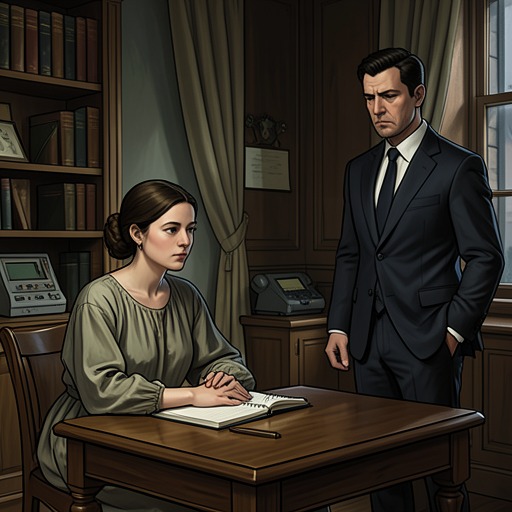
Amaia Salazar and James’s marriage
Ofrenda a la tormentaAmaia Salazar and James’s marriage is defined by genuine tenderness under pressure: they care for one another and their son, Ibai, yet Amaia’s work and buried family trauma repeatedly intrude on the private life they are trying to protect. Their conflict over a family funeral makes the strain explicit. James does not merely object to Amaia’s absence; he asks her to recognize that her sisters, too, need to grieve and move forward. The marriage is presented not as affection’s opposite, but as a relationship in which love cannot by itself settle competing needs or erase hurt.
A home built around care
At Engrasi’s house, Amaia comes in still wearing her coat and finds James with a book he is not reading, keeping watch over Ibai in a baby hammock on the sofa. She sits beside him and takes his hand, apologizing for arriving late because matters have become complicated. James accepts the apology and leans in to kiss her, though his response carries little conviction. The small domestic scene holds both sides of their marriage at once: the habitual closeness of a shared household and the fatigue that has begun to color their exchanges.
Their care for Ibai gives that domestic bond a physical, everyday form. Amaia notices James attending to the baby, while elsewhere she calms Ibai by rocking him and lies beside him as he touches her face and falls asleep. In one particularly intimate moment, the child’s quiet breathing brings her own tension down. These scenes show a family life sustained through practical attention and touch, even while the couple’s unspoken disagreements remain present around it.
The funeral dispute
The question of whether to attend a funeral turns private strain into a direct confrontation. James challenges Amaia for treating her own belief as decisive and asks her to consider what her sisters feel and their need to bring the episode to a close. He says he will attend the funeral and hopes she will go with him this time. Ros enters as the argument is unfolding, and Amaia leaves the room. The conflict is not simply about attendance: for James, the funeral matters as a step toward acknowledging other family members’ suffering, while Amaia’s resistance is bound up with her own fear and uncertainty.
After Amaia has gone, James turns to Engrasi and asks her not to encourage Amaia’s doubts or sustain her fear. He appeals to Engrasi because he believes Amaia will listen to her, and admits that he feels he is losing his wife. His plea gives the argument its cost: James is not speaking as a detached observer of Amaia’s distress, but as a husband who fears that it is pulling her away from him. At the same time, his appeal risks placing Engrasi between them, as he asks her to help Amaia move on in a way he cannot make happen himself.
Amaia understands that James had also been disappointed when she failed to accompany him to exhibit at the Guggenheim. They had discussed her absence, and she believes that if she had gone, Ibai might have died. Her sense of what was necessary therefore sits beside James’s disappointment rather than cancelling it. The scene exposes a painful asymmetry: Amaia can recognize why he was hurt, but the danger she associates with her choice makes that hurt difficult to resolve through understanding alone.
What they leave unsaid
Their strain persists beyond the argument. At dinner, after an afternoon spent buying clothes for Ibai, they choose wine and sit amid the busy, welcoming atmosphere of Santxotena. They have avoided talking about the funeral all afternoon, each aware that a difficult conversation remains and silently postponing it until they are alone. The pleasant public setting does not dissolve their private tension; it gives them room to defer it.
James asks about Amaia’s investigation, but she hesitates. Since becoming a police officer, she has kept the details of her work out of their home, unwilling to bring its darker realities into their shared life. She has also kept parts of her own childhood quiet, maintaining an appearance of normality. When that silence broke and her past nearly overwhelmed her, honesty with James became a breach in the wall of fear and a place where the two could meet. Their marriage thus depends partly on disclosure, but Amaia’s established habit of withholding makes openness difficult and uneven.
Strain, reassurance, and family plans
At another point, Amaia worries when James does not answer her calls. After bathing Ibai, she tries again, sends a message saying she is worried, and receives a brief reply that he is busy. When his car finally stops outside, she goes out to meet him and climbs into the passenger seat, still anxious. His understated assurance that he is there does not immediately answer the hurt behind her concern. When she asks about a meeting with representatives of the BNP, James asks whether she cares. Amaia lowers her voice and tells him how much he matters to her; his stern expression begins to soften. The exchange shows how quickly worry and resentment can overtake their communication, and how reassurance can restore some tenderness without resolving the underlying strain.
They also make plans around James’s family. He explains that his father needs a bypass operation after an early stage of arteriosclerosis and a coronary obstruction. The surgery is scheduled for the following Monday, and he expects his father to stop working afterward, something his mother had long hoped he would do. James proposes that Amaia and Ibai accompany him to visit his parents for four days after the funeral. His invitation places the marriage within a wider family life, with travel and shared care to be arranged around Amaia’s work and the funeral. It also underscores how many obligations press on them at once.
The bond and its limits
The marriage is neither presented as effortless nor reduced to its quarrels. James watches over Ibai, shares plans with Amaia, and asks her to consider the suffering of her sisters; Amaia reaches for his hand, worries when he is unreachable, and answers his doubt with an explicit expression of love. Yet the same scenes show the limits of mutual understanding. James can understand why Amaia missed his exhibition without being able simply to accept the loss, while Amaia can hear his wish for family closure without being able to set aside the fear behind her own resistance.
The relationship’s central tension lies in how love is asked to accommodate different forms of pain. James fears that Amaia’s unresolved past and relentless demands are taking her away from him. Amaia’s attachment to the habits that once helped preserve her sanity makes change feel both necessary and dangerous. Their exchanges therefore move between caretaking and accusation, tenderness and postponement. The evidence offers no easy resolution: instead, it shows a marriage still bound by affection, but increasingly required to make room for grief, family obligations, and the consequences of Amaia’s work.