Argi Beltz
Ofrenda a la tormentaArgi Beltz is a farmhouse in Orabidea whose changed appearance concealed its importance to Amaia Salazar’s investigation. Elena Ochoa had described it as the old house where a sectarian group once met; when Amaia found the property, it was a modern, secured mansion occupied by former members of that group. Its history, and the death of a baby associated with the household, made the isolated estate one point in a widening pattern of infant deaths around the Baztán River.
The Hidden Property
Amaia locates Argi Beltz while following Elena Ochoa’s account of the old meeting place. The house initially escapes her notice: a high, overgrown wall screens the frontage, leaving only a cast-iron mailbox painted green to blend in. A card inside names the Martínez Bayón family. Beyond the wall, a vine-covered fence leads to a modern entrance with a stone canopy, video intercom, and the badge of a security company. The estate’s name is carved into a timber beam, with a garage entrance nearby.
The name means black light, recalling Elena Ochoa’s description of a black house. Yet the property Amaia sees does not resemble that account: it is a recently built-looking mansion set in a broad, level meadow. Amaia considers whether the old building was demolished or substantially altered, and whether the land itself was reshaped. The discrepancy makes the location uncertain even as its setting seems to fit Elena’s description. When Amaia rings repeatedly, she hears a small click from the intercom despite no sign that anyone has answered. She leaves with the impression that she has been watched, and with no confirmation from the occupants.
The Earlier House and Its Residents
A photograph offered by the woman at Lau Haizeta helps establish that the modern estate occupies the site of the house Amaia seeks. The woman brings out an old cocoa tin filled with photographs and selects an image taken about fifty years earlier, when her parents rebuilt the farmhouse chimney after it was damaged by lightning. In the photograph, a worker in a txapela poses beside the large chimney; behind him stands an older farmhouse in a flat meadow. The image differs sharply from the guarded mansion but confirms the continuity of the site.
Elena Ochoa had placed the group’s activity in the late 1970s and early 1980s. Its members lived communally in a farmhouse in Orabidea and held cultural and spiritual gatherings that moved toward occultism. They sacrificed small animals, and the possibility of human sacrifice was raised. Elena left the group, which continued for a time. By the time Amaia investigates, the people living at Argi Beltz are a wealthy couple nearing retirement who belonged to the original group. A neighbor identifies Berasategui’s car at the property. The couple acknowledge knowing him but, when Amaia asks what connected them, hand her the card of the Lejarreta y Andía law firm rather than explain.
A Baby’s Death and the River Pattern
The couple’s history takes on greater weight when Amaia learns that they had a daughter who died as an infant. Their agitation when she asks about the child contrasts with their guarded response about Berasategui. Amaia treats the death as a troubling addition to the other cases, not as proof by itself, but the accumulation of infant deaths makes coincidence increasingly difficult to accept.
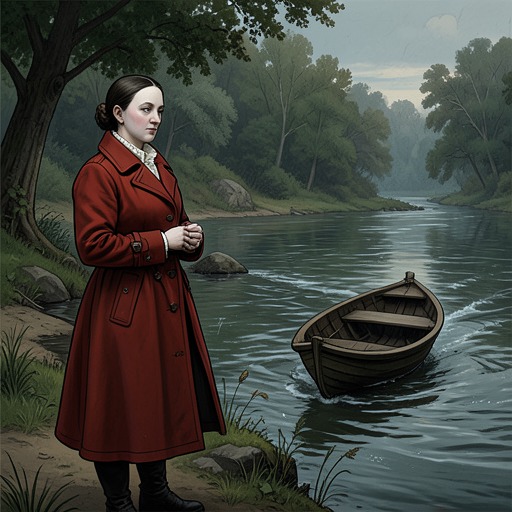
The investigation’s maps broaden the significance of Argi Beltz beyond the estate. Amaia’s files include the addresses of babies previously investigated, and she tests the plotted locations against roads and waterways. When she redraws the map, the distribution follows the course of the Baztán River rather than the nearby road. Later, the team adds older cases to a map tracing the river from its source toward its mouth, including the girl associated with Argi Beltz, Amaia’s sister, the girl from Lesaka, and other children. The marks form a disturbing chain through communities along the river and where it takes the name Bidasoa.
Significance
Argi Beltz brings together two kinds of concealment: a property whose old identity is hidden by reconstruction and security, and a history of communal occult practice that its former members will not openly discuss. The old photograph supplies a concrete link between the present mansion and the farmhouse Elena remembered; the couple’s evasiveness and the dead infant connect that local history to the investigation’s larger question of repeated child deaths. On the map, the estate’s associated case becomes part of a geographic pattern, turning a secluded house into one of the locations through which Amaia begins to see the river’s full, unsettling reach.