Discovery of a Pattern of Infant Deaths Along the Baztán–Bidasoa Rivers
Ofrenda a la tormentaThe discovery of a pattern of infant deaths along the Baztán–Bidasoa rivers turns scattered family tragedies into a connected investigative problem. When Amaia Salazar plots the victims’ towns rather than treating each death as an isolated case, the marks align with the river; recognizing that the waterway continues under another name beyond Navarra leads her to widen the search into Guipúzcoa. The map does not establish a cause or identify a perpetrator, but it gives the inquiry a new geography and a way to test its suspicions.
From separate files to a map
Amaia’s first map grows out of Jonan Etxaide’s case files. His scenario list contained addresses for babies whose deaths had already been investigated, and he had added Amaia’s twin sister while leaving out the children of Yolanda Berrueta. Amaia marks the towns on a map, includes her sister’s death in Elizondo, and initially avoids marking Ainhoa. The line made by the remaining points does not follow the N-121, as might be expected if a serial offender were using a major road to move between crime scenes. A new map, with the river’s fine blue trace visible, supplies a more persuasive alignment: the cases run from Erratzu through Elbete and Elizondo, continuing toward Oieregi.
The river also connects this discovery to earlier clues without making them conclusive. The remembered instruction to clean the river resonates with the mapped pattern, as do images of white flowers and empty coffins from Amaia’s dreams. She sees the cases alongside material on sacrificial practices and the dangers of Berasategui’s files. Those associations sharpen the question the map raises, but the spatial correspondence is a lead, not proof that every death has the same explanation.
A recurring profile—and its limits
When Amaia presents the developing map to her colleagues, she describes the cases as predominantly involving girls who died in infancy or very early childhood. The families were in poor financial circumstances when the children died; in the years that followed, every family identified in the profile experienced improved prosperity. In at least four cases, including those of the Berrueta family and Valentín Esparza, investigators knew that the parents had said at the time of the child’s death that things would be better from then on. These details give the investigation a behavioral and social profile to compare against the geography, while remaining circumstantial rather than proof of a shared act.
The cases themselves were not all equally established. For Esparza’s daughter, the forensic findings confirmed asphyxiation: the pressure mark on her face matched the nose of the teddy bear, and white fibers at her lips belonged to the toy. By contrast, investigators had no means to confirm their suspicion that Yolanda’s baby was missing from the family tomb, and a renewed judicial inspection of the grave was ruled out. Amaia’s map therefore gathered deaths supported by different kinds and degrees of evidence. Its force came from the recurrence of locations and circumstances, not from pretending that every entry had already been verified in the same way.
The river crosses the boundary
A crucial correction comes when Amaia revisits Jonan’s files on Nurse Hidalgo. Her employment history showed that she had worked as a midwife at hospitals and clinics in Irún and Hondarribia, including the Hospital Comarcal de Irún, Virgen de la Manzana, and Clínica Río Bidasoa. The latter name makes Amaia reconsider the map: the Baztán River is called the Bidasoa farther along its course, after leaving Navarra and entering Guipúzcoa, before reaching the Cantabrian Sea. The change of name had helped conceal the continuity of the route under investigation.
Amaia proposes that, if Nurse Hidalgo was involved in the practices and recruited parents, her activity might have extended to places where she had worked. She orders the search widened beyond infant deaths in Navarra to include Guipúzcoa, with particular attention to towns near the Bidasoa. This is framed as a hypothesis about the nurse’s possible reach, not as an established account of her conduct. The geographic correction matters because it prevents an administrative boundary—and a river’s change of name—from prematurely delimiting the inquiry.
A longer line of deaths
The expanded search produces a more specific set of cases. After reducing possible matches through baptism records, investigators identify deaths in Elizondo and Oronoz-Mugaire, one in Narbarte, two in Doneztebe, and two in Hondarribia. The baptism check is slow: researchers must identify each child’s parish and consult records held by individual priests. In Hondarribia, it reduces four initial cases to two; one excluded child was German and had died while her parents were on holiday, while another had been baptized.
Amaia then asks for older cases to be added in a different color, including the child associated with Argi Beltz, her own sister, the Lesaka child, the daughter of the lawyers Lejarreta and Andía in Elbete, and the child whose father confronted the forensic doctor in Erratzu. The resulting chain follows the watercourse from its source toward its mouth, through towns where it is known first as the Baztán and later as the Bidasoa. The pattern is no longer simply a cluster within one valley: it is a cross-regional sequence that can direct further record searches.
What the discovery changes
The map converts an intuition into a working investigative method. Amaia and her team can compare cases by location, age, sex, family circumstances, and relevant professional connections, while seeking records that may confirm or exclude individual entries. The map’s changing colors distinguish older cases from the current set; the parish inquiries and the search for historical records add checks that geography by itself cannot supply.
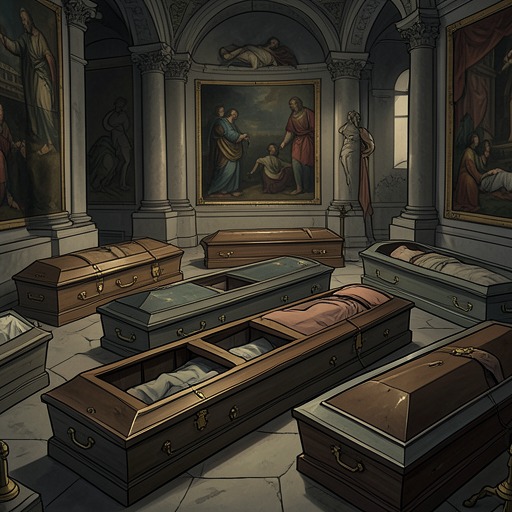
The discovery also gives renewed significance to accounts of missing bodies. Yolanda Berrueta had repeatedly insisted that her children were not in their grave; she later tells Amaia that although her own confusion and medication had led her to mix up the coffins, her conviction that her baby’s body had been stolen was right. She worries that, had the grave been opened and the other children found, nobody might ever have noticed the missing girl—or listened to another mother whose child was gone. Her statement makes the investigation’s pattern more than a distribution of deaths on paper, while leaving the evidence and circumstances of each family’s case to be established separately.