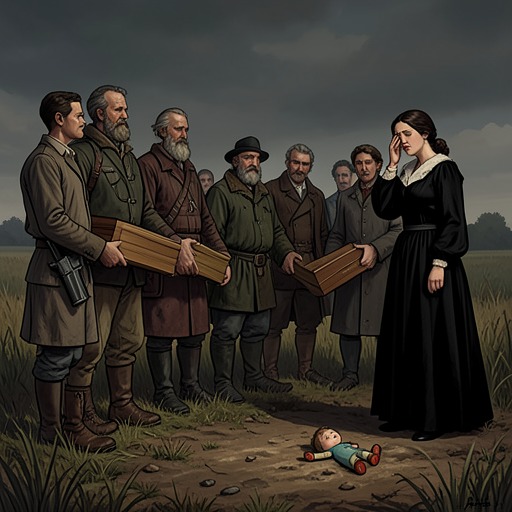
Discovery of the Sugar Bag in the Baby's Coffin
Ofrenda a la tormentaThe Discovery of the Sugar Bag in the Baby’s Coffin turns an overlooked detail in Jonan Etxaide’s photographs into evidence that a child’s body is missing. A bag that had been accepted as the remains of an infant’s cremation proves to be a sugar package; the discovery redirects the investigation from Yolanda Berrueta’s grief and suspicions to a concealed disappearance and a wider pattern of substituted burial contents.
The photographs and the clue
Amaia Salazar finds the evidence in Jonan Etxaide’s cloud files, which contain material gathered for several investigations. In the folder marked Ainhoa, she opens a sequence of photographs showing the interior of the family tomb at Ainhoa Church Cemetery. The pictures document the coffins of Yolanda Berrueta’s twin sons and a third, smaller coffin. Jonan has made more than twenty-five images, with close-ups that reveal the initials on the children’s coffins and details of the smaller one.
The third coffin is a metal casket intended for ashes. It appears overturned and open. A corner of a plastic bag is visible inside, and Jonan has enlarged the image until the blue-and-red edge of a logo can be examined. The color and placement make the bag look out of place among the expected contents of a burial. Rather than treating the image as an isolated oddity, Jonan has compared it with photographs of French food packaging: at least twelve containers of products including lentils, salt, flour, and sugar. In a further comparison, he places an enlargement of the bag’s corner beside a one-kilogram sugar package. The logos match.
That comparison changes what the small coffin means. Its contents are not a customary bag for human ashes, as investigators had assumed, but a food package for sugar. The discovery depends on the close attention given to an apparently minor object: Jonan’s photographs preserve the detail, and his comparisons make its identity legible to Amaia.
Identifying the missing child
At a police briefing, Amaia presents the photographs as evidence relevant to the homicide investigation, despite concerns about the proper handling of material from Jonan’s files. She explains that the tomb contained the twins’ coffins and a third small casket; the bag inside that casket was sugar packaging, not an ashes container. The coffin bears the initials H. T. B., identifying it with Haizea Tremond Berrueta.
Haizea was Yolanda and Marcel Tremond’s first daughter, born a year before the twins. She died shortly after birth at Yolanda’s parents’ home in Oieregi. Her death had been recorded as cot death. The identification of the sugar bag now conflicts with the family’s account of what happened to her body: the small coffin was supposed to contain it, yet the coffin holds a substitute instead.
Amaia adds testimony that makes the discrepancy harder to dismiss as a mistake in the photographs. Yolanda’s father and the funeral director who handled the wake and the transfer to Ainhoa Church Cemetery are prepared to swear that Haizea was not cremated and that her body was placed in the coffin. The bag therefore points not simply to an unusual burial container but to the absence of a body that witnesses say was there.
From suspicion to corroboration
Before presenting the clue, Amaia recognizes its significance through details from other cases. The bag recalls the gravel found in the coffin of her own sister and the bags of sugar Valentín Esparza had used to cover the bottom of his daughter’s coffin. It also brings back the question Yolanda had asked about why anyone would put sugar in a child’s coffin. What had seemed an inexplicable detail now joins separate instances in which ordinary materials stand in for expected remains.
The photographs also complicate the earlier dispute over Yolanda’s insistence that bodies had been removed from the tomb. A priest had told the investigators that she visited weekly, convinced that her children were not there; he had resisted encouraging her belief, saying that he had officiated at the funeral and watched the coffins lowered into the grave. The images establish that the twins were in their coffins, but they expose a different absence in the same tomb: the coffin for Haizea contains sugar, while witnesses say her body was placed there.
Yolanda later acknowledges that fear, confusion, and medication had led her to mistake the coffins, but maintains that she was right about her daughter’s body being stolen. She also explains the consequence of the interrupted tomb inquiry: confirming that the twins were present would not, by itself, have revealed that Haizea was missing. Her account reframes her repeated visits and insistence not as proof that every coffin was empty, but as an imperfect warning about a real absence.
Investigative and thematic significance
The sugar bag provides a material link between a particular family’s loss and the investigation into infant deaths and ritual sacrifice. In the group’s stated beliefs, children under two were considered to be in a transitional state and especially suitable as offerings; one witness describes the required victim as a girl under two who had not been baptized, and speaks of depriving her of air before yielding her body. These are the group’s ritual claims, not proof that the bag itself was part of a rite. What the photographs establish is more concrete: an infant’s coffin was used to conceal a substitution, and the child whose remains it was meant to hold was missing.
The clue also reveals how grief can be discounted when it arrives in a disordered form. Yolanda’s certainty had been treated as the product of mental illness, while the priest’s memories and the family’s funeral history seemed to settle the question. The photograph does not simply confirm her version wholesale: it distinguishes the twins’ presence from Haizea’s absence. That precision turns a suspected empty grave into an evidentiary lead, and makes the sugar package a small but decisive object in the search for the missing child and the people responsible.