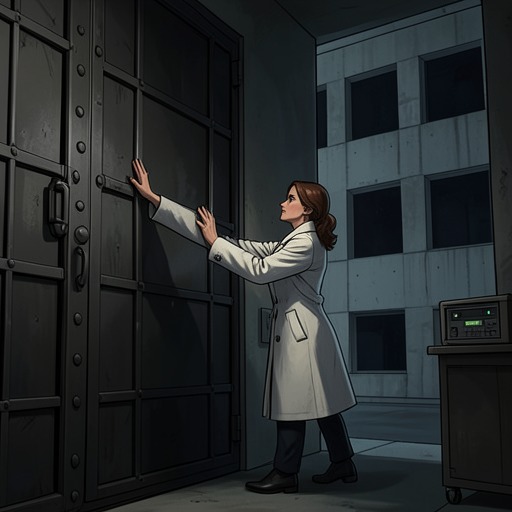
Dr. Hidalgo’s Private Medical Records
Ofrenda a la tormentaDr. Hidalgo’s Private Medical Records are a missing body of private medical files central to Amaia Salazar’s effort to test whether the same midwife and doctor had been involved in several suspicious infant deaths. Their importance lies not in any evidence the surviving pages disclose, but in the records’ potential to establish who attended births and deaths—and in the destruction that prevented the investigators from checking that possibility.
Identity and Scope
The files were associated with Fina Hidalgo’s brother, a rural doctor who had served as a family physician to many people in the valley. Fina, his sister, had worked as his nurse for years and later continued to practise privately. The evidence does not disclose the complete contents or precise organization of the archive. At the house, however, the files were stored in cardboard boxes marked with dates, a format that suggested a chronological record but did not itself establish what cases each box covered.
The records were distinct from official civil documents, hospital files, and death certificates. That distinction mattered because Amaia’s investigation depended on comparing sources with different origins: a birth certificate could establish that a birth had been registered, while a private doctor’s file might help establish who attended a birth or what medical care followed. The absence of one record could not, by itself, prove that an event had never occurred; the files’ value was in the possibility of corroboration.
Why Amaia Wanted Access
Amaia’s suspicion grew from overlapping professional and family connections. Fina Hidalgo had attended Amaia’s mother when Amaia was born and when Amaia’s twin sister died. Fina’s brother had signed the death certificate. Fina had also, according to Amaia, tried to attend the birth of Valentín Esparza’s daughter, and Amaia suspected she had been present at other cases under investigation. These links made the private files a possible way to check attendance against the circumstances of individual births and deaths, rather than relying on an inference from Fina’s professional history alone.
The certificate for Ainara Martínez Bayón illustrated the difference between a documented fact and an unresolved gap. It recorded her birth in Elizondo on 12 March 1979, identifying the home birth at Argi Beltz in Orabidea, and bore the rural doctor’s signature. Amaia’s team could not find a death certificate for Ainara. Searches in Britain had found no hospital record of her death and no autopsy record; the family register also contained no death entry. Those absences sharpened the questions surrounding the case, but they were not a substitute for the private files Amaia wanted to examine. She needed access to those files, as well as relevant death records, before she could establish whether Fina had been present in the cases she suspected.
The Search and Destruction
Amaia obtained a search order and led a team to the doctor’s house in Irurita early in the morning. Fina was already awake and opened the door at once, smiling as the team arrived. She accepted the printed order and directed the officers to the office her brother had used. Amaia immediately noticed that the welcome did not resemble the surprise she had expected: Fina appeared prepared for the search, though Amaia had no proof that the files had been moved or destroyed in anticipation of it.
The office still looked as it had when the doctor used it. The dated cardboard boxes were on the table, but they were empty, and their lids had been thrown onto the floor in haste. Fina said that her brother had kept the papers for sentimental reasons and that she too had held onto them as a memento. She explained that somebody had recently reminded her the boxes existed, and that she had finally decided to clear the dusty room the day before the search. The timing left Amaia furious and suspicious, but Fina’s explanation remained an assertion, not proof of when or why the files had been destroyed.
Fina acknowledged that she had burned the papers. She gestured toward the office window, where smoke still rose from the remains of a bonfire in the back garden. Jonan Etxaide and Zabalza ran outside; although there were no visible flames, they stamped down the ashes in case embers remained. Etxaide then found several pieces that seemed sufficiently intact to collect. The fragments were treated with care: technicians separated the burned sheets layer by layer and protected them between sheets of plastic film, a process that took more than three hours.
What the Fragments Could—and Could Not—Show
The effort to recover the papers produced no usable account of their contents. The fire had damaged the material too severely, and the examination of the collected samples yielded nothing that could be read or reconstructed. Thus the search confirmed that the files had been destroyed and that fragments survived, but it did not recover a medical history, identify a patient, or prove that Fina had attended any particular birth or death.
The failed recovery left the investigation dependent on other sources. In the Esparza case, the forensic findings concerning the child’s death came from the autopsy and physical traces, not from Dr. Hidalgo’s files. The records might have supplied context or a means of checking professional involvement, but the available evidence does not establish that they contained a decisive confession, a complete register of cases, or any particular incriminating entry.
Evidentiary Significance
The archive’s destruction changed what the investigators could know. Before the search, the private records represented a potential line of verification linking a doctor and his nurse sister to cases that otherwise had to be assessed through certificates, forensic findings, and incomplete institutional histories. After the fire, that line could no longer be pursued through the surviving material. The distinction is important: the files’ absence and the discovery of their burned remains are evidence of destruction, not direct proof of the suspicion that had made the search necessary.
Fina’s account and the condition of the office also created a pointed contrast. She described the papers as dusty keepsakes cleared away during an overdue cleaning; the empty dated boxes, discarded lids, smoking bonfire, and discovery of a few recoverable fragments made the destruction concrete without revealing its motive. The records therefore remain significant as an archive that might have answered questions but could not. Their loss marks the boundary between a pattern Amaia suspected and what the available documentation could actually demonstrate.