Fina Hidalgo
Ofrenda a la tormentaFina Hidalgo is a midwife whose professional reassurance and composed hospitality sit uneasily beside a remark that makes her a suspect in the investigation of suspicious infant deaths. Her claim that some families should be helped to escape the burden of raising children she considered unhealthy or abnormal turns the language of care into a potential justification for harm; when Amaia Salazar comes to search for records, the files are gone before the search begins.
Identity and Introduction
A woman recalling her own pregnancy remembered Fina as older but still very beautiful. Fina had told her that she had attended thousands of births, explained the procedure for a home delivery, and made her feel secure. The pregnancy, however, took a different course: the woman went into labor in her seventh month, and her premature baby was born in hospital. The account establishes Fina’s experience and her reassuring presence, while also placing her close to families at a vulnerable moment.
Suspicion and the Meaning of Care
Amaia’s suspicion centers on a conversation in which Fina said that, when children were not healthy or normal, families sometimes needed help getting rid of the burden of raising them. The statement is not presented as proof of a specific act, but it gives the investigation a troubling possible rationale: a claim to relieve suffering could conceal a judgment about whose life was worth sustaining. Amaia considers whether Fina might be an angel of death, a category associated in her explanation with medical or caregiving workers who believe they are performing a humanitarian service by killing vulnerable people. The connection remains an investigative hypothesis, not a confirmed identity.
The Search and the Missing Files
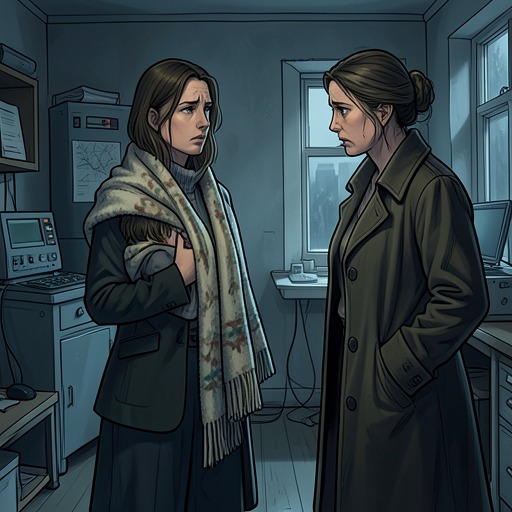
Before dawn, Amaia and the team set out for Irurita with a printed search warrant for Fina. The house showed no sign of activity, but its gate stood open. When the officers called, Fina opened the door immediately, dressed and smiling as though she had been waiting for them. She accepted the warrant, let the team enter, and pointed them toward the office they had come to search. Her calm cooperation only sharpened Amaia’s sense that the visit had not taken her by surprise.
The office still looked as it had when Fina’s brother used it: a distinctly masculine room, with dated cardboard boxes on the desk. The boxes were empty, and their lids had been thrown onto the floor in haste. Fina explained that the files had been stored there for ages, that her brother had kept them sentimentally, and that she too had retained them almost as a keepsake. She said someone had recently reminded her they existed, then offered a mundane account of the timing: the papers were dusty, and she had finally begun cleaning the office the day before, starting with that pile. Amaia was certain something was wrong and furious at the sense that Fina had been warned, but certainty was not proof. The empty boxes turned the search into a confrontation with absence: Fina had opened the door to the police, while the records they wanted were already missing.