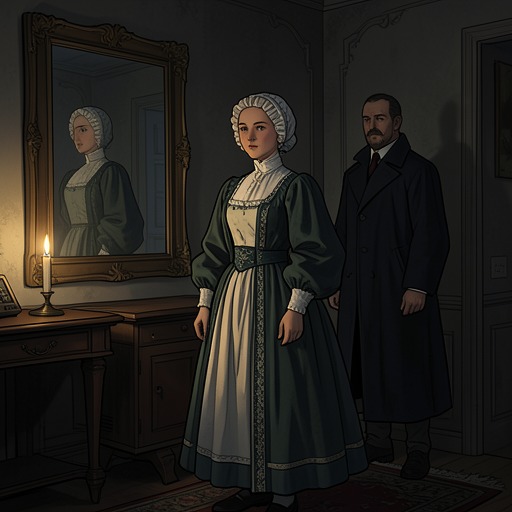
Flora Reveals Anne Is Her Daughter
Ofrenda a la tormentaFlora Reveals Anne Is Her Daughter is the disclosure in which Flora tells Amaia that Anne Arbizu was her biological child. The revelation recasts Flora’s long-hidden sorrow and her bond with Anne, while giving Amaia a new personal perspective on one of the victims in the Basajaun case.
The Disclosure
The truth emerges in Flora’s home, where Amaia has come to speak with her. Flora insists that she loved Anne as deeply as Amaia loves Ibai, then states that Anne was her daughter. Amaia is left speechless. The confession overturns the assumption that Flora’s feelings for Anne were those of an aunt or family friend: the intensity Amaia has seen was rooted in a relationship concealed for decades.
Flora explains that she became pregnant at eighteen. She had told her family she would spend a summer with their aunts in San Sebastián, but instead gave birth and relinquished the baby. The separation was not a simple, freely chosen adoption. Her mother required secrecy, forbade her from telling even her father, and described the child as one to be given away rather than adopted.
Pregnancy, Secrecy, and Separation
Before the birth, Flora tried to end the pregnancy by visiting a doctor across the border, at a time when abortion was prohibited throughout the country. The procedure caused severe bleeding and lasting injury: Flora says the doctor removed her ovaries and left her unable to have children, yet the pregnancy continued. Her mother took her to Nurse Hidalgo, who stopped the bleeding. Flora was told that she would not raise the baby and that the birth and the child’s placement would be handled for her.
At six months pregnant, Flora went to a charitable home run by religious women in Pamplona. She stayed there until the birth, then gave up the baby on the promise that she would go to a good family. She says she knew no group and met only Nurse Hidalgo; she did not ask further questions about what would happen. Her account therefore distinguishes what she understood at the time from what Amaia fears the word given might have meant.
After returning home, Flora resumed her relationship with Víctor and continued her life without discussing the child. Her mother never forgave her and made her pay for the secret. When Flora later heard that the Arbizu family had adopted a girl, she recognized Anne at once. From then on, she watched her daughter grow up in another household while concealing that she was her mother, a silence that kept Flora emotionally bound to the place where Anne lived.
Anne and Flora’s Late Relationship
The secrecy changed only when Anne sought Flora out at the bakery the previous year. Anne had investigated until she discovered who Flora was and understood their relationship. She did not reproach her birth mother. Instead, she asked to remain in contact without hurting the feelings of her elderly adoptive parents, and proposed that the truth could be made public after they had died.
Anne gave Flora a photograph of herself as a baby. Its resemblance to Ibai is so striking that Amaia had mistaken the picture for one of her own son. For Flora, the photograph holds both the brief closeness she had finally found with Anne and the years of separation that preceded it. She describes Anne as beautiful, self-assured, and intelligent, and says that the short period in which they were able to know one another brought her a happiness she had never imagined.
That happiness makes the news of Anne’s murder devastatingly personal. Flora says that the man who killed Anne killed her child. Her grief, previously held behind reserve, comes openly into view as she confesses; she no longer seems concerned that her sister can see her crying. The disclosure thus reveals not only Anne’s parentage but the cost of the silence that had governed Flora’s life and the brief reconciliation that made the loss newly immediate.
Aftermath and the Basajaun Case
Amaia leaves Flora’s home unsettled. She doubts that Flora and Ros have suddenly become united without an explanation, but has no way to prove her suspicion. Rather than let that uncertainty end the night, she goes to the police station and reopens the Basajaun case files, arranging photographs of the crime scenes, victims, and autopsies on the board.
The disclosure changes the emotional frame through which Amaia studies Anne’s murder, but the investigation also places the killings beside the secret group’s beliefs about sacrifice. A witness had described children under two as being in a transitional state and therefore especially suitable as offerings; the group’s reported rules also required an unbaptized girl. Amaia recalls that testimony while reconsidering the crimes against the older girls. In those murders, the killer strangled his victims with a thin cord, carried them to the Baztán River, tore their clothes, shaved their pubic hair, arranged their hair in two halves, and positioned their open palms upward. The staging returned the victims symbolically to childhood and innocence. The connection lies in the ritual language of purity and offering, not in evidence that Anne’s birth or Flora’s relinquishment made her part of the group’s infant-sacrifice practice.