Jonan's Scheduled Email
Ofrenda a la tormentaJonan Etxaide’s scheduled email reaches Amaia Salazar after he has died and been cremated, then guides her into a cloud archive assembled from investigative material. The message explains nothing; its timing, the password puzzle, and the files themselves turn Jonan’s absence into an active presence in the investigation.
Discovery and timing
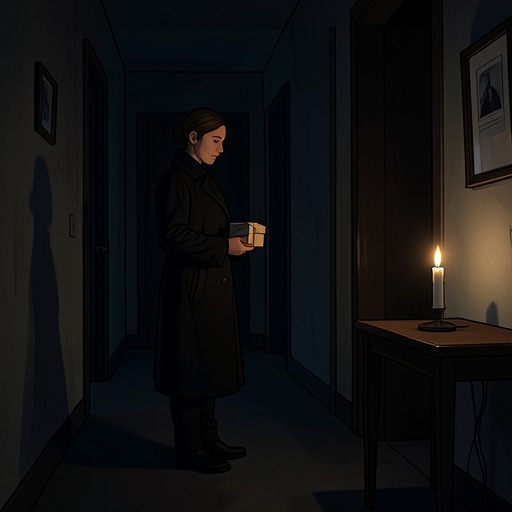
Amaia finds the message when she returns home to change clothes and notices that her computer is still running. She had left it on after using it to consult maps. On the desktop, a blue envelope marks new mail in an old account she rarely used. Her official work correspondence went to her Interior account at the police station, while she usually checked personal mail through Gmail on her phone. Apart from James, her sisters, and a few university friends, she doubts anyone knows the old address.
The sender is Jonan, from whom she has never received email at that account. The date makes the message more unsettling: it was sent two days earlier, in the afternoon, at the time of the funeral. Jonan had already been dead for more than twenty-four hours and cremated. The email therefore arrives as a communication sent from beyond the point at which an ordinary exchange with him is possible, but its timing offers no explanation of what he intended her to find.
The access puzzle
The message presents itself as an invitation to shared documents and images. Its title is obscured, and access requires an account name and a key. Two empty fields leave Amaia with no immediate clue. She stares at the blinking cursor, her heart racing, her mouth dry, and a tremor spreading from the finger poised over the mouse. She goes to the kitchen for cold water, returns, and rereads the short message, hoping that repetition will disclose something she missed.
She enters amaiasalazariturzaeta@gmail.com as the account name. For the key, a memory of Marc supplies the word Ofrenda, but not the number that must accompany it. Amaia considers Jonan’s phone number, rejects it as too obvious, and tests a run of zeros until the field reaches its four-digit limit. She then calls Iriarte to ask for Jonan’s number. His answer is 1269. Amaia adds that number after Ofrenda and submits the key; the drive opens.
This sequence makes access depend on fragments held in different places: the old email account, the remembered word from Marc, and a number Amaia must obtain from Iriarte. The email does not explain the combination or describe the archive in a personal note. Instead, the act of finding and assembling the credentials becomes Amaia’s first work on the message, before she has seen what Jonan left.
What the drive contains
There is no explanatory text inside the drive, only about a dozen folders arranged alphabetically. Their titles include Ainhoa, Escenarios, Berasategui, Hidalgo, and Salazar. Amaia opens folders at random. The material has no readily recognizable arrangement, and its grouping suggests that the cloud drive served as a backup rather than as a carefully ordered report. Among the contents she finds a search warrant for nurse Hidalgo’s house, an audio recording of Yolanda Berrueta’s statement at the police station, and the nurse’s employment record. The archive ranges across documents, images, and recorded testimony without supplying a guide to their connections.
The folder titled Markina contains photographs of Amaia with Judge Markina on the esplanade outside the Baluarte auditorium. Their presence in Jonan’s archive makes the folder more than a label: it shows that he had collected images of Amaia alongside the files relating to the investigation. Faced with those photographs, she whispers a question to Jonan, but the drive offers no answer in return.
The Ainhoa photographs and the unfinished message
The Ainhoa folder opens onto photographs of the interior of the tomb of Yolanda Berrueta’s children, including close enlargements of particular details. Amaia sees the tiny hands of one baby protruding from a box and the hypnotic, completely blackened face of the other. Jonan has taken more than twenty-five photographs, concentrating especially on a metal casket intended to hold ashes. It is lying overturned and completely open.
The photographs also show the initials on the children’s coffins: D. T. B., for Didier Tremond Berrueta, and M. T. B., for Martín Tremond Berrueta. Jonan has enlarged and rotated the initials on the open metal casket so they can be read: H. T. B. He has also enlarged a visible corner of a bag, though the account of Amaia’s inspection breaks off before identifying what it contains. The images preserve not just the tomb’s overall appearance but the minute evidence Jonan chose to isolate.
The email’s significance lies in this transfer from a dead investigator to a living colleague: not a conclusion, but access to a body of evidence. Its blankness forces Amaia to read the archive through its labels, contents, and photographic attention. The message thus extends Jonan’s work while leaving its meaning unfinished; the casket’s initials and the fragment of a bag remain visual clues rather than an explanation supplied by their sender.