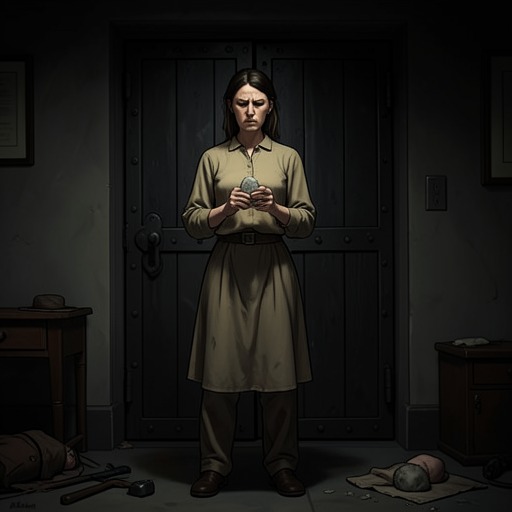
Markina
Ofrenda a la tormentaMarkina is a judge whose relationship with Amaia Salazar entwines professional authority with personal intimacy. He can authorize investigative steps, arrange the movement of a suspect, and defend the value of Amaia’s unorthodox methods; he can also rebuke her for ignoring his decisions. Later, evidence places him at a prison visit he appears not to have disclosed, making the judge who demands accountability an unresolved subject of scrutiny himself.
Identity and Professional Role
Markina enters the evidence as a judicial authority involved in active police investigations. At the scene of a child’s death, Amaia notices him standing a few paces behind the investigators beneath a black umbrella. He has apparently been informed by San Martín and watches silently while forensic work continues. As the relatives’ anger rises and the child’s mother cries out, Iriarte calls for the man to be removed. Markina intervenes with an immediate order: the man is to be transferred directly to Pamplona. Iriarte explains that a transport van cannot be secured at once and that the man will first go to the police station. Markina’s instruction establishes him as more than a distant judicial presence: he exercises authority over the investigation’s immediate handling, even when practical arrangements prevent his preferred course.
His manner is observant and controlled. Amaia registers the intensity in his eyes when he greets her at the scene, a brief exchange that leaves her looking to Iriarte and San Martín to see whether they noticed it too. The moment makes his official presence feel charged for her without displacing the public business around them: the technicians are packing evidence, Iriarte is monitoring the crowd, and the dead child’s family is demanding answers.
Authority, Trust, and Reprimand
Markina’s professional relationship with Amaia is founded on a qualified respect. In a private meeting, he tells her that since taking up his post he has accepted her methods because they produce results. He describes her as brilliant and recognizes that her colleagues, the prison director, and the forensic doctor tolerate procedures that unsettle them because she solves unusual cases. His criticism is therefore not a dismissal of her ability. It is a charge that she has treated his authority and the consequences of her decisions as obstacles to work around.
The conflict concerns Amaia’s decision to approach a French judge and open a tomb without first informing him. Markina has just authorized a search of Hidalgo’s files; he objects that the next thing he learned was that Amaia was in France conducting an exhumation. She replies that France is another jurisdiction and that she believed he would refuse permission. Markina counters that the result vindicates his caution. He focuses not only on her procedural breach but on its human cost: the family has been forced to relive the loss of its children, and a woman has lost four fingers and the sight of one eye. His anger is sharpened by the fact that he had warned Amaia about the suffering of mothers who lose children and had drawn on his own family experience in doing so.
The rebuke briefly changes the terms of their address. Markina first insists that Amaia stop speaking and listen, then emphasizes that he had told her about his family and his life. He returns to informal address only at the most personal point of the reprimand, making clear that his grievance is not solely institutional. Amaia admits that going to the French judge without consulting him was a mistake, while denying that she discounted his experience. She explains that she hoped to find a stronger investigative lead: two children had died simultaneously without autopsies, the husband was connected to Berasategui, his lawyers, and the house, and the woman’s account resembled others Amaia knew. The exchange leaves both positions intact: Amaia’s suspicion has a stated evidentiary basis, but Markina insists that a plausible lead does not erase the harm and responsibility created by her method.
The Prison Record and an Unresolved Contradiction
Markina’s authority and Amaia’s personal regard intersect again around Berasategui. After leaving the prison, Amaia moves several streets away before parking and calling Markina’s private phone, wary of the cameras around the prison. It is the first time she has called that number. He answers calmly, notes the novelty of the call, and listens as she explains that she has just interviewed Berasategui. Later, when Amaia is working at a grave, he interrupts her attempted explanation by ordering her to come to his office at nine the next morning. She has to check the screen to make sure he has ended the call.
A review of photographs in Jonan Etxaide’s Berasategui file later raises a problem. Some images show Markina in jeans and a blue shirt, speaking in the prison corridors with Amaia and San Martín. Other photographs show him alone in a suit. Amaia identifies the latter outfit as what he was wearing when she called him that morning to alert him to what had happened to Berasategui; the timestamp on one image reads noon. The prison director had said Markina telephoned to request Berasategui’s urgent transfer, but was out of the city, leaving the task to his deputy. That deputy had not mentioned seeing the judge at the prison. Yet a recording places Markina outside Berasategui’s cell.
The discrepancy changes the meaning of his earlier involvement without, on the evidence here, explaining it. The order to transfer Berasategui, the account that Markina was away, the deputy’s omission, and the recorded visit do not fit neatly together. Amaia leaves the prison with the contradiction in mind and heads back toward Baztán, thinking of the lies she has encountered. Markina’s role in the episode is consequently both procedural and suspicious: he is a judge with a documented presence near the cell, while the circumstances and purpose of that visit remain unstated.
Personal Closeness and Family
Outside official encounters, Markina approaches Amaia in a different register. After a funeral, she sees him briefly among the crowd. Later, as she leaves a building in the city, he appears by his car in jeans and a heavy sailor-style coat. She thinks he looks younger than he had at the funeral and waits while he crosses the pavement toward her. When she asks what he is doing there, he tells her that he has come to wait for her. The plainness of the answer contrasts with their careful formal exchanges at work and confirms that their connection extends beyond the cases they share.
That closeness does not eliminate strain or secrecy. Fifteen minutes after Amaia visits the clinic in Madrid where Markina’s mother is staying, he calls her. His voice conveys sadness and disappointment. He asks why she went to see his mother and says Amaia could have asked him whatever she wanted to know. Amaia silently notes the speed with which the clinic notified him, particularly after she had been given the impression that the people there did not know who paid the bills. The exchange makes his family life part of their relationship, but does not settle what he knows about the clinic’s arrangements or why Amaia chose to visit without speaking to him first.
Narrative Significance
Markina’s scenes repeatedly put personal knowledge beside formal authority. At the child’s death scene, his brief greeting reaches Amaia through the noise of a public tragedy; in the office, the judge’s procedural reprimand draws force from the family grief he has shared with her. The narrative thus gives his professional judgment an intimate basis without making that intimacy a guarantee that he is right. Amaia’s evidence-driven urgency and his insistence on procedure remain in tension, particularly when she acts across jurisdictional boundaries.
The prison photographs intensify that tension by turning official records into a test of Markina’s own account. The man who chastises Amaia for bypassing him is shown in a situation whose surrounding explanations conflict, while his personal closeness to her makes the discovery harder to treat as a merely administrative irregularity. The evidence establishes the contradiction, not its full explanation. Markina therefore occupies an unsettled position: trusted interlocutor, judicial superior, intimate presence, and a figure whose conduct in the Berasategui investigation demands further scrutiny.