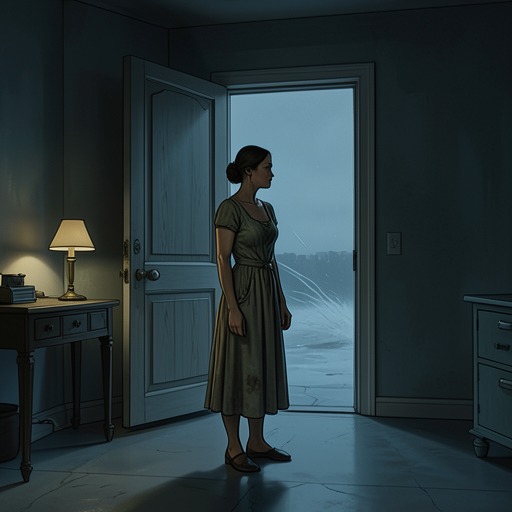
Night terrors and sleep-paralysis-like experiences
Ofrenda a la tormentaNight terrors and sleep-paralysis-like experiences are described as frightening episodes that can be understood both as stress-related parasomnia and through older supernatural beliefs. The novel brings these explanations into contact through reports of threatening presences, sleep-related breathing distress, and deaths that appear to repeat among particular groups. Neither framework simply erases the other: the clinical explanation accounts for the experiences, while the mythic one gives their recurrence a culturally charged form.
Clinical Explanation and Symptoms
Engrasi explains night terrors as a type of parasomnia originating in stress, through which severe suffering may emerge as terrible nightmares. She connects the subject to Amaia Salazar’s own history of nightmares and says that her earlier clinical work in Paris, followed by reading about Amaia’s experiences, led her to study the phenomenon closely. She also discusses severe anxiety disorders and the condition called Ephialtes, a Greek term meaning one who leaps upon another.
Reported experiences vary. They can include a presence in the room or a threatening figure looming over the bed; some people describe dark shapes or ghostlike shadows nearby. The most frightening accounts are tactile: the sufferer feels a visitor as physically present. Breathing-related hallucinations may add a sensation of choking or suffocation. The distinction between a perceived attack and its consequences is unsettled by the narrative’s examples of people who died during sleep, even while their experiences could be described as nightmares.
Mythic Interpretations
Alongside the scientific account, the conversation recalls ancient explanations that attribute such attacks to succubi, incubi, or Daimon: demonic spirits believed to torment people during sleep through visions or their mere presence. The local name that brings this tradition into Amaia Salazar’s investigation is Inguma, identified as the being that steals the breath of sleepers. The resemblance between the myth and the reported symptoms makes Inguma more than an isolated piece of folklore; it becomes a framework through which recurring infant deaths and other anomalies in the valley can be discussed.
Recurrence Across Cultures
Amaia Salazar relates that an expert, Father Sarasola, described comparable demons in multiple religious and cultural traditions, including Sumerian demonology and accounts from Africa, the United States, Japan, Nigeria, and the Philippines. In the account she conveys, the cases share a pattern: deaths recur during sleep within a particular geographic area and among a particular age and sex group. The comparison broadens the question beyond a single local legend, while leaving open how such similarities should be interpreted.
The conversation also refers to scientifically documented cases that prompted the Centers for Disease Control in Atlanta to issue an alert when unexplained deaths seemed to be spreading like an epidemic. Engrasi recalls viewing a recording made by the Japanese military after apparently healthy soldiers began dying in their sleep. The recorded men appeared to struggle against an unseen attacker pressing them against their beds. For Engrasi, the footage made the clinical explanation difficult to separate from the reality of the deaths: the episodes could be called nightmares, but the people experiencing them were dying.
Narrative Significance
The concept allows the novel to hold rational inquiry and inherited belief in the same frame. Engrasi gives the episodes a psychological and medical vocabulary, while the cross-cultural accounts and the figure of Inguma make their repeated pattern feel larger than an individual nightmare. Amaia Salazar’s lifelong experiences give that discussion personal stakes, and the possibility of real deaths prevents the clinical explanation from functioning as a complete resolution. The uncertainty is central: the story distinguishes what sufferers experience from how communities explain it, but refuses to make the fear disappear merely by naming it.