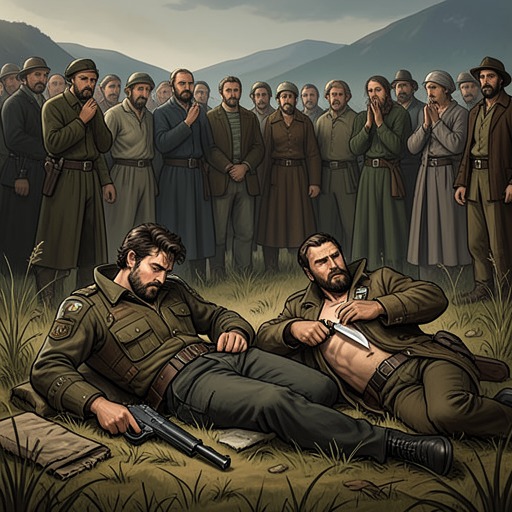
Pistol Used to Kill Jonan
Ofrenda a la tormentaJonan Etxaide’s pistol is more than the weapon used to kill him: its unexplained disappearance from a Madrid court becomes a lead in Amaia Salazar’s investigation, and its reappearance in Judge Markina’s hand at the crypt makes the case’s hidden connection physically undeniable. For much of the inquiry, the gun is absent from view but present as a question about custody, evidence, and who has been able to conceal the truth.
The weapon and the murder investigation
The pistol enters the investigation through a discrepancy at Jonan Etxaide’s apartment. Investigators found a single cartridge case there, although two shots had been fired. The mismatch leaves open a question not only about what happened but about how the weapon was used and what traces it might have left behind.
Reconsidering the scene, Amaia revisits a diagram on which Doctor Hernández had marked Jonan’s fatal wounds and proposed the trajectory of the shots. Amaia had rejected the theory that the shooter was seated. She now considers another possibility: the killer may have stood in front of Jonan and fired from inside a pocket or through the lining of a coat. In that reconstruction, the upward angle of the bullet and a portion of light fabric carried by the shot could help explain the evidence. This remains a newly plausible hypothesis, not a confirmed account of the shooting; its importance is that Amaia is again reading the physical details instead of treating her earlier conclusion as final.
The search for the gun’s origin
Amaia urgently asks for the specific court from which the weapon used to shoot Jonan disappeared. She directs the inquiry to obtain that information as soon as possible and suggests contacting Zabalza if help is needed. The question turns an absent pistol into a traceable object: if its disappearance can be located institutionally, the weapon’s history may intersect with the people under scrutiny.
The answer identifies the Penal Court Number One in Móstoles, Madrid. Iriarte already has the information and objects that Amaia did not call him, since he had previously told her about it. Zabalza explains why the court’s name catches his attention: while looking into the judge’s professional history, he found that Judge Markina had been assigned there. The matching connection is a lead, not by itself proof that Markina took the pistol or used it. Its force comes from the way it joins a missing weapon to a specific point in Markina’s past, giving the murder investigation a concrete line to pursue.
The pistol at the crypt
At the final confrontation, Markina raises a gun and points it at his own head. Amaia recognizes that it is Jonan’s pistol. The identification changes the scene: a weapon whose disappearance has driven an urgent inquiry is no longer an abstract item in a case file but an object held by the man she confronts.
Amaia has been weeping over Jonan’s death and has raised her own Glock toward Markina. The two stand only two metres apart. Before she can act, shots ring out from the entrance of the crypt. Markina is struck in the chest and falls beside her, his gray suit reddened by blood. Iriarte approaches with his weapon still smoking. Amaia takes Jonan’s pistol from Markina and tells Iriarte that Markina killed Jonan; Iriarte confirms her accusation with a nod. The weapon’s presence in Markina’s hand gives the confrontation its stark material force, even as the passage does not establish that the pistol itself was the gun fired by Iriarte in the crypt.
Evidence, custody, and consequence
The pistol’s narrative role depends on a sequence of different kinds of evidence: the single cartridge case against two shots, Amaia’s reconsideration of the shooting angle, the record of a gun disappearing from a named court, and her recognition of Jonan’s weapon in Markina’s possession. No one clue supplies the entire explanation. Together, they move the investigation from an unresolved forensic inconsistency toward a specific connection between the missing gun and Markina.
The object also brings the personal and procedural strands of the case into contact. Jonan’s death is not simply recalled through Amaia’s grief; his pistol returns in the hands of the man she accuses of killing him. After Markina falls, Amaia retrieves the gun rather than leaving it in the crypt. Its movement—from missing evidence, to the focus of an urgent search, to an object in the final confrontation—makes the question of who possesses it inseparable from the question of who can answer for Jonan’s death.