Ros Salazar
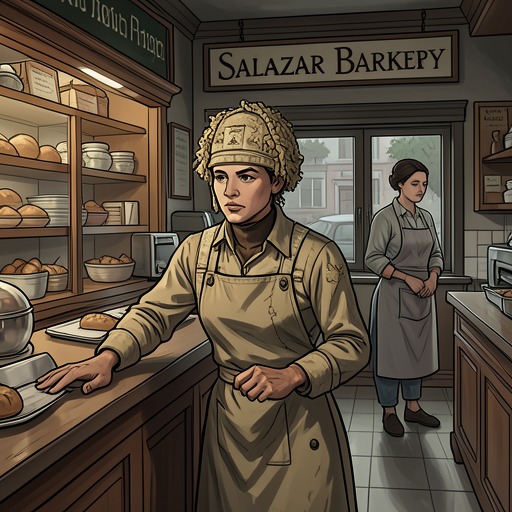
Ofrenda a la tormentaRos Salazar, the proprietor of the Salazar Bakery and sister to Amaia Salazar and Flora Salazar, is drawn with a life that extends beyond her family’s investigations. She longs to become a mother, lives alone after separating from her husband, and, in a late-night visit to the closed bakery, notices signs that Flora has been concealing something. Her careful attention to the office leads her to a safe hidden behind a picture, though what she learns from it remains unresolved in the evidence presented here.
Identity and Private Life
Ros has not smoked tobacco since she decided she wanted to be a mother, a choice that marks a lasting change in her habits. After separating from her husband, she has had only a couple of brief barroom encounters, and she sees little likelihood of meeting someone new in Elizondo. Her wish for a child nevertheless persists, increasingly often, even as she doubts that motherhood in her case will involve having a man beside her.
The account of her private routine complicates that resolve without undoing it: when her aunt has gone to bed, Ros sometimes rolls a joint, goes out under the pretext of getting air, and walks to the bakery. There, in the closed business she owns, she smokes alone after the workday has ended. The scene places her desire for motherhood beside a private ritual of solitude, away from the demands of customers and family.
Family and Loyalties
Ros’s loyalty to her family appears in her response to uncertainty about her mother’s fate. Amaia questions whether their mother can officially be considered dead, pointing to the circumstances of her disappearance and the clothes recovered from the river. Ros agrees that the family should move forward: she supports holding a funeral for their mother’s soul and closing that chapter. Her position contrasts with Amaia’s unresolved doubt, but the exchange presents it as a considered wish for an ending, not proof that Ros knows what happened.
Ros also shares the family’s bakery with the private business tensions surrounding Flora. One night she finds the bakery lit after closing and discovers Flora there, offering a pretext about a missing handbag before leaving. Ros is left with the impression that Flora has come to the office for a secret purpose and has lied about it. The encounter turns her attention from the excuse to the room itself.
The Bakery Discovery
Instead of following Flora, Ros returns to the office and studies its contents. She moves the swivel chair into the middle of the room, sits down, and smokes while turning slowly, as though the objects around her might disclose what had happened. Nearly an hour passes before she focuses on the market-scene picture she has often admired for its calm. This time, what catches her attention is not the scene but a heel mark Flora has left on the upholstery of the sofa beneath it.
Ros stands on the sofa, lifts the heavy frame, and finds a safe built into the wall. She already knows it is there: Flora had arranged for it to be installed years earlier, supposedly to keep cash for suppliers. Ros believes it should now be empty, since payments are made through bank accounts. She touches the safe’s dial but recognizes that trying it would be pointless; instead, she returns to the chair and spends the remaining hours of the night looking at it and turning over questions. The episode establishes Ros as observant and patient, but it does not establish that she opens the safe or discovers what it contains.
Narrative Role
Ros’s scenes give the family story a viewpoint outside Amaia’s formal investigation. At the bakery, knowledge comes not from interviews or official records but from attention to a familiar room: a light left on, a false explanation, a heel mark, and a concealed safe. The objects do not solve the mystery for her; they redirect her suspicion and leave her awake with unanswered questions. Together with her support for a funeral, this private discovery presents Ros as both a family member seeking closure and an independent observer who is not easily satisfied by appearances.