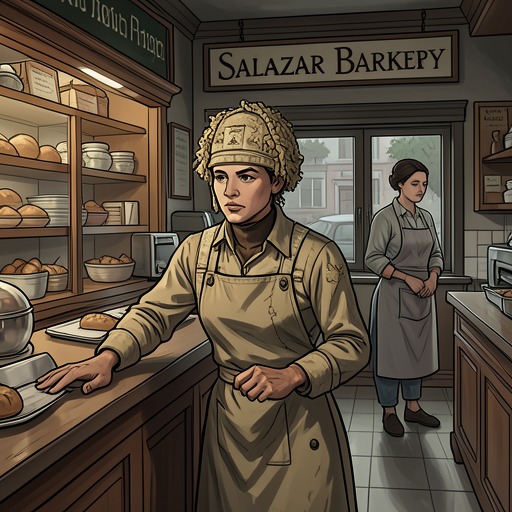
Salazar Bakery
Ofrenda a la tormentaSalazar Bakery is the Salazar family’s production business and the setting for a consequential shift in ownership. Its machinery, ovens, worktables, and office make it a place of labor and administration; for Ros, it has also become the focus of her plans and her first major success. The contest over who controls it ends with Flora announcing that Ros will become its sole owner.
The business and its workplace
The bakery is shown as an active operation: workers prepare goods at steel tables, while machinery and ovens fill the production space. Its office, set apart from the work floor, serves as a vantage point over the business. The long-serving administrator who keeps its accounts is present during a visit by two suited men, one of whom measures the premises and photographs the equipment. The scene suggests an assessment of the business’s assets, though the purpose of the inspection is not specified.
A struggle over control
Ros sits silently behind the office desk while unfamiliar cars, as well as Flora’s Mercedes, are parked outside. Her stillness contrasts with Flora’s conspicuous performance of authority. Flora behaves as though she is the owner, projecting command through confident gestures and a louder-than-necessary voice, but Amaia recognizes that this is a pose. Flora’s furtive looks toward Ros reveal her unease: Ros does not react as Flora expects, and that lack of response unsettles her.
The sisters attach different stakes to the confrontation. Flora treats the dispute as another opportunity to demonstrate her strength and dominance. Amaia and Engrasi, however, believe that the bakery means far more to Ros: during the past year it has become the center of her existence, the place where she has developed projects and perhaps achieved the first major success of her life. They fear that what Flora experiences as a contest of wills could devastate Ros.
Ros’s independence
Engrasi tells Amaia that she has offered to help Ros, despite recognizing that doing so might be unfair under the circumstances. James has also offered assistance, but Ros has rejected both offers. She has said she needs to manage the situation alone. Her refusal makes the bakery more than a source of work or a family asset: it is a test of whether she can claim and direct an enterprise on her own terms.
The announced transfer
The dispute reaches a reversal when Flora tells the family that she has reconsidered returning to the bakery’s management. She says that taking up the role again would consume time she wants for other projects, including television, and presents Ros’s demonstrated ability to run the family business as the reason to leave her in charge. Flora announces that the paperwork will be arranged within days and that Ros will then be the bakery’s sole owner. Ros confirms that Flora told her the previous day, though she is as surprised as the others. The transfer is therefore presented as Flora’s decision and a coming formal change, not as a completed legal transaction. It also turns the earlier standoff into a consequential handover: the business that Ros insisted on handling alone is set to become hers outright.