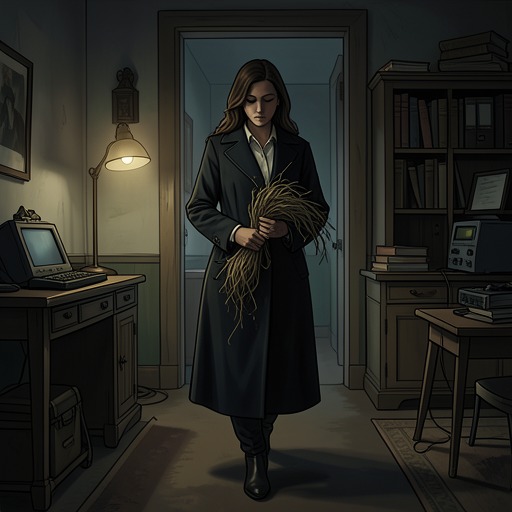
Sara Durán’s Mental Decline and Long-Term Institutionalization
Ofrenda a la tormentaSara Durán’s mental decline and long-term institutionalization are rooted in the death of her infant son, a bereavement that fractured her family and left her unable to recognize the child she had already raised. Years later, she is still alive in the clinic where investigators expect to find a dead patient. During Amaia’s visit, Sara mistakes her own son, Judge Markina, for her husband and speaks of him with the longing she once felt for his father. Her condition turns a family history of loss into a present-tense encounter with grief that has never loosened its hold.
Identity and Family History
When Judge Markina was twelve, his parents, already older, were unexpectedly delighted by the birth of another child. The baby lived for only three weeks. At around midday, Markina heard his mother cry out; he ran upstairs with his father and found her trying to breathe life into the infant. Even at twelve, he understood that the baby was dead. His father struggled to pull Sara away from the body, while Markina watched, horrified and unable to help.
The death did not remain a single moment of shock. Markina remembered Sara’s cries continuing for hours, followed by a silence that felt worse. She stopped speaking except to ask where her baby was, withdrew from her husband and surviving son, and no longer touched or addressed Markina. She became convinced that the death had been her fault and that she had failed as a mother. After attempting suicide, she was admitted to a psychiatric clinic. In Markina’s account, grief, guilt, and the inexplicability of an apparently healthy baby’s natural death overwhelmed her; she forgot that she was married and had another child, and was left alone with her mourning.
Long-Term Institutional Life
Years later, Sara is still a patient at the clinic. A staff member corrects Amaia’s mistaken understanding that Sara had died there, explaining that she has been resident for many years and was alive when her medication was given shortly before. The warning makes clear that a visit will not produce a stable or straightforward account: Sara’s perception of reality differs sharply from other people’s, her thoughts are confused, her emotions shift rapidly from laughter to tears, and she is easily distracted. Staff advise Amaia and her companion to remain steady if Sara’s behavior changes.
The scene establishes the material circumstances of Sara’s continued care without presenting her as a reliable witness to her own history. She sits among residents watching a Western on television; she is very thin, her face deeply lined, and she remains in a stained dressing gown over her nightdress late in the afternoon. Her hair, however, is still abundant and lustrous, gathered in a low ponytail. These details place her in an ordinary institutional day while the conversation that follows reveals how powerfully the past still organizes her inner world.
The Son Mistaken for a Husband
When Amaia raises Sara’s husband and son, Sara’s smile disappears and she begins to cry, insisting that her baby died. She rejects the suggestion that she has another child. Amaia then shows her a photograph of Judge Markina. Sara immediately smiles and recognizes the man in the image as her husband, praising his beauty and touching the screen with her fingertips. She speaks as though he remains the irresistible man she loved, and as though his absence means he no longer wants her.
Amaia identifies the man as Sara’s son and considers whether explaining that his father is dead would help or merely distress her. Sara does not accept the correction. Instead, she wonders whether she has been told she is his mother because she looks so old, asks for a mirror in her room, and promises not to cut herself again. Several scars are visible on her wrist. Her request and promise make self-harm part of the encounter, while her renewed attention to the photograph shows how quickly she returns to the relationship as she understands it. When the celador intervenes, Sara again denies having another child and describes herself as condemned because her baby died. She says she still thinks of the man she calls her husband every day, despite his absence and her belief that he no longer loves her, and still desires him.
Grief, Guilt, and the Novel’s Wider Pattern
Sara’s suffering is not simply a forgotten past: the infant’s death remains the central fact through which she interprets herself, her family, and the man in the photograph. Her inability to recognize Judge Markina coexists with intense feeling directed toward him, but that feeling is attached to the identity of her lost husband. The distinction matters to Amaia, who must decide how much truth to press upon a woman whose emotional response can change in an instant and whose understanding of events is profoundly confused.
The novel places Sara’s history beside other forms of maternal bereavement without making them identical. Yolanda Berrueta is initially treated with caution when she insists that her children’s bodies are missing; she later recognizes that the confusion over the coffins did not erase the truth that her baby’s body had been stolen. Amaia, too, is shown weeping in Engrasi’s arms over death, fear, anger, and what has been violated. Against those different experiences, Sara’s long institutionalization shows the cost of a loss that has consumed her relationships and endured without resolution. Her story also marks the limits of what an interview can recover: Amaia can uncover the family connection in the photograph, but cannot restore Sara’s recognition of her son or make the past intelligible to her.