Tabese Family Tomb
Ofrenda a la tormentaThe Tabese Family Tomb is the isolated crypt in which Amaia Salazar finds the remains of at least twenty children, including infants whose bodies had disappeared from their graves. Its weathered entrance first registers as a physical anomaly: the tomb is supposed to hold one long-dead occupant, yet its door has recently moved. Inside, that discrepancy becomes the terrible answer to the investigation’s questions about missing bodies and the river corridor’s pattern of child deaths.
Setting and Exterior
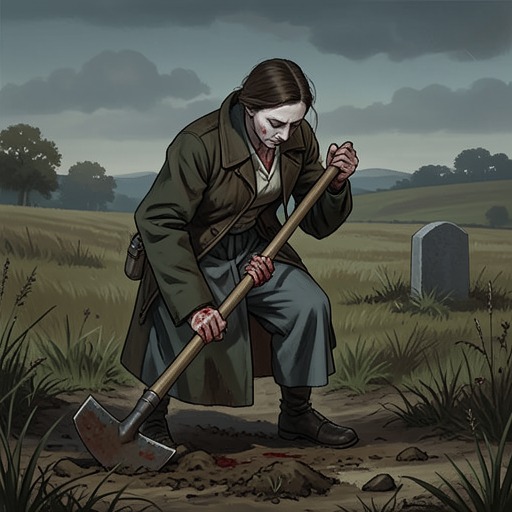
The tomb stands apart from neighboring graves in a cemetery in Hondarribia. Unlike the nearby family plots, it is not aligned with the surrounding burials: raised above them, set at an angle, and enclosed by a thick chain supported on four columns of dull granite. A circular headstone bears a characteristic anthropomorphic line, while a plaque covers the tomb’s original name with a single designation. Large white flowers cover almost all of the slab, obscuring any further inscriptions. These features distinguish the tomb from the orderly cemetery around it, but the decisive clue lies not in its unusual appearance alone. It is in the evidence that someone has recently opened it.
Behind the tomb, in an area reserved for cemetery workers, Amaia finds folded blue tarpaulins, a thick rope, a rusty wheelbarrow, a garden tap, and an open drain. Nearby is a mesh-topped table used to remove remaining soft tissue from bones before they are transferred to a communal ossuary. The arrangement belongs to the practical work of burial and exhumation; in this investigation, it also makes the possibility of disturbing graves concrete. The tomb’s isolation and access to this work area form part of the setting in which its concealed contents have remained hidden.
The Sign of Recent Entry
Amaia reaches the crypt by descending three steps to a heavy door set low enough that anyone entering would have to stoop. She has left her flashlight in the car, so she uses her phone’s camera light to examine the entrance. The old door and its ancient-looking lock seem inconsistent with a recent opening, but the ground supplies a more immediate record: a pale arc scored into the dark stone shows where the door has swung. Dust coats the hinges except at their edges, where the metal is polished. Leaves have gathered in a right-angled line beside the entrance, as if swept or pushed there.
The cemetery register sharpens the contradiction. According to the record, the sole occupant of the Tabese Family Tomb died fifteen years earlier, and no other burial has taken place there. Yet the worn arc and bright hinge edges indicate recent movement. The tomb is therefore not merely an old family vault whose appearance happens to seem peculiar; its door has been used despite there being no recorded reason for it to open. That physical evidence prepares Amaia for the confrontation and discovery that follow.
Yolanda at the Crypt
During a storm, a small explosion sounds from the cemetery, its noise quickly swallowed by thunder over Mount Jaizkibel. Amaia enters the dark grounds and finds the only light behind the wall at the rear of the tomb. At the crypt entrance, she hears blows against wood and sees a flashlight swinging with each kick. Yolanda Berrueta has blasted a small hole in the door, but the damaged lock has caught between the wood and the wall, leaving the entrance jammed. Yolanda says she believes her daughter is inside and has more explosive in her car.
The urgency of the scene comes from the conflict between the danger of forcing the door and Yolanda’s certainty that her missing child is there. Earlier, she had repeatedly told a priest that her children’s bodies were not in their grave and that a mother could feel their absence. The priest had understood her grief but insisted that he had seen the coffins lowered into the ground. Her conviction had been treated as the consequence of a bereaved mother’s distress; the crypt makes it impossible to dismiss her claim as only that. When Amaia later tells her that the failed attempt to open the grave had left Yolanda suffering and unable to prove what was missing, Yolanda answers that the delay also meant no one would have discovered the missing girl, and that another bereaved mother might never have been heard.
Inside the Tomb
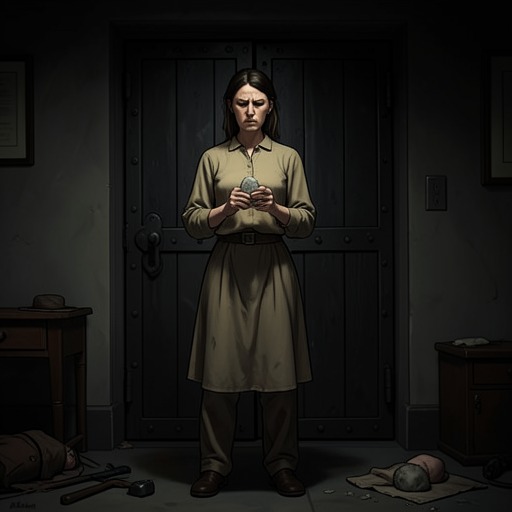
The chamber is simply built around a central altar supporting a heavy, dark wooden coffin decorated with intricate carvings. Around it, arranged in an oval, lie the remains of at least twenty children. Some are old enough that only bones remain. At Amaia’s feet is the swollen, badly decomposed body of the Esparza girl. Beside it, on an old shawl, lies a very white skeleton missing an arm. The contrast between the decayed body and the bright, incomplete bones makes the chamber a record of losses accumulated across different times, not an ordinary family burial.
Amaia drops her flashlight and falls to her knees, overcome by what she sees; Markina enters behind her, retrieves the light, and props it into a crack in the wall so the chamber is illuminated. Her reaction is not simply shock at an unexpected crime scene. The remains expose the scale of what had been concealed and give physical form to the missing children whose deaths had been charted across the region. The chamber also brings her into direct conflict with Markina: she confronts him with the knowledge that his father was responsible and asks why he concealed it.
Geographic and Narrative Significance
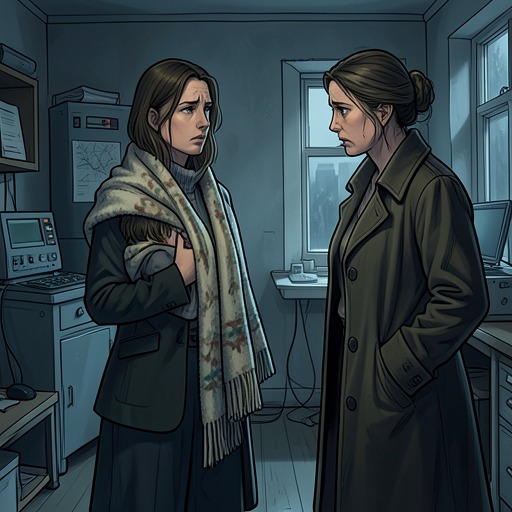
Before the discovery, Amaia and her colleagues have been plotting infant deaths and missing remains against the geography of the Baztán River. A map of cases running through towns from Erratzu and Arraioz to Elbete, Elizondo, and Oieregi makes the river’s course visible as a line through the investigation. Broader checks add further cases in communities beside the river, including Oronoz-Mugaire, Narbarte, Doneztebe, and Hondarribia. The map does not itself prove what happened at any grave, but it gives the scattered cases a spatial pattern that demands explanation. The Tabese Family Tomb supplies a hidden physical site at the end of that inquiry, where the missing bodies are not an abstraction on paper but remains gathered together in one chamber.
The tomb’s significance rests on this convergence of place, evidence, and grief. A cemetery is meant to certify that the dead have been laid to rest; here, the official record of one occupant and the testimony that children were buried elsewhere have obscured a chamber full of their remains. Yolanda’s insistence that her daughter was missing, once treated as an expression of madness and loss, becomes a crucial demand to look again. The crypt turns the investigation’s map into a reckoning with bodies that had been denied both their graves and, in some cases, even the recognition of their deaths.