The cult's belief in sacrifice
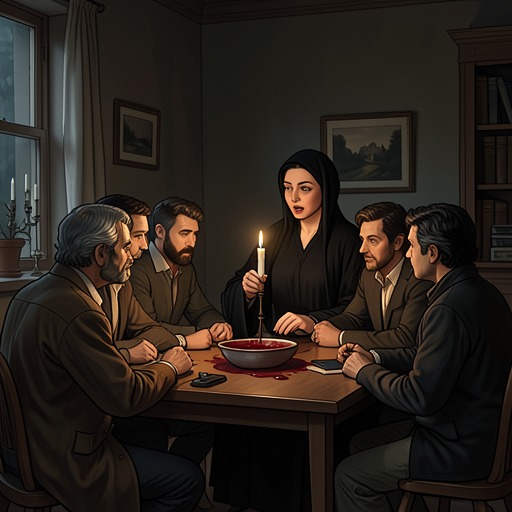
Ofrenda a la tormentaThe cult's belief in sacrifice is the doctrine that binds its members to a supposed exchange with ancient forces: offerings bring power and favors, but every gain incurs a debt that must eventually be paid. What begins as a promise of spiritual knowledge and belonging hardens into a system that legitimizes the killing of children and makes departure from the group seem impossible.
Recruitment and the Promise of Power
The belief takes shape inside a community that initially presents itself as an experiment in recovering tradition, understanding humanity, and engaging with the forces of nature. One young visitor, who had recently finished university, came to Lesaka during San Fermín and was invited to a house shared by the group. There, marijuana, fire-dancing, and talk of spirituality, witchcraft, and the natural world made the gathering seem at first like an unconventional search for meaning. The group also invited potential recruits, including locals and visitors who had arrived looking for spiritual experience.
The visitor's account shows how that welcoming surface became a means of attachment. After the summer, many people left, but he was asked to remain. Only then, he said, did the group's true character emerge. Members spoke frequently of Tabese, who appeared unpredictably and whose arrival made the house feel festive. The witness recalled being captivated by him and described a group whose members loved him and believed they would do anything he asked. His authority rested not simply on commands but on a combination of charisma, intimacy, and the promise that he could give them power.
The Doctrine of Offerings
Tabese taught the members that the ancient inhabitants of the Baztán Valley had marked the land with megalithic monuments and ley lines, which he connected to the presence of supernatural beings. In his account, these beings could be awakened through offerings, and the group could obtain what it wanted by making them. He presented the relationship as an old and mutually beneficial exchange: people received favors from powerful forces and gave lives in return, initially through small animal sacrifices carried out according to particular procedures.
The witness described the first apparent favors as intoxicating. The group felt powerful, as though it had acquired the capacities of medieval witches; the experience of believing that an action had produced an effect made members feel almost godlike. But the exchange did not remain at its original scale. As the group received more favors, it was asked for more in return. The doctrine therefore makes escalation part of its own logic: increasing power is not a final reward but a reason for a greater offering.
Human Sacrifice and Its Aftermath
The escalation culminated in the killing of a girl. The witness could not bring himself to discuss the sacrifice directly, but admitted that it happened and that everyone participated. He said that the girl's own parents offered her and gave her death, because the act had to be carried out in that way. Afterward, the body was taken away. Within days the group began to disperse, and in less than a month its members had disappeared; Tabese never returned. The witness was among the last to leave, and by then only the couple who had made the offering remained.
The group's disappearance did not erase the act or release its members from the obligation they believed it created. Years later, a former member encountered a doctor from the group while visiting his cancer-stricken son in hospital. The doctor said the illness could be solved if the father made a sacrifice. Faced with his child's suffering, the father admitted that he considered the proposal and understood his circumstances through the memory of the earlier crime. The available account confirms that his son died, but does not establish that he made another offering. His testimony instead presents sacrifice as a debt whose consequences can reach into ordinary family life long after the ritual gathering has ended.
Debt, Membership, and Reuse
The belief explicitly rejects the idea that members can simply leave. One former participant says that the group dispersed as part of its arrangement, not because its members had ceased to belong; sooner or later, Inguma would collect what was owed. He considers himself still in debt and says he has not finished paying its consequences. In this framework, separation is geographical rather than moral: the group can dissolve outwardly while retaining its hold through fear, obligation, and the expectation of a future offering.
The doctrine also appears in the later accounting of women connected to the group through their own membership, their families, or their partners. The investigators conclude that these women remained in debt, although they could no longer bear children or provide a suitable offering to Inguma. One exception, Lucía Aguirre, had daughters who were already too old for that purpose. The discussion proposes that the women might instead be used for a lesser, flesh-hungry god, while the girls associated with the river are described as unfinished work. These details show how the sacrificial system can be adapted when its original victims are unavailable: the debt persists, and the intended recipient or target can change.
Control and Narrative Significance
The cult's methods help explain why its members' participation cannot be understood as a simple sequence of isolated choices. It identifies vulnerable people and channels their existing obsessions, then offers them a group that loves, protects, respects, and listens to them. This manufactured belonging gives recruits a place in the world and a sense of importance, while the doctrine redirects their need for connection into obedience and sacrifice. Its promise of care is therefore inseparable from its capacity to exploit its adherents.
In the confrontation at the tomb, Markina describes himself as a channel for an ancient religion rooted beneath the stones of Amaia Salazar's valley and insists that its power must be fed. Faced with the remains around the coffin, Amaia identifies the practice as murder; Markina instead casts it as a costly exchange whose extraordinary reward justifies its price, and blames Christianity for making people forget how to address living forces. The opposing descriptions expose the doctrine's central moral mechanism: violence is renamed as sacred obligation, and the suffering of children is treated as payment within a cosmic bargain. The novel presents that bargain as the cult's own belief, not as an independently verified account of supernatural reality.