USB Copy of Jonan’s Files
Ofrenda a la tormentaThe USB Copy of Jonan’s Files is the portable record through which Amaia Salazar receives and eventually understands Jonan Etxaide’s final investigative work. It carries both his last instruction and a collection of documents and images that recast seemingly settled details as deceptions; its importance lies not merely in preserving information, but in making the pattern of concealment legible to Amaia.
Copying and preserving Jonan’s last message
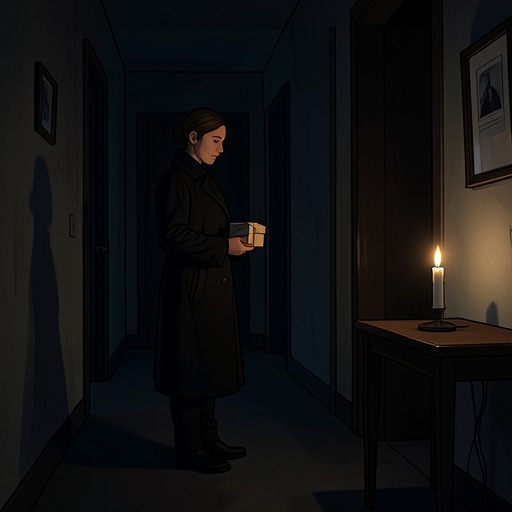
At home, Amaia transfers the contents of a file Jonan sent her, along with the accompanying instruction, onto a pen drive. The words were generated by an automated message, yet she recognizes them as her friend’s last will. Deleting them from the computer feels like breaking a nearly spiritual link, one important enough to threaten someone and, in her understanding, to have contributed to Jonan’s death. She keeps the drive in her bag rather than leaving the message exposed on the computer.
Before leaving, Amaia also takes a book belonging to Dupree. The book is separate from the digital evidence, but its presence alongside the drive places Jonan’s message within a wider inquiry that she continues to carry with her. The physical copy gives her access to the file beyond the computer on which she has removed the message.
The break-in and the empty drive
When Amaia returns to her home in Pamplona, the door opens after only one turn of the key, although she normally locks it with two. Armed, she searches the rooms, checking the house and the maps pinned in the sitting room. Nothing appears out of place, but she is certain that someone has been inside. She is relieved that she deleted the data from the computer, then notices that a second, unused pen drive has disappeared.
Amaia leaves with her bag and locks the door as usual before calling Fermín Montes. She explains that she found fibers in Jonan’s apartment and gave a sample to Doctor Takchenko, a Russian doctor who conducts parallel analyses for the team in Aínsa. Someone forced Doctor Takchenko’s car off the road and searched it; she is expected to recover. The intrusion at Amaia’s house follows that attack. She tells Montes that the stolen drive was empty and says she asked him to watch her aunt’s house in case the intruder searched there as well. The distinction matters: the missing drive is not the protected copy containing Jonan’s files.
Files that turn appearances into lies
Later, Amaia connects the USB drive containing Jonan’s files to her computer and begins opening its folders. For the first time, she understands what she is looking at: a collection of lies, simulations, and deceptions. The files bring together evidence whose apparent meanings have to be reconsidered. A grave in Ainhoa that should not have contained babies, and the body of a little girl supposedly resting there, point to a false account. An interview between Yolanda Berrueta and Inma Herranz records another constructed story, while Nurse Hidalgo’s employment history and Berasategui’s connection with the Argi Beltz Group conceal further truths. Photographs of Judge Markina at the prison on the day Berasategui died add yet another layer of suspicion.
The dossier does not resolve every image as Amaia opens it. She reaches photographs of herself with Markina outside the Baluarte auditorium and wonders what lies behind them, then closes that folder and proceeds to the next. There she finds the address of a Madrid rest clinic where a woman named Sara is confined. The files leave Amaia asking what deception is concealed behind that name, making the drive not a finished explanation but a sequence of leads that continues to open.
A portable dossier and a changing investigation
The drive’s contents connect apparently separate strands: graves, interviews, employment records, prison photographs, and the location of a woman in a clinic. Their juxtaposition shifts Amaia’s task from assessing isolated pieces of evidence to recognizing repeated false appearances. Jonan’s files are themselves fragmented, and their meaning emerges as she moves from folder to folder, testing what each record seems to say against what it may conceal.
The contrast between the saved copy and the stolen empty drive sharpens the danger surrounding the investigation. Someone has entered Amaia’s home and searched Doctor Takchenko’s car, but the object taken from the house contains nothing; the evidence that matters remains available to Amaia. The USB Copy of Jonan’s Files thus preserves Jonan’s final communication while turning his unfinished work into the means by which Amaia begins to see the investigation’s many apparent truths as linked acts of deception.