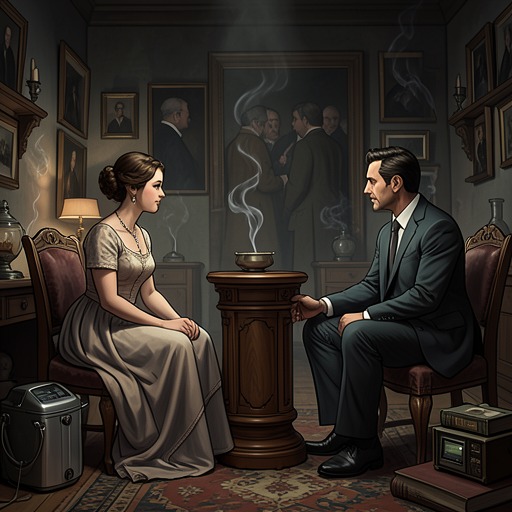
Una casa no es un hogar
Ofrenda a la tormentaUna casa no es un hogar is an expression about the distance between possessing a house and inhabiting a home. Its force comes from two sharply different contexts: Yáñez’s house, transformed by grief into a place of death and confinement, and Amaia Salazar’s recognition that James wants a meaningful place in her future.
Meaning and First Context
Yáñez describes the saying through the history of his marriage. He had believed that happiness was assured: his wife was young, beautiful, and good, and the couple had a child. After the birth, however, she became persistently sad, stopped smiling, and did not want to hold the baby. She felt unprepared to love the child and believed the child rejected her. Yáñez answered that these fears were nonsense, not understanding that his response made her sadness worse.
The contrast between domestic order and emotional desolation gives the expression its first meaning. His wife kept the house spotless and cooked every day, but she no longer smiled or sewed; in her free time she slept and closed the shutters. The couple had once been proud of their house: they painted it and put out flowerpots. Yet its care and attractive appearance could not make it a home for his wife. In Yáñez’s account, the house became her tomb.
The House as a Place of Memory
The saying grows darker when Yáñez describes what the house has become for him. Under house arrest while awaiting trial, he expects that he may serve his sentence there. The place that once embodied shared hopes now threatens to become his own tomb. At night he cannot sleep, haunted by the feeling that his wife’s blood is beneath his head.
That memory is attached to a particular object: the sofa. Its appearance does not match the rest of the room because Yáñez had it reupholstered after it was covered in his wife’s blood; the original fabric was no longer made. The new covering changes the visible surface but cannot erase what he remembers. When he lies on it, he can still smell the blood beneath the upholstery. The house thus holds its past not only in Yáñez’s story but in an ordinary piece of furniture that renovation has failed to make ordinary again.
Recall and Reuse
Later, the expression returns to Amaia Salazar while she is speaking with James. His seriousness makes her understand that he has needs and plans of his own and wants a place in her life. She remembers the building materials standing unused in front of Juanitaenea and Yáñez’s words. In this context, the expression shifts from a widower’s account of a home made uninhabitable by loss to a recognition that a shared home and life require attention to another person’s hopes.
Amaia responds physically before giving her answer: she reaches across the table and touches James’s hand. She tries to smile and says she will submit the request the next day, expecting little difficulty because nobody asks for leave in winter. The remembered phrase helps connect James’s request for a place in her life with the practical decision she makes. Its recurrence does not promise that a house alone can secure happiness; instead, it marks the difference between a dwelling and the relationships and choices that might make it a home.