Bustopher Jones
Old Possum's Book of Practical CatsBustopher Jones, also called the Cat about Town and the St James's Street Cat, is a figure of conspicuous urban polish and club-going distinction. His portrait sets immaculate dress and public recognition against a large, still-growing body: the same roundness that makes him remarkable is linked to the meals and routine that fill his day.
Identity and Public Standing
Bustopher Jones is introduced as the opposite of a thin, gaunt figure: he is remarkably fat. The poem makes that physical distinction central to his identity, then gives him a social one. He does not haunt ordinary pubs; he belongs to eight or nine clubs and is identified with St James's Street. His title as the street's cat and his circuit of clubs place him within a recognizably fashionable world.
That standing is visible whenever he walks down the street. People greet him, and his fastidiously black coat makes him immediately recognizable. The poem distinguishes his trousers from those of commonplace mousers, presenting even this everyday item of clothing as a mark of exceptional cut and care. His reputation is not described through private thoughts or speech; it is displayed in the attention his arrival receives and in the narrator's admiring account of his appearance.
The poem also casts him as the feline equivalent of a celebrated man of fashion, calling him the Brummell of Cats. In the same passage, it names him as the smartest name in St James's and describes the pleasure of receiving his nod or bow. His white spats complete the carefully composed outfit. The greeting, the formal gesture, and the precise clothing details together make his social distinction something staged in public and confirmed by those who recognize him.
Clubs and the Daily Circuit
His clubs are not merely a count that establishes wealth or access; they organize the portrait's sense of time. The poem says that he has eight or nine clubs, and later sums up his day by placing him at one club or another. The repetition makes his movements feel habitual: the public figure seen in the street is also sustained by a regular circuit of fashionable rooms.
The account names the Senior Educational as a place he visits occasionally. It also identifies the Tomb through a meal associated with one of his moods. These details give the circuit individual stops rather than leaving it as a general claim to club membership. His routine is presented through visits, meals, and appearances, not through a dramatic change in circumstance; the portrait's interest lies in how reliably the same polished identity recurs from place to place.
Appetite, Weight, and Contrasts
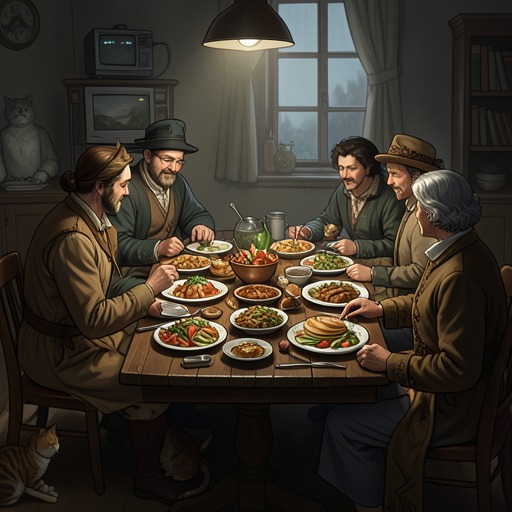
Food makes the connection between Bustopher Jones's daily life and his body especially plain. When he looks gloomy, the poem says he has lunched at the Tomb on cabbage, rice pudding, and mutton. The specific menu gives his mood a comic, material explanation: the verse links an expression readers might take as emotional to what he has eaten. It does not develop the gloom into a larger crisis; instead, the meal returns the portrait to appetite and routine.
The poem explicitly connects that routine with his increasing size. It says that he has grown unmistakably round under the observers' eyes, calls him a twenty-five-pounder, and adds that he is putting on weight every day. These are not isolated descriptions: the repeated attention to his body makes his gradual rounding part of the character's continuing public story. Yet the description does not reduce him to weight alone. His careful clothes, club life, and composed social manners remain in view alongside it, producing the portrait's central contrast between bodily abundance and fastidious presentation.
The verse then balances the report of daily weight gain with the assertion that he is well preserved because he is observed. That explanation keeps the comic account from becoming a simple tale of decline: his increasing roundness is acknowledged, but so is his maintained condition. The wording makes observation part of the portrait's logic without spelling out a further regimen or practice.
Characterization and Narrative Role
Bustopher Jones is characterized primarily through repeated outward signs: his size, clothes, clubs, meals, street appearances, and the gestures exchanged with those who greet him. Together, these details make him recognizable at once, while the changing particulars of his circuit and meals give the portrait its movement. His character is less an unfolding plot than a social routine rendered in accumulating details.
The collective voice's admiration is affectionate but not uncritical. It takes pride in being nodded or bowed to by him, yet it also keeps count of his weight and makes his appetite part of the joke. His prestige and his roundness are not opposing versions of him; the poem makes them coexist. The result is a comic portrait of a cat whose public elegance is inseparable from the well-fed life his clubs and meals represent.