Growltiger
Old Possum's Book of Practical CatsGrowltiger is a barge-roving Bravo Cat whose violence and hatred of foreign cats define both his reputation and his downfall in Growltiger’s Last Stand. Known as The Terror of the Thames, he appears first as a figure who imposes danger on others; the final image reverses that pattern, as an encircling enemy forces him to walk the plank.
Identity and Reach
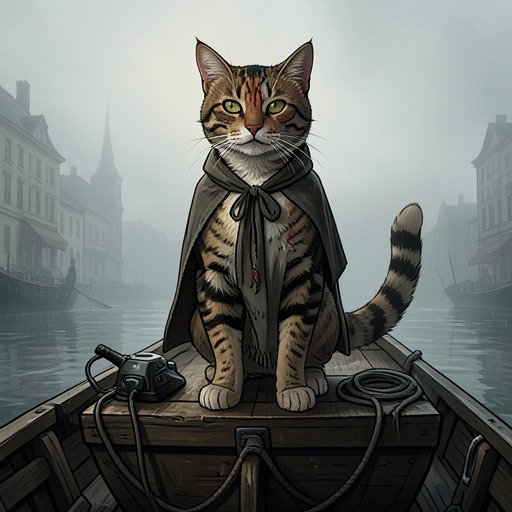
Growltiger is introduced as a Bravo Cat who travels on a barge. The poem calls him the roughest cat ever to roam at large, a description that establishes not merely his capacity for violence but the scale of the menace attached to his name. His setting is mobile: he moves by water rather than being confined to one place, and his journey extends from Gravesend up to Oxford as he pursues what the narration calls his evil aims. The route gives his threat a broad reach, while the barge supplies the characteristic image through which the account presents him.
The poem’s account of his identity is deliberately stark. Growltiger is not introduced through a sympathetic history, a private grievance, or a change of heart; the supplied portrait centers on roaming, cruelty, and the harm he inflicts. The account also gives his notoriety an epithet, The Terror of the Thames. That name compresses his reputation into a single image: a danger associated with the river and with the barge from which he exercises his power.
Reputation and Enmity
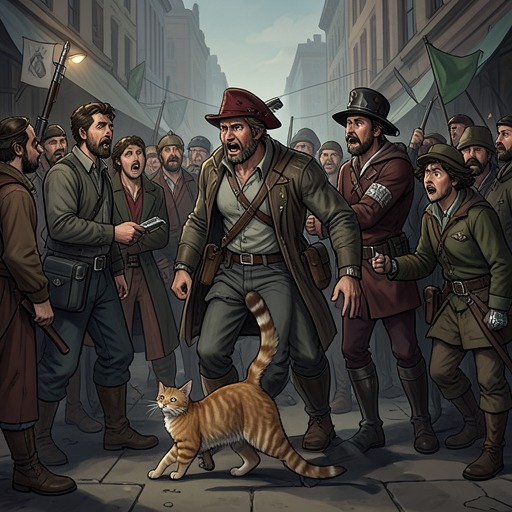
Growltiger’s violence is sharpened by a particular prejudice. His hatred is vowed most strongly against cats of foreign race, and the poem states that cats of foreign name and race receive no quarter from him. The distinction makes his hostility more than indiscriminate roughness: the narrative identifies a category of intended victims and presents his cruelty toward them as a defining feature of his rule.
The Persian and the Siamese Cats are said to regard him with fear. Their fear gives his reputation a social dimension: Growltiger’s danger is not only what he does to individual opponents but also the apprehension surrounding his presence among those he targets. Yet the poem does not leave that reputation as proof of invulnerability. The same tale that reports his capacity to terrorize others eventually shows him caught in a situation where the surrounding force belongs to his enemies.
The Encirclement
The turning point is prepared through an image of watching and silent approach. Moonlight is reflected in a thousand bright blue eyes, while sampans draw closer and closer around Growltiger’s position. The enemy makes no sound. This contrast between the visible sign of a gathering force and its silence delays the moment of open confrontation: the threat is revealed through the eyes and the circling boats before the account describes the enemy pressing forward.
The Lady Griddlebone is part of the scene’s humanizing, and then unsettling, contrast. She seems enraptured by Growltiger’s manly baritone and appears disposed to relaxation, expecting no surprise. The calm suggested by her response stands against the hidden pressure accumulating around them. The poem later says she probably escaped with ease and was not drowned, presenting her survival as the narrator’s confident speculation rather than as a witnessed certainty. Her apparent danger and likely escape are thus distinguished from Growltiger’s fate.
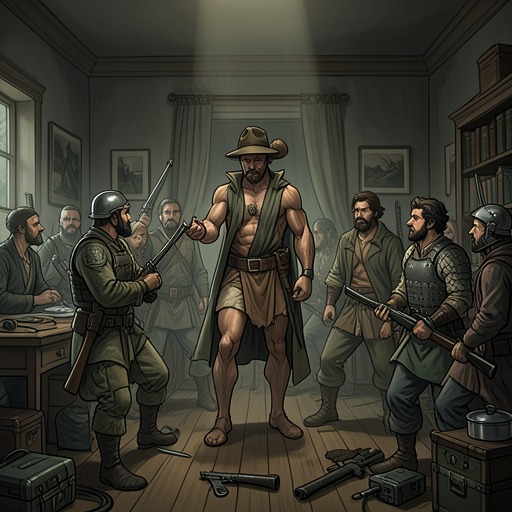
When the enemy finally advances, the threat becomes physical and unavoidable. A serried ring of flashing steel surrounds Growltiger; the foe presses forward in stubborn ranks. The motion is collective and unyielding, unlike the singular image of the roaming cat who had previously made others fear an encounter with him. His vast surprise marks the reversal: he is no longer the one dictating the terms of danger, and he is forced to walk the plank.
Reversal and Narrative Significance
The ending explicitly connects Growltiger’s punishment to the harm he caused. He had driven a hundred victims to the drop; at the close of his crimes, he is made to face the plank himself. The parallel turns his habitual violence into the measure of his downfall. The narrative does not need to describe a long reckoning: the reversal is concentrated in the change of position from the cat who sends victims to the edge to the victim who must go there.
The poem’s tone also shifts the force of the scene. The ring of steel and the ranks pressing forward present a serious defeat, while the final, bouncing phrase ker-flip, ker-flop gives the plunge a comic, rhyming finish. That contrast makes the end both decisive and deliberately theatrical. Growltiger’s menace is not erased from the account—the fear he inspired and the victims he drove remain central—but the ending deprives that menace of its last word. The former terror is reduced to the figure being forced over the plank, and the story closes by making his own violent practice return upon him.