Jellicle Ball
Old Possum's Book of Practical CatsThe Jellicle Ball is the anticipated gathering at the heart of the Jellicle Cats’ nocturnal life. The poem introduces it through an invitation, links it to the rising Jellicle Moon, and shows the cats arranging their routines around the chance to dance. Rather than recounting a complete ball, it builds the event through expectation and preparation: the night is named, the participants are summoned, and their stored-up energy is directed toward dancing together.
Invitation and Occasion
The ball is presented as a collective event, not a private performance. The invitation calls the Jellicle Cats to come together, moving from an open welcome to a shared destination. That repeated sense of arrival makes the gathering feel available to the group as a whole; the emphasis is on coming together, rather than on a named host or a single featured dancer.
Its timing is inseparable from the Jellicle Moon. The moon is described as shining, and the cats are said to wait for it to rise before the ball begins. This gives the occasion a clear threshold: daytime belongs to quiet and apparent idleness, while moonrise marks the point when the gathering and its dancing can take precedence. The poem supplies no calendar date or account of how the moon is chosen. Instead, its recurring appearance provides the event with its own recognizable signal.
The invitation’s bright, repetitive language also makes the ball sound like an occasion that can be called into being again and again. It is not introduced through a history of previous celebrations or a list of formal rules. Its identity emerges through the recurring conjunction of the cats, the moon, and the dance.
Preparation and the Cats’ Daily Rhythm
The cats’ preparation gives the ball a distinctive relation to ordinary time. Before the moon appears, they make their toilette and take their repose. Washing behind their ears and drying between their toes are small, particular acts, but their placement gives them the function of preparation: the cats tend to themselves and rest before the night’s activity.
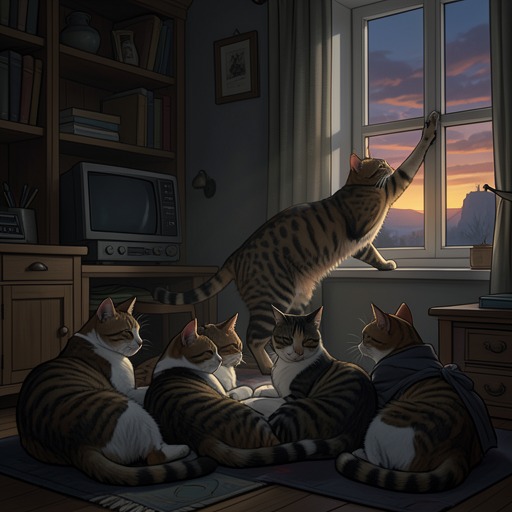
The poem contrasts this readiness with their quietness through the morning and afternoon. In bright daylight, an observer might think they have nothing to do. The account reverses that impression: their stillness is purposeful because they are resting and saving themselves for the Jellicle Moon and the ball. What looks like inactivity is therefore recast as an interval within a planned cycle, with energy held back for a later communal use.
This rhythm makes the ball more than a dance mentioned in passing. The event organizes the descriptions around it, connecting grooming, rest, moonrise, and movement. The text does not specify how long the cats sleep, how they travel to the gathering, or what happens after it; the supported sequence is narrower and more suggestive, beginning with preparation and culminating in the anticipated dance.
Dance and Collective Identity
Dance is the ball’s defining activity. The Jellicle Cats practise their airs and graces, and the poem identifies their ability to dance a gavotte and a jig. These named forms lend the celebration a measure of recognizable skill and decorum. The cats are not merely described as moving when the moon rises: they practise, and their preparation implies that dancing is a valued part of their shared occasion.
The account balances this refinement with a deliberately plain, physical portrait of the participants. The Jellicle Cats are described as black and white, rather small, and roly-poly; they have cheerful faces and bright black eyes. These details do not turn the ball into a display of grandeur. Instead, the contrast between modest, rounded bodies and practiced airs gives the gathering its particular character: the cats combine an ordinary, even comic appearance with the poise and skill of dancers.
That contrast also helps define the event as communal rather than exclusive. The poem gives no ranking among the dancers and names no solitary star who owns the occasion. The collective name recurs, and the invitation, preparation, and dancing all remain attached to the group. The ball offers a shared setting in which this group’s habits and abilities become visible together.
Narrative Shape and Significance
The poem’s account is chiefly anticipatory. It announces the ball, establishes the moon as its signal, and describes the cats’ habits in the period before it. Although it says that they dance by the light of the moon, it does not unfold a detailed performance scene: there is no described sequence of dances, named partner, or narrated ending. The event’s force lies in the build-up and in the repeated promise that quiet, preparation, and waiting will give way to communal movement.
Repetition reinforces that structure. The return to the Jellicle Cats, the moon, and the ball keeps the event in view while surrounding details fill in what the cats are like and how they prepare. The repeated invitation works both as information and as a summons, giving the passage the quality of a song addressed to an audience. Its language makes the gathering feel imminent even where the poem stops short of narrating every part of it.
The Jellicle Ball consequently serves as the organizing occasion through which the cats’ nocturnal identity is expressed. It brings together their grooming, repose, discipline, and dancing under a shared lunar cue. The text leaves the celebration’s practical arrangements and final outcome unspecified, but makes its essential pattern clear: the cats wait for the Jellicle Moon, preserve their strength through the day, and gather in expectation of dancing.