Jellicle Cats
Old Possum's Book of Practical CatsJellicle Cats are a small, black-and-white community defined by a shared rhythm of rest, preparation, and dance. In The Song of the Jellicles, their bright-eyed, cheerful appearance and practiced social graces lead toward a common event: they come out when the Jellicle Moon shines and gather for the Jellicle Ball. The group’s identity rests less on individual distinction than on coordinated expectation, with ordinary inactivity revealed as preparation for a particular night.
Identity and Collective Portrait
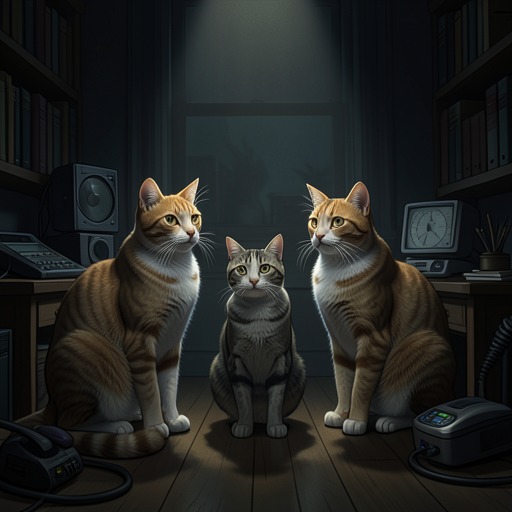
The poem introduces Jellicle Cats as a group rather than as individually named characters. Their description accumulates in paired traits: they are black and white, rather small, merry and bright, and pleasant to hear when they caterwaul. Cheerful faces and bright black eyes make them recognizable as a collective, while the recurring descriptions of their size give that portrait a compact, rounded quality. They are said to develop slowly, not to grow too big, and to be roly-poly. These details establish a distinctive physical type without suggesting that any one cat stands apart from the rest.
Their shared character is also expressed through conduct. They practise their airs and graces and know how to dance a gavotte and a jig. Such polish and skill sit beside the poem’s playful descriptions of their smallness and roundness: the cats are both composed enough to rehearse manners and exuberant enough to caterwaul and dance. The result is a communal portrait built from contrasts, in which disciplined preparation does not suppress liveliness but gives it a form.
Daily Rhythm and Preparation
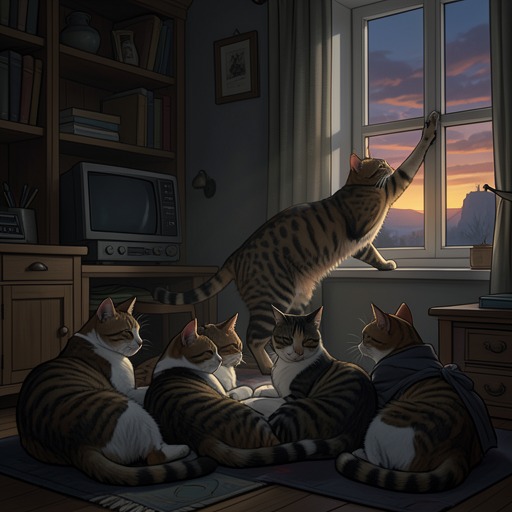
The group’s schedule turns on the appearance of the Jellicle Moon. Until it rises, Jellicle Cats make their toilette and take their repose; the description even specifies that they wash behind their ears. Grooming and rest are small, concrete routines, but their placement in the poem gives them a larger purpose. The cats are not simply described as idle or well-kept: their preparation belongs to an anticipated gathering.
That rhythm is made especially clear through the contrast between afternoon quiet and nighttime activity. The cats reserve their terpsichorean powers for dancing by moonlight. Whether the day is stormy or bright, an observer might think there is nothing for them to do; the poem corrects that impression by presenting their apparent inactivity as rest and conservation. They are saving themselves to be ready for the Jellicle Moon and the Jellicle Ball. The shift in interpretation is central to the group’s characterization: stillness is not evidence of aimlessness, but one phase in a recurring cycle of preparation and release.
The Moon and the Ball
The Jellicle Moon serves as the signal around which the poem organizes the cats’ communal life. Its appearance is awaited, and the repeated connection between moonrise and the ball turns the night sky into more than a backdrop: it marks the moment when the group’s reserved energy can be put to use. The refrain that calls Jellicle Cats out tonight, and invites them to come one and all, makes the gathering sound open to the entire community. The emphasis falls on collective arrival, not on a solitary performer or a contest between individuals.
The Jellicle Ball is the culmination of the poem’s descriptions of practice, grooming, and rest. The cats are shown as knowing both the gavotte and the jig, so their dancing is presented as a shared capability rather than a newly discovered talent. The song does not detail the ball’s proceedings; instead, it builds anticipation by showing the preparations and naming the event toward which they lead. That focus gives the gathering a defining place in the group’s identity while leaving the dance itself as an anticipated communal occasion.
Song, Repetition, and Group Identity
The Song of the Jellicles develops its portrait through recurring descriptions and returns to the moon and ball as organizing refrains. Repetition makes the group feel recognizable and cohesive: the same broad traits—small size, black-and-white coloring, brightness, and readiness to dance—are restated as parts of one shared identity. The repeated invitation to come together reinforces this collective emphasis, while the changing details of grooming, repose, and dance fill out the routine behind it.
The poem also lets appearance mislead before correcting the impression. In daylight, the cats may seem to have nothing to do, but the explanation that they are resting and saving themselves gives that quiet a purposeful relation to the night. Their energy is not absent; it is held in reserve. In this way, the group is characterized through timing as much as through looks: their distinctive life emerges in the contrast between daytime repose and moonlit activity. The Jellicle Cats are presented not merely as a collection of similar animals, but as a community whose habits, skills, and shared anticipation converge on the Jellicle Ball.