Macavity
Old Possum's Book of Practical CatsMacavity is the elusive criminal at the center of “Macavity: The Mystery Cat,” a figure whose defining power is not simply wrongdoing but the ability to evade the moment when wrongdoing is investigated. Called the Hidden Paw, he is described as a master criminal who can defy the law and confound Scotland Yard and the Flying Squad. The poem’s central contradiction gives him his legend: his presence is inferred from crime, yet whenever investigators arrive, he is not there.
Identity and Appearance
Macavity is introduced through names that make concealment part of his identity. The Mystery Cat marks him as an enigma; the Hidden Paw links him to unseen criminal action. His reputation is stated in sweeping terms: he is the master criminal who defies the law, and a source of frustration to Scotland Yard and the Flying Squad. These are not separate reputations so much as a single method. His notoriety grows because the authorities cannot catch him at the point where a case might be resolved.
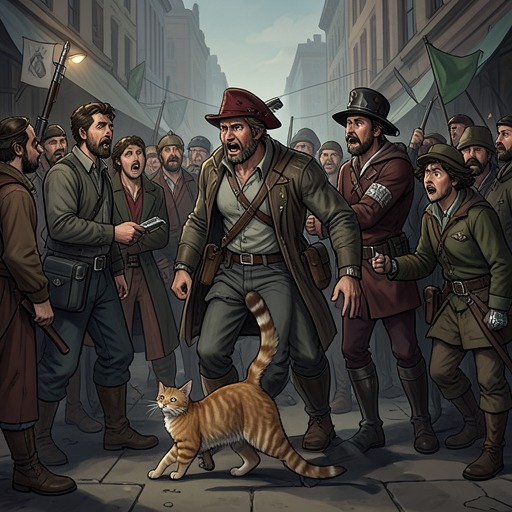
The poem also supplies a distinctive physical description, giving the absent criminal a memorable outline. Macavity is a ginger cat, very tall and thin, with sunken eyes, a deeply lined brow, and a highly domed head. The description suggests a face associated with thought and calculation, while the recurring claim that he cannot be found makes even this portrait feel like an identification offered in his absence. The poem says that he would be recognizable if seen, but recognition is not the same as capture: his appearance can be described even as his whereabouts remain beyond reach.
Crimes and Elusiveness
Macavity’s relationship to crime is presented through the pattern of investigation and disappearance. When the Flying Squad reaches a crime scene, he is already gone. Searching does not solve the problem: the poem imagines looking in the basement or up in the air, only to insist again that he is nowhere to be found. Even a scrap of paper left in a hall or on a stair offers no useful route to him; investigating it is futile because Macavity is absent.
That repeated absence is the poem’s chief evidence of his power. It does not narrate a particular crime from beginning to end, or show Macavity being caught in the act. Instead, it builds his character through the recurring failure of pursuit. Each investigation confirms the same pattern: evidence may remain, suspicion may settle on him, and the authorities may search, but they do not encounter the criminal himself. The refrain turns evasion into a defining action, making nonappearance as consequential as the crimes attributed to him.
Reputation, Evidence, and Alibis
Macavity’s reputation becomes especially clear when a loss is disclosed. The Secret Service concludes that he must have been responsible, but the poem immediately undercuts that confident attribution: he is a mile away. The accusation and the distance coexist. His name explains a crime to those seeking a culprit, while his location prevents that explanation from becoming a witnessed encounter or proof of presence at the scene.
The poem further says that Macavity always has an alibi, and one or two to spare. It stresses that he was not there at whatever time the deed took place. The abundance of alibis makes his evasion sound prepared rather than accidental, although the poem does not detail how any alibi is made or verified. The resulting gap between accusation and presence is central to the character: he is blamed often enough to dominate the account of crime, yet remains physically removed from the decisive moment. The song offers no arrest or confrontation to close that gap.
Control and Narrative Significance
Macavity’s influence extends beyond the crimes directly assigned to him. The poem says that cats whose wicked deeds are widely known, including Mungojerrie and Lady Griddlebone, are merely agents for the cat who controls their operations. It culminates in naming him the Napoleon of Crime. This claim enlarges his role from elusive offender to organizer: other notorious cats appear not as independent rivals but as parts of a larger criminal order directed by Macavity.
The shift also changes how the earlier pattern of absence can be understood. Macavity is not only difficult to locate at a crime scene; the poem presents him as a power operating through others, able to remain out of view while their deeds sustain his reputation. The portrait and the refrain work together: the reader is given a recognizable body, but the narrative’s repeated investigations deny the encounter that would make recognition useful. Macavity’s decisive distinction is therefore the paradox at the heart of his legend—his name is everywhere in the explanation of crime, while he himself is never there.