Mr. Mistoffelees's conjuring
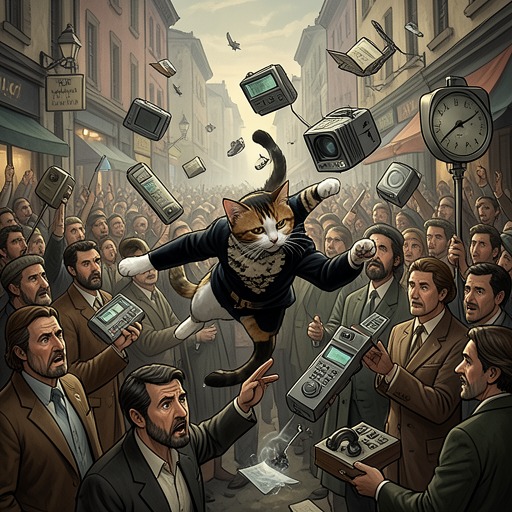
Old Possum's Book of Practical CatsMr. Mistoffelees's conjuring defines him as a master of self-invented illusion whose tricks move from nimble feats and vanishing household objects to the spectacular production of seven kittens from a hat. The poem makes his power felt not through an explained method but through a mounting series of claims, demonstrations, disappearances, and astonished reactions.
Identity and claimed authority
Mr. Mistoffelees is introduced as the Original Conjuring Cat, and the poem insists that no other cat in the metropolis matches him. It attributes his inventions to his own initiative, presenting his skill as original rather than borrowed or taught. The boast that he holds all the patent monopolies for surprising illusions and eccentric confusions turns conjuring into his exclusive domain: his distinction lies not just in performing tricks, but in having a seemingly inexhaustible right to invent them.
His expertise is named in a pair of technical terms, prestidigitation and legerdemain. Yet the poem immediately makes that specialized language a promise of bafflement: examination cannot expose his methods, and deception succeeds again and again. The greatest magicians, the verse claims, still have something to learn from his Conjuring Turn. The exaggerated scale of that comparison establishes his reputation before the list of particular feats begins, making each trick seem like evidence for an already extravagant title.
Feats of dexterity and misdirection
The account gives his skill a physical as well as an illusory character. He can creep through the tiniest crack and walk on the narrowest rail, feats that make confinement and balance seem effortless. Alongside these acts are familiar tests of dexterity and chance: he can pick any card from a pack and is just as cunning with dice. The variety matters. His command is not confined to one apparatus or one kind of trick; narrow spaces, precarious footing, cards, and dice all become occasions for surprise.
His most persistent deception is to make observers believe that he is merely hunting for Mice. That harmless appearance disguises the broader pattern of his activity: the poem has already described a cat whose inventions produce eccentric confusions, and the supposed mouse hunt becomes another cover for what he can do. The contrast between an ordinary explanation and a conjurer's hidden capability is central to the portrait. The tricks work not only by making things happen, but by encouraging a mistaken account of what Mr. Mistoffelees is doing.
Vanishing objects and delayed return
The poem then turns to small, everyday materials. Mr. Mistoffelees can perform a trick with a cork, or with a spoon and a bit of fish-paste. These modest props make the conjuring feel close to domestic life rather than confined to a formal performance. Even a knife or fork that seems merely misplaced may be part of the deception: an object is present one moment, gone the next, and found the following week lying out on the lawn.
That delayed return gives the disappearance its own comic afterlife. The object does not simply reappear at the place where it vanished; the poem relocates it and stretches the trick across time, from the moment of loss to the discovery the next week. By treating an everyday search for a misplaced utensil as the aftermath of conjuring, the verse lets the magician's influence persist beyond the instant of performance. The small scale of the props also sharpens the contrast between what appears trivial and the confusion their disappearance causes.
The hat and the escalating climax
The largest and most emphatic marvel comes near the end of the catalogue: Mr. Mistoffelees produces seven kittens right out of a hat. The poem calls him phenomenal as it introduces the feat, then lets the number and the image carry the surprise. The account supplies no explanation of how the kittens appear; their production is offered as the culmination of a conjurer whose methods have already been declared beyond examination.
The response is collective and immediate. After an earlier exclamation of astonishment at the disappearing knife or fork, the seven-kitten feat draws another cry of amazement, followed by an expression of disbelief. This repeated reaction gives the recital a rising shape: a vanished utensil provokes wonder, but the hat trick exceeds it. The conjuring is therefore presented both as Mr. Mistoffelees's remarkable capacity and as a sequence measured by what it can make its witnesses exclaim.
Narrative role and effect
The passage builds its portrait by alternating sweeping claims with concrete examples. It begins with exclusive authority, names the arts in which Mr. Mistoffelees excels, and then tests that reputation through movement, cards, dice, domestic props, and finally the hat. Each escalation enlarges the range of the preceding claim without supplying a practical explanation. The gap between the apparent simplicity of the objects and the impossibility of their disappearance or transformation is part of the comic effect.
The conjuring also depends on reversals of expectation. A cat that seems to be hunting Mice is said to be deceiving observers; a utensil that appears misplaced turns out to have vanished and to return somewhere else; an ordinary hat yields seven kittens. The verse leaves the tricks unresolved, preserving the magician's mystery rather than exposing a mechanism. Mr. Mistoffelees's distinction rests on that combination of ingenuity, concealment, and audacious scale: every explanation fails, while each new demonstration gives the audience another reason to be astonished.