Mungojerrie and Rumpelteazer's burglaries
Old Possum's Book of Practical CatsMungojerrie and Rumpelteazer's burglaries are presented as a recurring pattern of theft and household havoc in Victoria Grove, where the two cats live. Their notoriety rests not only on what goes missing but on how thoroughly they unsettle a home: windows are left ajar, drawers are emptied, food disappears, and breakages sound from different rooms. Because the cats work so closely together, the family’s recurring question is not simply whether a burglary has occurred, but which cat—or whether both—has carried it out.
Home, Reputation, and Method
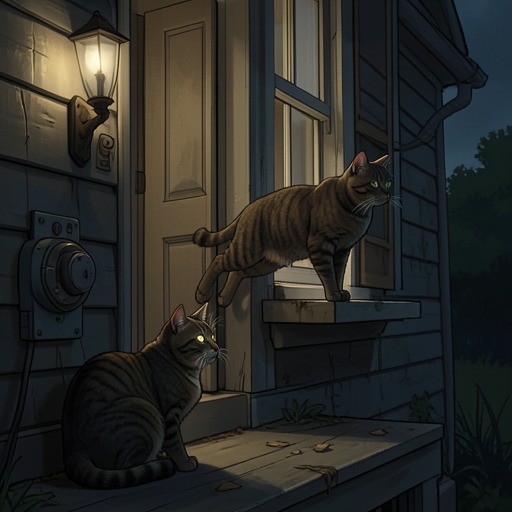
The burglaries are associated with the cats’ home in Victoria Grove. The account describes them as highly efficient cat-burglars and remarkably smart at a smash-and-grab, while also giving them an unusual gift of the gab. Their reputation, established before the individual household examples, is therefore both practical and social: they are capable thieves, but also plausible conversationalists who like to engage a friendly policeman. The text places that sociability alongside their criminal skill without describing a particular conversation as part of any one theft.
Their shared method is harder to separate into individual roles. They have a wonderful way of working together, and the resulting confusion makes it difficult for a witness to swear whether Mungojerrie acted, Rumpelteazer acted, or both were involved. The account compares the pair’s passage through the house to a hurricane. That image conveys the scale and speed of the disruption, while the uncertainty about attribution makes their cooperation itself part of the spectacle.
Signs of Disorder and Missing Property
The first signs are domestic disturbances that might, taken separately, seem like damage or disorder rather than a clearly witnessed theft. The area window is found ajar, the basement looks like a field of war, and tiles come loose on the roof until it ceases to be waterproof. Inside, drawers have been pulled out of bedroom chests, and one of the family’s winter vests cannot be found. The account links these disparate clues as a recognizable pattern: damage to the house and the disappearance of ordinary possessions occur together, but no culprit is caught in the act.
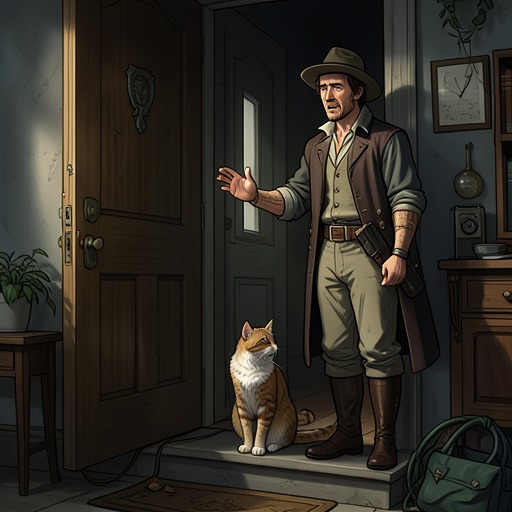
A second missing possession sharpens the family’s suspicion. After supper, one of the girls suddenly discovers that her Woolworth pearls are gone. The detail gives the burglary a personal, everyday scale: the stolen object is not presented as an abstract prize, but as something whose absence is noticed within the family’s routine. In response, the family blames the “horrible cat” and names Mungojerrie or Rumpelteazer. Most of the time, that accusation is where the matter ends; the episodes supply no further investigation or recovery of the missing things.
The Sunday Dinner Disappearance
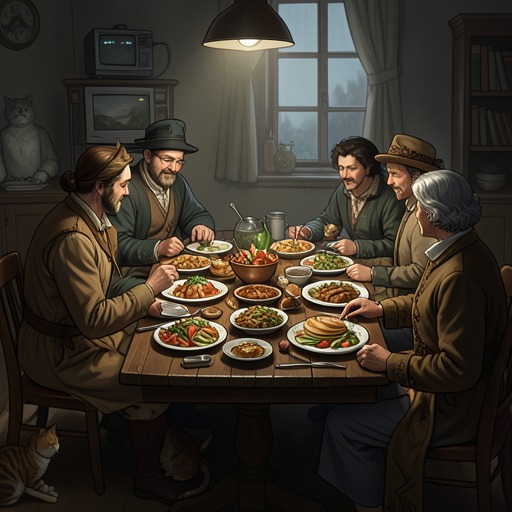
The theft of the Sunday joint shifts the disturbance from property and household order to a meal the family is waiting to share. The family has assembled for Sunday dinner, expecting Argentine joint with potatoes and greens. The cook appears from behind the scenes to announce, in a sorrowful voice, that dinner must wait until tomorrow because the joint has gone from the oven. The disappearance interrupts a specific family occasion: the meal has been anticipated, the household has gathered, and the central dish is suddenly unavailable.
The family again attributes the loss to Mungojerrie or Rumpelteazer and, as before, leaves the accusation largely at that. The dinner episode repeats the pattern of an absence discovered after the fact, but makes the cats’ reach feel broader than the loss of clothing or jewelry: even the prepared food at the center of a gathering is not secure. The cook’s announcement supplies the household consequence plainly—no Sunday joint that day—while the family’s familiar response turns a fresh disruption into another instance in an already established run of burglaries.
Partnership and the Problem of Attribution
The account’s most revealing variation comes when a series of crashes makes the family ask not which cat is responsible, but whether both have been at work. A smash comes from the dining room, a loud crash from the pantry, and a ping from the library, where a vase commonly said to be Ming is broken. The sequence carries the disorder through three distinct rooms and culminates in damage to a particular object. Rather than identifying a single thief, the scattered sounds intensify the uncertainty: the family concludes that Mungojerrie and Rumpelteazer are both involved, and that there is nothing to be done about it.
That change in the family’s refrain gives the pair’s teamwork a concrete consequence. Earlier episodes leave room for one cat to be blamed; the sounds across the house make joint responsibility seem the likelier explanation. The poem does not resolve every individual theft into a precise account of who took what. Instead, repetition turns uncertainty into the defining fact of the burglaries: the family recognizes the cats’ characteristic disruption, but cannot reliably distinguish one offender from the other. The lost vest, missing pearls, vanished joint, damaged roof, and broken vase accumulate into a portrait of a household repeatedly outmaneuvered by two unusually coordinated thieves.