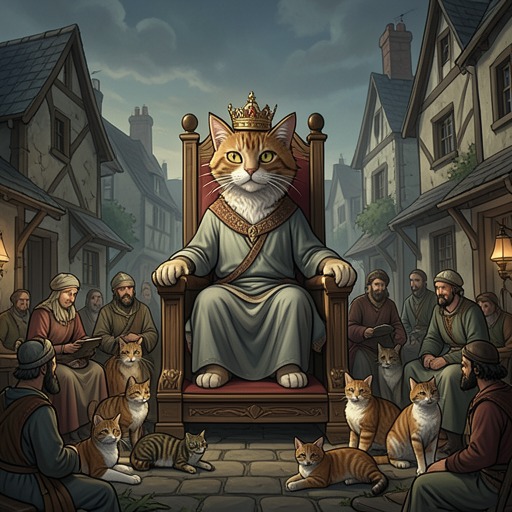
Old Deuteronomy
Old Possum's Book of Practical CatsOld Deuteronomy is the poem’s venerable village cat: long-lived, surrounded by a thriving family, and so familiar that observers keep finding him in their account of ordinary public life. His portrait joins extraordinary claims about age and family history to plain, recurring scenes—a cat on a wall, in the High Street, and asleep on a pub floor—while the uncertainty of those who recognize him gives his local presence a gently comic edge.
Identity and Background
Old Deuteronomy is introduced as a cat who has lived a long time and, in the poem’s deliberately expansive phrasing, has lived many lives in succession. That language makes his age seem almost beyond ordinary measurement, though the passage presents it as part of a poetic portrait rather than explaining it literally. His fame is similarly deep-rooted: he was already famous in proverb and rhyme before Queen Victoria’s accession. His reputation, then, is not merely a consequence of present-day visibility; the poem places it against a span of time reaching back before a named historical marker.
The account of his family adds a second measure of his long life. He has buried nine wives, and the speaker ventures that the number may be ninety-nine. The distinction between the stated nine and the speaker’s tempting exaggeration matters: the verse gives a concrete claim, then stretches it into comic hyperbole without pretending to verify the larger figure. Meanwhile, Old Deuteronomy’s numerous progeny prospers and thrives. His advanced age is therefore set beside continuing family abundance, and the village is proud of him even in his decline. The portrait holds decline and flourishing together rather than treating old age as an end to his social importance.
A Familiar Presence in the Village
The poem makes that importance visible through repeated settings. Old Deuteronomy sits in the sun on the vicarage wall, where the Oldest Inhabitant sees his placid, bland physiognomy and begins an emphatic recognition. The choice of a vicarage wall and the quiet image of a cat in the sun give the scene an unhurried, settled character. His face is not described as dramatic or imposing; its placidity is part of what makes him instantly recognizable to someone who knows the village.
He appears again sitting in the High Street on market day. Around him, bullocks bellow and sheep bleat: the street is filled with the noises of livestock and the activity implied by the market, while Old Deuteronomy remains seated. This contrast anchors the far-reaching reputation of the old cat in a commonplace public scene. He is not introduced through a grand entrance or an extraordinary deed; he is simply there, occupying a familiar place amid the market’s commotion. The repeated act of sitting links this busy street appearance with the earlier sunlit wall, making his stillness one of the portrait’s recurring details.
Recognition and Uncertainty
Recognition of Old Deuteronomy is repeatedly accompanied by doubt. After the Oldest Inhabitant sees him, the speaker admits that their mind may be wandering before confessing a belief that the cat is Old Deuteronomy. In the market-day passage, the observer again qualifies the judgment, saying their sight is unreliable but that they can guess the cause of the trouble is Old Deuteronomy. These qualifications do not erase the identification; they turn it into a comic refrain. The observers hesitate over their own faculties, yet the old cat’s name remains the answer they reach.
That pattern shapes how the reader encounters the character. The poem does not supply a detailed account of the trouble attributed to him, so it cannot establish exactly what he has done in the street. Instead, the uncertainty is part of the scene’s point: even when sight or memory is suspect, Old Deuteronomy is readily invoked as a familiar presence. The lines about the wandering mind and unreliable sight make recognition less like a formal description than a recurring village habit, with his name returning whenever the observer tries to make sense of what is before them.
Rest and Lasting Importance
A final glimpse places Old Deuteronomy on the floor of the Fox and French Horn, lying down for his afternoon sleep. The location shifts from the vicarage wall and public High Street to a pub, but the essential image remains consistent: the elderly cat is settled in an ordinary village place. Men say there is just time for one more as he sleeps. The passage establishes the moment and its timing without spelling out what follows, leaving the contrast between the men’s remark and the cat’s rest to carry the scene.
Across these appearances, Old Deuteronomy’s distinction lies less in a narrated sequence of exploits than in the accumulation of signs that he has endured and become part of village life. The claims about his many lives, his wives and descendants, and his fame before Queen Victoria’s accession enlarge his history; the wall, market street, and pub floor bring him back to the present. Even the observers’ uncertainty reinforces his familiarity: they may question their minds or eyesight, but they keep returning to his name. The village’s pride in him during his decline completes the portrait of an old cat whose standing persists as his life slows.