Pollicles
Old Possum's Book of Practical CatsPollicles are one side of the entrenched canine rivalry at the center of The Awefull Battle of the Pekes and the Pollicles. The poem presents them as proud, combative dogs whose hostility toward the Pekes turns a chance meeting into a street confrontation; when the Great Rumpuscat intervenes, their noisy show of force gives way to caution.
Identity and Rivalry
The Pollicles are defined above all by their enduring antagonism toward the Pekes. The poem calls the two groups proud, implacable, and passionate foes, and insists that their enmity recurs wherever one goes. This framing makes the rivalry more than a personal quarrel: it is a familiar, repeated condition of the poem’s canine world.
The description also gives the Pollicles a recognizable, if deliberately broad, character. A Pollicle Dog is called a dour Yorkshire tyke, while the group’s Scottish cousins are described as snappers and biters; the dogs are collectively characterized as notable fighters. These details connect their combative reputation to both temperament and inherited local types, without distinguishing individual dogs or giving any member a personal history.
The Street Confrontation
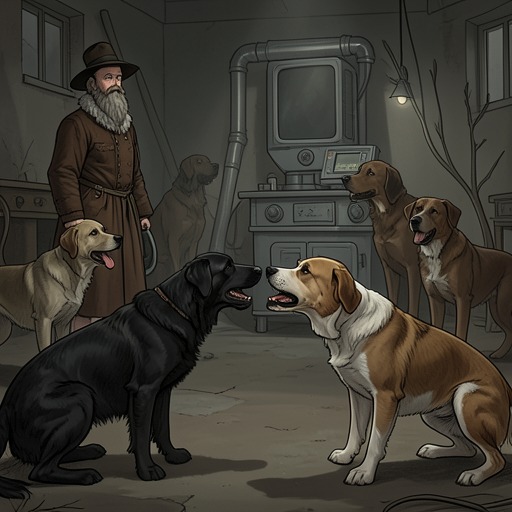
The battle begins with an encounter between a single Peke and a single Pollicle on an otherwise empty street. Neither dog advances, but neither retreats. Instead, they glare at one another and scrape their hind feet, a held moment of mutual challenge in which hostility is plain but the first move has not yet been made. The poem’s account makes this hesitation part of the conflict: the eventual uproar grows out of a face-off that could still have stopped short of open fighting.
The Pollicles are associated with noise as well as aggression. The narrator says that they like a terrible din, and their confrontation expands into a larger show of force. They step out with pipers in order, playing When the Blue Bonnets Came Over the Border. The music gives the dogs’ advance a Scottish coloring and turns the street disturbance into a staged, almost ceremonial display. The Pollicles are no longer represented only by the solitary dog who met the Peke; they now appear as a group, organized around sound and collective action.
The Wider Fray
The Pugs and Poms, although generally said not to like fighting, eventually join the fray. Their involvement broadens the encounter beyond the original rivalry, while preserving the Pollicles’ role as a force that helps draw the conflict into public view. The poem does not describe a detailed sequence of blows or identify a victor. Instead, it emphasizes the growing commotion and the way the dispute attracts other participants and alarms the neighborhood.
The disturbance becomes frightening enough that some neighbors start calling the Fire Brigade. That response supplies a comic measure of the battle’s scale: what began with two dogs staring each other down has become an uproar that nearby residents treat as an emergency. The Pollicles’ fondness for a din is therefore not just a trait in their description; it helps explain how their encounter becomes a neighborhood event.
The Great Rumpuscat’s Intervention
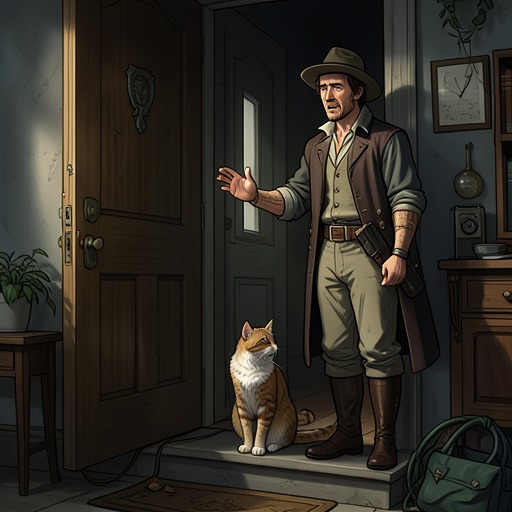
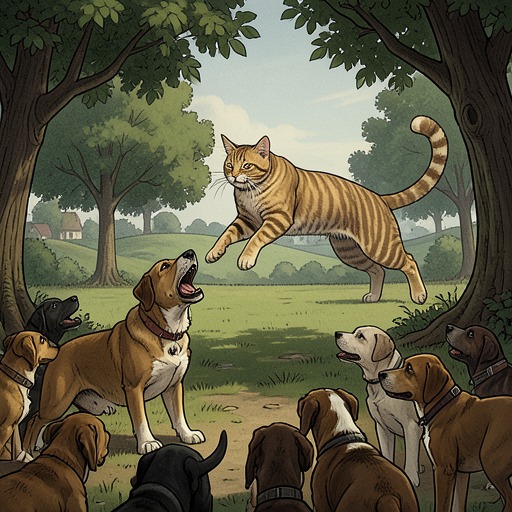
The escalation is interrupted when the Great Rumpuscat stalks out of a small basement flat. His blazing, fireball-like eyes and fearsome appearance command attention. Looking through the bars of the area, he seems fiercer and hairier still; his glare and yawn are enough to make the Pekes and Pollicles take warning. The poem also describes him looking at the sky and leaping, adding a sudden physical flourish to his entrance.
For the Pollicles, this is the decisive change in the scene: the threat they had presented to one another is displaced by a more imposing presence. The poem does not specify what becomes of the rivalry afterward or describe the dogs’ individual reactions. It establishes only that the Great Rumpuscat’s appearance makes both sides cautious. Their role thus moves from instigators of a noisy confrontation to participants checked by an unexpected intervention.
Narrative Role
The Pollicles are drawn collectively through repetition, reputation, and action rather than through individual characterization. The recurring claim that they and the Pekes are implacable foes establishes the conflict as a comic fixture, while the scraped feet, ordered pipers, and alarmed neighbors give that familiar feud a concrete sequence of escalation. The Great Rumpuscat’s entrance then supplies a reversal of scale: the dogs who have made the street their stage are made to take warning by a figure emerging from an ordinary basement flat.